Ratepayer Protections

Oregon State Legislature sent this bulletin Tuesday, February 13, 2018 by devadmin

One of my bills, the Ratepayer Protection Act (SB 1552) will be heard on Wednesday, Feb. 14th. This bill has several sections designed to cap costs for Oregon energy users. The bill proposal would help establish strong, consistent policies aligned with keeping electric rates as low as possible.

Specifically, one piece of the legislation would prohibit a public utility from exceeding a 4.5 percent rate of return. Utility Companies can freely ask the Public Utility Commission (PUC) for rate increases. These increased payments come from the customers, who are businesses, households, commercial and industrial users. These ratepayers are the same ones trying to living within their means with little room to spare.

The Public Utility Commission exits, first, to “protect the customers from unjust and unreasonable extractions by establishing fair and reasonable rates.” (cf. ORS 756). This standard is established by definition, “Rates are fair and reasonable for the purposes of this subsection if the rates provide adequate revenue both for operating expenses of the public utility or telecommunications utility and for capital costs of the utility, with a return to the equity holder.”

Here is the rub. A small team of political appointees make up the commission and must exhibit what I call an “unattainable degree of neutrality.”  The problem is in the presumption that the central planners know or can determine what is “fair and reasonable.”

In free, open and voluntary market economies consumers determine what are “reasonable and just” value assessments because each individual makes their own choices about what to buy, or not. There is no requirement for a neutral party or government entity to “decide” what would be appropriate because each shopper can buy what they think is appropriate. This is why gasoline prices are writ large at every service station. People can make their own choices.

This self-interested, market-driven mechanism is far more efficient for determining value and setting prices. In actuality, people set prices not companies. People willingly part with their own money based on their own understanding of value. Therefore, any accepted price will necessarily be reasonable because people are buying and selling freely, without any government or corporate coercion. Agricultural products, our daily bread, meat, dairy, fruits and vegetables provides the easiest illustration.

We all eat food. The modern grocery store is a testament to American diversity and ingenuity. Various stores cater to various tastes, ethnicities and preferences. Each store makes their best effort to service their customers.

Some individuals prefer organic. Some avoid sugar, peanuts, or dairy while others can eat anything. It is easy to see that farms fill these stores by providing a blend of products to service the consumer. Farming occupies a unique place of importance in all of our lives and the free-market allows for the diversity and specialization that has fed the world.

The single-supplier electric generation and transmission franchise necessitates the requirement for a Commission. Once the boundary and service area (franchise area) are mapped out, no single user can purchase from any other supplier. Consumers are essentially trapped within the monopoly boundary and need someone to represent them. The franchisee is in a similar boat. They too, need to justify their investment matrix, re-capitalization requirements and cost of service parameters.

SB 1522 does not deny any of the complexities of the large-scale electric generating enterprise, it simply binds the public utility to “reasonable” returns.

The bill also prohibits a utility’s Public Purpose Charge from exceeding 1.5 percent of utility customers’ costs and prohibits the gross collections, from Public Purpose Charges, from exceeding the 2016 total. It also limits salaries for Energy Trust of Oregon employees, essentially keeping them from being greater than the Governor’s salary.

The final section of the bill would stop the collection of the Klamath Dam removal surcharge from ratepayers’ utility bills. The devil is always in the details, so here is some background information.

For nearly two decades, disparate factions struggled to implement their respective irrigation, power and water-related interests with regard to the Klamath River Basin. Their efforts resulted in the Klamath Basin Restoration Agreement (KBRA) and the Klamath Hydroelectric Settlement Agreement (KHSA). These agreements were part of a major push to remove the four PacifiCorp dams on the Klamath River.

The stage was first set via a 2008, Agreement in Principle, which compelled the Federal Government to assess the costs and benefits of dam removal and either designate a non-federal dam removal entity (DRE) to remove the dams, or “decline to remove the dams at which point PacifiCorp will return to the Federal Energy Regulatory Commission (FERC) for relicensing.”

Although a DRE has been designated, Klamath River Renewal Corp. (KRRC), the KBRA and KHSA agreements have long expired due to congressional inaction. A third agreement, the Upper Klamath Basin Comprehensive Agreement (UKBCA) has also been terminated by the DOI.

The time has come for Oregon’s legislature to call the dam removal effort, whether good or bad, a failure. The agreements have little chance of being resurrected and it is time to exercise the last clause (above) where PacifiCorp declines dam removal and returns to FERC for relicensing.

SB 1552 would require PacificCorp to discontinue the assessment of dam removal surcharges that appear on ratepayers’ electric bills.  Specifically, if the Klamath Dam removal has not started by Jan. 1, 2019, the dam removal surcharge will be discontinued, and funds collected by PacifiCorp would be returned pro-rata to ratepayers with a 4 percent interest on the monies which have been held in trust.

Additionally, I also have an amendment where the monies could be used for fish ladders or fish passage alternatives. This would aid in mitigating PacifiCorp’s main problem with FERC re-licensing requirements.

Alan Mikkelsen, deputy commissioner for the U.S. Bureau of Reclamation has said BOR will not interfere with the FERC process and believes the dams will be removed. However, there are still plenty of environmental, legal and financial hurdles to deal with.

First, is the long-term liability for unknown and known problems, such as dealing with the 20 million cubic yards of accumulated sediment that will pollute the river after the dams are removed. Turbidity, water quality, and long-term fish habitat are all big environmental issues at stake.

Lastly, a host of legal problems associated with the tentative dam removal agreement between Oregon and California will become tangled in strategies to find non-federal funding sources. Prior dam removal cost estimates, for the four dams, range upwards from $950 million and possible funding streams have not yet been identified.

Pinocchio

It’s time to stop the never-ending appearances from our dueling pair of “good cop/bad cop” protagonists with their endless questioning, changing, redefining and reinterpreting important issues. The opposing sides are arguing about what the definition of “is” is, and it should be as plain as the nose on Pinocchio’s face.

Here’s the straight scoop: Oregon’s hydro-electric power generation facilities are the most cost-effective base-load power sources for our state’s growing electric needs. Wisdom demands that we get back to using real-world economics, science and common-sense to steer Oregon’s natural resource policies in the right direction.

If we don’t stand for rural Oregon values and common-sense  – No one will!

Best Regards,
Dennis Linthicum
Oregon State Senate 28
The Ever-expanding Universe of Laws

Oregon State Legislature sent this bulletin Wednesday, February 8, 2017 by devadmin


 “There ought to be a law…” 

Have you every seen something silly or ridiculous and muttered to yourself, “There ought to be a law?”

You and I might say, “There ought to be a law?”  when we see something that we think is ironic, unexpected, or just plain nuts. But, most of the time we realize that people have the freedom to make their own personal choices, even if the house color that they happen to choose isn’t our own favorite color.

Fundamentally, we are each faced with living, and cooperating, in a world with thousands of choices. We must be willing to allow others the same opportunity for free and independent action, unless an individual’s freedom impinges on someone else’s freedom or their personal property.

This is probably easiest to understand in the sense of property. I’m free to purchase and drive my car under obedience to the rules of the road. These rules have been established over time to create what I call “Ordered Liberty.” It is ordered so that there is a smooth  and safe flow of traffic. I have the freedom to go where I wish, when I wish, and the only constraint is that I pay attention to others, allowing them equal freedom while all of us follow the rules.

This may sound like common-sense, and it is, but things quickly go haywire when the legislature gets a little too cocky for our own good. You see, we send men and women to Oregon’s Senate and House and we call them legislators.

As legislators, they feel their job consists of being able to legislate, i.e. to make laws. So, when they get to Salem, what do they do.

They do their jobs, they legislate…

I think this has turned out to be detrimental to Oregon and it’s citizenry.

Why do I think that?

Because we have so many laws and so many regulations that no one can keep track, except the bureaucrats who are payed for their rule making efforts. They also write the enforcement measures, discover the appropriate fee schedule, determine the stiffness of the fines and/or penalties they adjudicate any grievances to determine whether or not they have done their jobs correctly.

Jefferson noted this danger, even during our nation’s earliest years. He said, “An elective despotism was not the government we fought for…”  He continues, describing the nature of a truly free and representative government by adding that it would be one, “in which the powers of government should be so divided and balanced among general bodies… as that no one could transcend their legal limits without being effectually checked and restrained by the others.”

Oregon’s legislature is so busy making new laws, that there isn’t time to focus on the principles of good governance or self-governance.

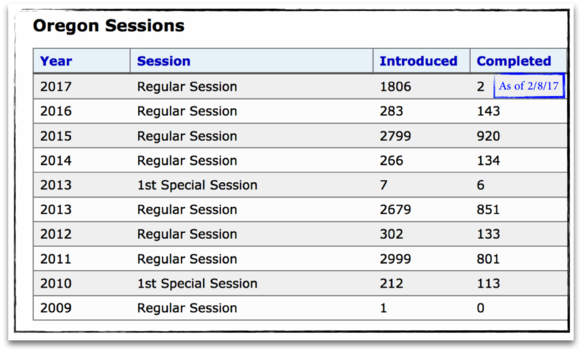
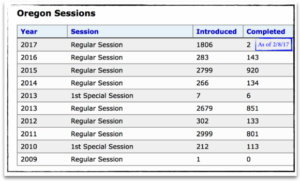
To date, in the 2017 session, the Legislature has introduced 1,806 measures.

Just how many laws do Oregonians need to ensure that their liberty is protected?

This growth essentially represents the problem with government – that is, it has an uncanny, but natural propensity for growth. It turns out it is worse than germs growing in a lab petri-dish. It is really more akin to our ever-expanding universe.

The American astronomer, Edwin Hubble, discovered in 1929 that the distant galaxies were moving away from our Milky Way system. His observation was generalized into a universal law, known as Hubble’s law, where science can measure the speed and rate of expansion of the universe by observing a redshift in light emanating from distant objects.

It appears our government is experiencing this same natural redshift tendency. It even follows Jefferson’s pattern where the black-ink on our budgetary pages experiences a natural shift towards red. Jefferson described the process, where there is a consistent multiplication of public offices, increases in expenses beyond income, and the growth and entailment of a public debt. This is exactly the path set forth by the governor’s budget.

Additionally, the numbers above only represent the number of acts or measures, not the number of pages within the bill. Some of these bills are short while others are several hundred pages in length. The real impact on law-abiding citizens includes not only these laws but also the administrative costs for creating and enforcing subsequent rules and regulations.

For each of these laws, the bureaucracy creates and writes the regulations and then formulates the rules regarding fines, punishments and enforcement measures. These rules and stipulations might span several thousand more details all spelled out in mind-numbing legalese.

It turns out Oregon doesn’t need any more Legislation. We need some de-Legislators who will lesson the burdens placed on Oregon’s businesses, families and individuals.

Please remember –– if we do not stand up for rural Oregon and common-sense, – no one will.

Constant Clamor

Oregon State Legislature sent this bulletin Monday, February 5, 2018 by devadmin

This week I joined as a Co-Sponsor of HB 4005 – the Prescription Drug Price Transparency Act because for the past twenty years pharmaceutical prices have been sky-rocketing upwards. US drug prices have long out-paced historical norms and there is no foreseeable downward pressure on the cost curve.

I’ll be the first to admit that government intervention is problematic because it creates a constant clamor for more government. Once some segment of any industry gains a legislated upper hand then everyone else rushes in for more legislation and government grows. Congressional meddling, over-regulation and unintended consequences, stemming from well-meaning healthcare policy initiatives, has caused a large part of these price increases.

HB 4005, however, is not invasive government intervention but a well-crafted surgical strike focused on the cost of prescription drugs. It will shed light on drug pricing whenever a drug manufacturer has a steep price increase or when they bring a new expensive blockbuster drug onto the market.

President Trump mentioned the problem in his State of the Union address, He said, “One of my greatest priorities is to reduce the price of prescription drugs. In many other countries, these drugs cost far less than what we pay in the United States. That is why I have directed my Administration to make fixing the injustice of high drug prices one of our top priorities.”

It will be fascinating to see how Congress handles this challenge because they created the lopsided environment where complexity reigns and patients lose.

The federal healthcare system is a giant spaghetti ball of legislation, with myriads of alphabet-soup agencies and 50 years of re-do’s, take-overs and fixes. The end result is an overly complex and extremely messy bundle of rules, regulations and unintended consequences.

And, we’re stuck in the middle…

However, in the face of continued skyrocketing prescription drug prices, Oregon can provide a little bit of needed transparency. Oregonians for Affordable Drug Prices announced bipartisan and statewide support for HB 4005 that will require pharmaceutical manufacturers to share information on any drug price increase that is more than 10% annually.

I have more faith in free, open and voluntary markets than government bureaucracies. The injection of government into the healthcare arena did not create better solutions for those in need. What it did supply is a source of revenue – the taxpayer.

Decades of lobbying has resulted in a protectionist system plagued by three systemic issues. First, the beneficiaries, or patients, present an insatiable, unquenchable and uncontrollable demand on the system. This is a hallmark of socialism where third-party payers carry the burden of an ever-growing desire for more and more services.

Secondly, current law provides the best of crony capitalism – market monopolies. Healthcare service providers composed of delivery system cartels of doctors, hospitals, nursing homes, pharmaceutical suppliers, medical device makers, etc., have implanted themselves deep into congressional organs.

Patients experience the results in a complex system of excessive wait-lines, multiple referrals, and continual follow-ups while the providers are party to a rigged reimbursement system which maximizes revenue gains, minimizes system efficiency and has no competitive discipline.

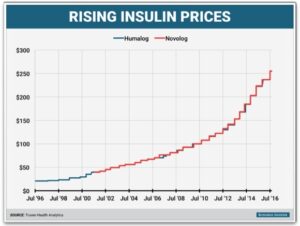
The graphic below shows dramatic tandem price increases over the past twenty years for two competing insulin analogues. The upward trend is not due to normal inflationary increases; it is due to federal policies.

Competitive pressure should surface when supply chain circumstances, commodity contracts or manufacturing advantages present themselves in a free market. As can been seen, even when alternatives exist, there is little competition and prices do not go down. In fact, the opposite occurs – prices increase in tandem with one another.

This is because the Medicare Modernization Act of 2003, which established Medicare Part D, banned direct negotiations for lower prices on prescription drugs by the government. If the Centers for Medicare and Medicaid Services could negotiate with pharmaceutical companies, the agency could leverage its enormous purchasing power to pay less for drugs.

Lower prices would reverberate through the market because information is power. “I can’t give you a discount because when the word gets out then I’ll have to give discounts to everyone.”

Also, in the thousands of ACA pages there are several items that favor the lopsided pricing fiasco we recognize. These items are a mandate prohibiting re-importation of drugs (like insulin from Canada), preserving Medicare’s over-payment for drugs, mandates requiring state subsidies for drugs under Medicaid, and hundreds of billions in subsidies for drugs in Medicare part B and D.

Under HB 4005 drug makers will be required to give advance notice to payers before price increases of more than 10 percent a year. Additionally, for all drugs that increased more than 10 percent in the prior years, the manufacturer must report to the state their research, development and marketing costs, profit margins and whether generic drug alternatives are available.

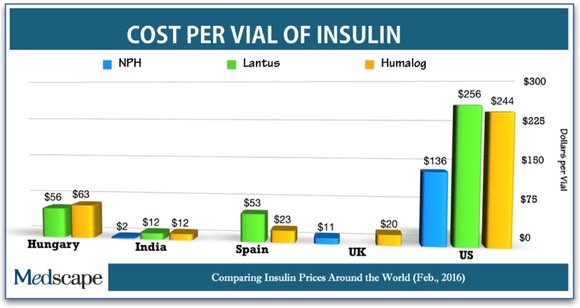
Another feature of the bill requires companies to report what the price for their medication is in other countries, an especially pressing issue when prices are, on average, 50 percent lower in other industrialized nations. The graph below illustrates the enormous price discrepancy for insulin in the US verses other countries.

The US spends 18% of GDP on health care compared to 10-12% in the rest of the developed world. There is no hope of slowing down the health care monster without some transparency and the restoration of basic free market principles like consumer sovereignty, patient responsibility, risk-based pricing and a free market supply chain.

HB 4005 is one small step for transparency and gaining insight into the problem of rising prescription drug prices. The public hearing for HB 4005 will be on Monday, Feb. 5th at 3:00pm in Hearing Room E in the Capital Bldg.

Remember, if we don’t stand for rural Oregon values and common sense – No one will!

Best Regards,

Dennis Linthicum
Oregon State Senate 28

Session will begin with a Budget Bang! – Part II

Oregon State Legislature sent this bulletin Thursday, February 2, 2017 by devadmin

Last weeks article highlighted that the Governor’s released budget had everyone in media gasping for breath because of a $1.7 billion shortfall. Yet, Oregon is expected to receive $1.5B more revenue this biennium than last. That is an increase of 15 thousand million or 1,500,000,000 extra dollars in the state’s coffer.

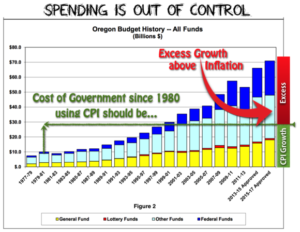
I pointed out that Oregon’s budget has increased eight-fold since 1980 and then I posed some thoughtful questions:

  • Did our state’s service requirements or population grow by eight-fold?
  • Did your school district attendance grow by eight-fold?
  • Did your own personal salary or wages grow eight-fold since 1980?
  • Did the value of your home grow by eight-fold?

If you are like me, you are probably having trouble identifying anything in our lifetime that has grown as rapidly as government.

This has occurred mainly because we have allowed government to absorb responsibilities that previously belonged to families and individuals. Government has done this quite stealthily.

It starts with people who want to help. They become politicians. Politicians get elected to the legislature. Legislators have a job to do – legislate. Yet, even if the legislature, their committees and constituents propose solutions that sound reasonable, it doesn’t mean the legislation will work reasonably.This is exactly where we are today – Legislators are legislating and government is growing.

Our unique American form of government was designed to protect the rights of the people and ensure their individual freedom. Oregon’s constitution does not provide a mandate to micromanage, interfere and legislate away citizen’s individual choices and freedoms on a daily basis.

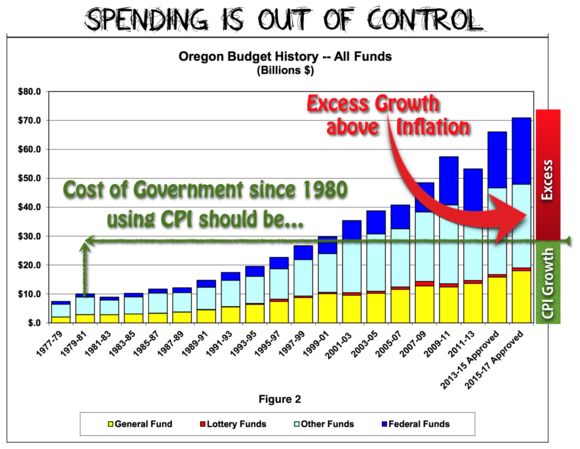
How much would government services cost if we had constrained government by the Bureau of Labor and Statistics – Inflation Calculator?

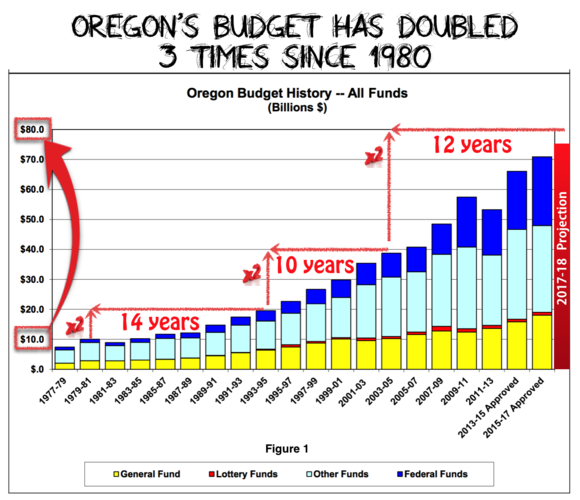
Using the inflation calculator, for example, $10B in 1980 is the equivalent to $29.1B today (cf., Figure 2). This means $50B dollars of the current $80B budget is in excess of the cost of inflation.

Even accounting for an increase in Oregon’s population which has grown by only a factor of 1.54 since 1980 levels, not an 8X increase, the $29.1B number would only increase by $15B, not $50B.

Again, why is Oregon’s budget pegged at nearly $80B?

Are Oregonians really that much more needy? Do we need that many more state bureaucrats shuffling paper and creating regulations?

The problem rests with the baseline budgeting methodology where after funding our last biennium’s base of operations no one has enough resources available to seek answers to different questions.

There will never be a change to any part of an agency’s inner-workings if the agency will automatically receive the same, or better, for doing the same ol’, same ol’. This is partially why Oregon’s graduation rates stay so abysmally poor – same ol’, same ol’.

ORS 291.210, requires the Legislative Fiscal Office (LFO)  to develop a projected tentative General Fund/Lottery Funds budget for the 2017-19 biennium.  A couple of bullets from that document are below:

  • State personal services growth is projected at 9% for the biennium, including step increases, roll-up of current collective bargaining agreements and management salary packages, health benefit costs, Pension Obligation bond payments, and an increase in the PERS rate.
  • Standard biennial inflation of 3.7% for services and supplies and 4.1% for medical costs.
  • Backfill of 2015-17 one-time funds with General Fund, or fund shifts, that change 
funding sources for programs between the two biennia, total a net $626 million. This is primarily in the Human Services and Education program areas, and includes $328 million related to an increasing state responsibility for Affordable Care Act costs and other federal match changes.

These are all growth items.

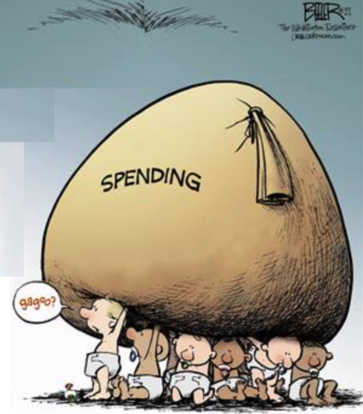
We don’t face a revenue problem, we face a problem with government growth and spending. Oregon’s legislature must be willing to address our state’s spending problem and this will mean breaking through factional barriers.

Otherwise, we really are just kicking the can down the road.

We all recognize there is more squeezing that needs to be done in the state’s budget. But, if the Governor has her way, the squeeze is going to happen with our wallets. Oregon’s Governor put forward a budget proposal that is “too expansive.”  As legislators we must be committed to squeezing government, not the hardworking taxpayers wallets.

Please remember–if we do not stand up for rural Oregon values and common-sense, no one will.

Best Regards,

Dennis

Senate District 28

Economic Tsunami

Oregon State Legislature sent this bulletin Wednesday, January 30, 2019 by devadmin

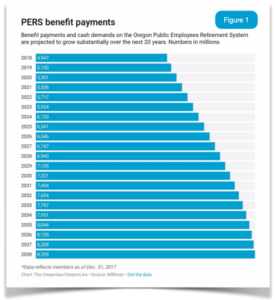
Last year, Oregon’s Public Employee Retirement System (PERS) extracted roughly $1,400,000,000 ($1.4 billion) in contributions from tax-payers to fund state employees’ pension benefit programs. Over that same period, it paid out $4,700,000,000 ($4.7 billion) in pension benefits to state employees. (See Figure 1.)

Any bookie would recognize a lame horse when they saw it. Namely, PERS had a negative cash flow of $3,300,000,000 ($3.3 billion) during that one-year period and the problem is getting worse.

One would think that a negative operating cash flow of this size, shape and demographic velocity would be seen as a bad omen and everyone would be worried. Yet, no serious reforms can even get traction because everyone is bogged down in language about fairness, safety, inclusion and the need to fulfill promises.

Yet when the trestle bridge gets overloaded because everyone wants off the island at the same time, a lot of people will get hurt.

In this environment it’s hard to project the details lying dormant within the blue-sky assumptions undergirding the PERS system. Even more difficult to grasp is the catastrophic potential that these assumptions mask when market events slowdown causing liabilities to balloon.

In a recent Oregonian article, Allen Alley, a past gubernatorial candidate, inventor and technology investor, suggested that policymakers should start looking at the actual cash flowing out of the system. Alley calculates, that the 4.1 million tax-payers will owe $225,000,000,000. ($225B) for state employee retirement benefits over the next three decades.

Although PERS, as an issue, is always present, it is treated like a heavy punching bag in the corner at the gym–it gets ignored. Unfortunately, our governor’s top two policy goals aren’t related to PERS. They are revenue, staff, and policy issues that grow government and eventually worsen the tax-payer burden while ignoring the economic reality barreling straight at all municipal, county and state governments across the US.

All public sector retirement plans, and most private sector plans, carry unheard of levels of unfunded actuarial accrued liabilities (UAAL). The public pension crisis has been intensifying for quite some time and state governments are unwilling to go to the bag. This is mainly because governors, senators, representatives, county commissioners and city council members get elected on “present day promises,” not “future unintended consequences.”

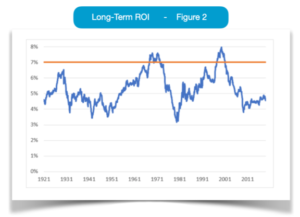
For many years, annual returns for employees and their benefit accounts were pegged at 8-percent per annum. These promises were made during a brief period when that rate seemed  reasonable but would have long-term unintended consequences. Additionally, this return-on-investment (ROI) was guaranteed by tax-payer pickups during years with lower returns.

The folly of this strategy becomes clear in a Bloomberg article, which looked at long-term returns (50-year periods) and noted average returns, for pension-fund-like portfolios, are well below 6-percent and have only generated returns of 7 percent or greater twice since 1871. (See Figure 2.)

The article continues, saying the problem is worse today for two primary reasons: 1) “Cumulative returns are lower than the averages;” 2) “An extended period of bad returns cannot be made up even with astronomical returns later.”

Bloomberg goes on to explain that the compounding of these return projections is the real fly in our collective soup bowl. According to Bloomberg most funds can never keep up with their actuarial demands following a market downturn. The capital lost and the compounding interest required on the remaining capital is too great. This would be true, even if the pension was already fully funded, which Oregon PERS is not. Following market retractions, “there is no chance existing assets are enough to pay already-contracted liabilities.”

The proverbial spilled-soup comes when one realizes that once the base value of assets starts to decline there is no scooping it back up. The shrinking asset base can’t keep up with the demand pressure from the actuarially accrued increases in liabilities. Additionally, as payouts create greater shortfalls, the overall asset base shrinks even more, further inhibiting the fund’s ability to ever get ahead of the curve.

Bloomberg goes so far as to say, “Worrying about the next five decades is pointless, because there’s also no chance the current system will survive long enough to discover what the next 50-year average returns will be.”

This is a truly dire situation created by more than 50 years of unrelenting government growth sanctioned by elected representatives. It is unconscionable to not address this inadequacy when there are thousands of folks who will be negatively affected by this tragedy if we fail to act.

Alley claims that his calculation of $225B doesn’t even account for any new employees coming into the system but focuses only on existing employees. “As a CEO of a company, you think about cash,” he said. “What’s the check I have to write and where’s that money going to come from?”

Rest assured, there are no worries in that quarter… the political majority can easily figure out how to use our slowly deteriorating social contract and government’s misused power of coercion to their own advantage. As the noted 19th-century philosopher Pierre-Joseph Proudhon outlined, the tax-payers can expect to be:

fleeced, exploited, monopolized, squeezed, hoaxed, drilled, registered, counted, taxed, stamped, measured, numbered, assessed, licensed, authorized, admonished, prevented, forbidden, reformed, corrected, punished regulated, enrolled, indoctrinated, preached at, controlled, checked, estimated, valued, censured, repressed, fined, harassed,  judged, condemned, or deported…

Without a momentous shift toward slowing the growth in government our PERS dilemma will only worsen. Additionally, significant and serious modifications to new employee standing is the only mechanism that can begin to stem the potential economic tsunami resulting from a market downturn. Without these changes Oregonians will face far more turmoil than the political elites ever imagined.

Remember, if we don’t stand for rural Oregon values and common sense – No one will!

Dennis Linthicum
Oregon State Senate 28

What’s up for the 2018 Session?

Oregon State Legislature sent this bulletin Thursday, January 25, 2018 by devadmin

Here’s a look-see…

PERS unfunded liabilities are looming ever larger, high-school graduation rates, OHA budget over-runs, carbon emission debates, over-spending tendencies, school choice, criminal incarceration rates, marijuana problems and the opioid epidemic.

Additionally, we will be dealing with Clean Air Oregon, Carbon Cap and Trade, a potential constitutional referendum on unanimous juries, electric rate-payer protection, pharmaceutical drug transparency act and a limit on late-term abortions.

Myself and my fellow Legislators have got our work cut-out for us.

Aside from these and other issues, the Senate President added me to two new committees. Additionally, the Governor appointed me to a Special Task Force dealing with the rash of Opioid deaths by overdose.

Opioid overdoses plague rural and urban communities, alike.

Opioids such as morphine and fentanyl are the preferred clinical treatments for moderate to severe pain because of their strong analgesic (pain-relieving) properties. Effective pain management is one of the greatest challenges of modern medicine.

The increases in opioid deaths highlights the need for safer analgesics. Opioids, typically, cause death from respiratory depression induced by an overdose.

It is estimated that more than 100,000 adults suffer from chronic pain in the United States alone, and that this costs up to $635 billion per year in medical treatment and lost workforce productivity. The most commonly used drugs for pain management can have numerous side effects. For example, some cause cardiovascular complications, gastrointestinal bleeding, and renal disease.

Aside from these medicinal side-effects, opioids are extremely addictive. Opioids, both prescription and illicit, are the main driver of drug overdose deaths. Opioids were involved in 42,249 deaths in 2016, and opioid overdose deaths were five times higher in 2016 than 1999.

Oregon’s own statistics mirror the national averages. In Oregon, the opioid overdose death rate in 1999, was 2.1 persons per 100,000, while in 2016 the rate was 11.9 persons per 100,000. However, Oregon is at the high-end of the scale with regard to opioid prescriptions. There are 82.2 – 95 opioid prescriptions for every 100 people in Oregon.

A dedicated coalition is needed among the medical and pharmaceutical industries. Prescribers will need to focus on accurate data collection of distribution systems and product tracking to curb opioid abuse. Over the long-term, researchers are ever-hopeful for scientific breakthroughs in academic and pharmaceutical research for the treatment of chronic pain.

More items for investigation will be Oregon’s mandatory minimums on controlled substances, our prison and incarceration systems, local community-based re-habilitation efforts, staffing and budgetary requirements for state and local law enforcement.

Incarceration rates mandated by Oregon’s sentencing guidelines costs taxpayers hundreds of millions annually.

The biggest single problem with the system, as it is engineered today, is that it costs too much and is largely ineffective because the incarcerated individuals are rarely rehabilitated.

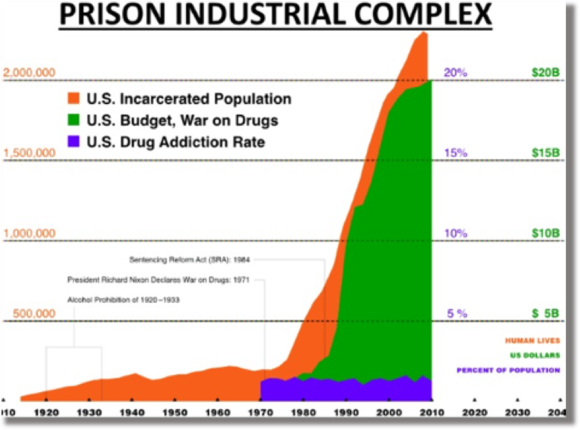
Here is a graphic summarizing what we see for all 50 states. (I will try to acquire Oregon specific data for next time.)

As shown in the chart above, drug addiction rates in the US (purple area/scale) are essentially unchanged from the time the War on Drugs was launched by Richard Nixon in 1972. Back then it was somewhere between 1-2% of the adult population. Today, it remains nearly the same, after 50 years of following the same formula.

Meanwhile the budgetary requirements for the nationwide system, including public safety, corrections, parole and probation has soared from a reasonable amount (green area/scale) to $20 billion in 2010 and $32 billion in the most recent year (FY 2017).

At the same time, the US prison population has exploded from 400,000 to more than 2.3 million (orange area/scale).

The current system knows no boundaries and is the perfect tax and spend machine. The licit and illicit drug industries continue to harness the power of the market by supplying drugs that are no longer scarce but remain extremely valuable and extremely dangerous.

The results are broken homes, damaged lives, homelessness and a rash of opioid over-dose deaths.

So, we clearly have our work cut-out for us.

“No government at any level, or at any price, can afford, on the crime side, the police necessary to assure our safety unless the overwhelming majority of us are guided by an inner, personal code of morality. And you will not get that inner, personal code of morality unless children are brought up in a family – a family that gives them the affection they seek, that makes them feel they belong, that guides them to the future, and that will build continuity in future generations. . . . the greatest inequality today is not inequality of wealth or income. It is the inequality between the child brought up in a loving, supportive family and one who has been denied that birthright.”

                                                                – Lady Margaret Thatcher, from her speech,                                      “The Moral Challenges for the Next Century,” March 5, 1996.


Remember, if we don’t stand for rural-Oregon values and common sense – No one will!

Best Regards,

Dennis Linthicum
Oregon State Senate 28

Session will begin with a Budget Bang! – Part I

Oregon State Legislature sent this bulletin Tuesday, January 24, 2017 by devadmin

Oregon’s Legislative Session starts on February 1st and the biggest topic will certainly be the budget. Gov. Kate Brown released a recommended budget last month that has everyone in media gasping for breath because of a $1.7 billion shortfall.

The governor is quoted as saying, “The budget includes significant cuts at a level I find absolutely unacceptable…”

I agree–the budget proposal is unacceptable.  It is unacceptable because it merely supports the status-quo by presenting ever-growing government, more regulations and increasing taxes as the only reasonable budget expectation.

Yet, Oregon is expected to receive $1.5B more revenue this biennium than last. that is an increase of $1,500 million or $1,500,000,000 extra dollars in the state’s coffer. The story that Oregon has a shortfall is fiction. We have a budget that has grown beyond any semblance of normal.

The budget proposal has been created by assuming that Oregon’s current service levels or baseline of operations should be the standard for next year. The baseline budgeting process starts with current programs intact and then adds cost of living adjustments (COLA) combined with increases in service level goals.

Using “baseline budgeting” ideology as the operating standard doesn’t identify programs  that are inefficient or unnecessary. It also fails to address or support any significant technological choices that might transform the lives of Oregonians. It only instills more of the same for the future. This is not how our future should be planned.

During the governor’s inauguration speech there was a reference to our Oregon Trail heritage. The governor said, “And we now have two modern-day Oregon trails to choose from. One trail is to continue the endless process of slicing and squeezing, of diminishing our hopes and expectations, and shrinking our dreams of what it means to be an Oregonian. The other trail is to follow the advice of Governor McCall.  To not be guided by regionalism and factionalism.”

This is good advise.

Let me wade past the rhetoric and imagine trying to use our illustrious Oregon Trail heritage as the historic baseline mark on the landscape.  Think of the transformative technologies that have occurred. Now, ask yourself which of these modern technologies you would be willing to ignore because you were wed to the old stuff you brought from Missouri. Your Conestoga wagon, for example.

The reason baseline ideology can’t properly assess the potential efficiencies that might be gained through alternatives is because the baseline receives the funding not new ideas.  A requirement when trying to address maximum utilization from limited resources requires flexibility in weighing and ascertaining the value of various approaches.

A more flexible management approach would provide a credible rationale for reallocating resources by focusing on a systematic review and justification of the funding and performance levels in current programs.

However, if this sounds too complicated then let’s just drive our wagon down the well traveled trail of common-sense.

Since 1980, Oregon’s budget requirements have ballooned by eight-fold.  This means it has doubled three times, 2 x 2 x 2 = 8 (cf., Figure 1). In 1980 Oregon’s budget was near $10B and today the budget projection is approaching $80B.

Noticing this eight-fold growth, let’s ask some thoughtful questions:

  • Did our service requirements grow by eight-fold?
  • Did our state’s population grow by eight-fold since 1980?
  • Did your city’s population grow eight-fold?
  • Did your school district attendance grow by eight-fold?
  • Did your own personal salary or wages grow eight-fold since 1980?
  • Did the number of seniors living in your community grow by eight-fold?
  • Does your computer/cell-phone or TV cost eight-fold more than it did in 1980?
  • Did the value of your home grow by eight-fold?
  • Is criminal activity in your neighborhood up eight-fold?

Even if a couple of these questions come out within a reasonable close-call, my question is still valid: Should the cost of government services have risen eight-fold since 1980?

Please remember–if we do not stand up for rural Oregon, no one will.

Best Regards,

– Dennis

Senate District 28

Gunsmoke and Mirrors

Oregon State Legislature sent this bulletin Tuesday, January 22, 2019 by devadmin

After the recent elections, the Democrat Party has a “super” majority in both of Oregon’s Legislative chambers. They also own the Governor’s office. This means they have a 60% majority in the legislature and can pass any tax or spending increases without pesky Republicans getting in the way.

While their goals may appear noble, admirable or desirable since they defy logic, science, and fiscal rectitude they cannot provide Oregonians with a viable future. They can only lead to a larger, more rapacious state government. Nevertheless, the majority appears willing to use a gunsmoke and mirrors campaign to mask attacks on our Constitutional rights while promoting their own Utopian agenda.

They desire a world where wealth and prosperity are abundantly available and evenly distributed. But nothing in the universe is equally distributed; not height, weight, melanin, academic abilities, artistic aptitude, creative genius or mechanical inclinations.

Today’s Utopians want free universal healthcare but keep driving the costs higher and higher while the care gets worse and worse. They want low-cost or free college education for today’s students who will end up paying for it tomorrow. They also promise jobs galore and high-tech employment for everyone, yet the market has no way to efficiently respond to this temporary, abnormal and artificial flood of competing job-seekers.

At the heart of the matter is an age-old collectivist vision delivered by government control. If you think I’ve gone overboard, read what the Utopian Robert Owen wrote in 1816:

Society may be formed so as to exist without crime, without poverty, with health greatly improved, with little, if any misery, and with intelligence and happiness increased a hundredfold; and no obstacle whatsoever intervenes at this moment except ignorance to prevent such a state of society from becoming universal.1

The reason Utopian dreams don’t work in the real world is because they don’t account for scarcity, human resourcefulness, compassion or commerce.

Human-beings are our only true source of wealth.

Wealth does not come from our state’s untapped natural resources or from state government. It does not come from our rivers, forests or land. These things become productive resources only through the innovation, creativity and genius of working people. Without the rich contributions of hard-working Oregonians, we would never have had lumber, crops, beef, concrete, wine, milk or cheese.

Only men and women can supply the creative genius to turn natural resources into usable goods that improve the well-being, quality and health in our lives. This means however, that Oregon must be willing to allow people to create and keep the rewards that flow from their voluntary engagement in the free-market system. Confiscating the fruits of a person’s labor will naturally remove their desire for work.

While this may sound like common-sense, I fear our governor has missed this point. The Democratic-socialist party’s legislative agenda includes enormous disincentives for productive labor, capital formation and investment.

History tells us that increasing a tax, like the “sin taxes” on inhalant products, cigars and cigarettes will decrease their consumption. Yet, no one asks what might happen to the productive industries for malt beverages and wine when taxes are applied to those products. Also, imposing higher taxes on personal, corporate, and out-of-state income will decrease the activities that produced that income, not the other way around. The same negative consequences will impact our transportation industries as higher boating fees, aviation, diesel, and gasoline fuel taxes are bandied about.

Lastly, increasing our property taxes is supposedly the price we have to pay to live in Oregon.

What’s left to tax or regulate out of existence? Ohh, yeah, …  our 2nd Amendment rights! The gunsmoke and mirrors gang is just getting started.

Their propaganda message is, “Oregon’s children are only safe in gun-free zones.” In other words, your home must become a gun-free zone. However, we know that gun control laws only work for law-abiding citizens, which by default means only law-breakers and criminals will own firearms.

Guns are not the biggest problem which citizens, and/or children, face with regard to their lives, health and safety. Have you seen the statistics for opioid overdoses or automobile fatalities? Recently, economist Antony Davies and political scientist James R. Harrigan, reported that Americans are artificially tied up in knots over violent crime—particularly crimes committed with “assault weapons.”

They note, “This concern, statistically speaking, is fairly irrational. You are far more likely to be killed by being beaten or stabbed than you are to be killed by any kind of rifle, ‘assault’ or otherwise.” Their timely podcast goes through the actual numbers, here.

Liberty and respect for the individual demands that we act in the interest of the individual – not in the interest of the state.

If we don’t stand for rural Oregon values and common-sense – No one will!

Best Regards,

Dennis Linthicum
Oregon State Senate 28
Saving Thousands of Millions

Oregon State Legislature sent this bulletin Tuesday, January 1, 2019 by devadmin

Johnson continued, “He that is extravagant will quickly become poor, and poverty will enforce dependence and invite corruption.”

Frugality, in the dictionary, is simply economy. For the individual this means exercising prudent techniques for saving so that resources are not wasted but used judiciously to serve the most appropriate hierarchy of needs without needing to beg or borrow.

For our state, the definition would apply; except, the sources of revenue would no longer be classified as voluntary contributions (begging or borrowing) but would become forced contributions through taxation and debt-bonding.

Likewise, the state that is extravagant or wasteful will quickly impoverish itself and its citizens. Additionally, in their poverty, the citizens will be forced into dependence and the state will experience corruption throughout its domain.

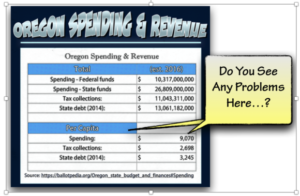
Let’s look at some numbers. During the 2015-17 biennium, Oregon’s Department of Administrative Services (DAS) processed nearly $8 billion worth of procurement services. That’s big money! That is 8,000 million dollars’ worth of goods and services. Wow! Especially when you consider that Oregon only has 4.1 million residents.

That’s right! Oregon spent 8,000 million dollars on 4.1 million people. That’s just under $2,000 of stuff for every man, women and child of every category, background, country of origin, make or model.  That’s just stuff; the total outlay for all goods, services, salaries, wages and benefits came to about $9,100 in 2016, on a per capita basis.

On the other-side of the accounting ledger Oregon only collected $2,700 in taxes on a per capita basis. This is what any normal person would call living beyond one’s means. The federal printing press barely helps reduce our overall shortfall, even though that contribution is an amazing 30% of all state revenue.

Recently, the Secretary of State’s (SOS) office auditors found Oregon missed opportunities to save 5 percent to 20 percent of the state’s procurement budget. That means Oregon missed the opportunity to save 1,600 million dollars ($1.6B) on state purchases.

The audit reveals that Oregon’s current procurement systems lack the information necessary for procurement specialists to effectively evaluate spending with regard to possible opportunities for cost savings.

Understandably, the DAS specialists buy lots of stuff for many disparate agencies. They purchase for Capital Finance and Facilities, Fleet Services, Operations and Maintenance, Building Security, Custodial, Landscape, Repair and Maintenance, Planning and Construction Management, IT, Real Estate Services, Interiors, Leasing, Land transactions, Surplus Property, and Enterprise Goods & Services.

This extraordinary range of goods and services crosses multiple agency boundaries and the state’s procurement services could be effectively streamlined if there existed a single data-store for this information. The audit found that of the $8 billion spent in procurements in 2015-17, the state only has purchase-level data for about 12.5% of the transactions, or roughly $1 billion.

What about the source level information on the other 87.5% of the state level procurements reviewed by the auditors? Obviously, the auditors found this to be subpar.

SOS Dennis Richardson’s office suggested that the statewide implementation of an eProcurement system should be implemented and would provide the additional data needed to perform a full spending analysis. It is no surprise that understanding the capital cost of an asset, including its full-life cycle costs – maintenance, operating and disposal costs, along with supplier bidding and contract opportunities could result in hundreds of millions in potential savings.

After reading this audit report, several small-government proponents in Oregon State Legislature called for swift procurement changes. Sen. Kim Thatcher (R-Keizer), issued a press-release stating, “the state needs to modernize its 1990s-era system. Oregon could have saved $1.6 billion had it previously implemented the system, meaning if Oregon succeeds in implementing OregonBuys ahead of the next biennium, the state could prevent the need for any new taxes being pushed to fill a supposed budget gap.”

Rep. Bill Post (R-Keizer), echoed those thoughts, “Had the system been previously implemented in the last biennium, it could have potentially saved billions of taxpayer dollars.”

My own statement was, “We should not be raising taxes until the government’s procurement system is fixed. Some in the partisan supermajority seem to view Oregonians as ATMs rather than constituents.”

Obviously, taking people’s hard-earned money away from their families and communities, only to push loads of cash into a broken vending machine of a government, is not only senseless, it is immoral. As a legislator, I have a duty to my constituents, and I will continue to be a strong voice for government accountability and change this upcoming session.

In an era of rising taxpayer dissatisfaction, higher expectations and rapidly changing economic conditions, high-performance sourcing, procurement, and supply chain management services are crucial to our state.

Our state’s ungainly combination of legacy systems, spreadsheets, email, and yellow sticky-notes has burdened taxpayers with unnecessary costs. Many of these problems can be relieved with advanced digital technologies for sourcing and procurement. The lack of technological integration and automation in our state is a legacy built over the past 30 years. It is time for leadership so that we can make Oregon great again.

It’s time for Governor Kate Brown to trim expenses, reduce unnecessary burdens and pursue budgetary and tax moderations. These steps would empower Oregon’s citizens to live within their means while enjoying the abundance that comes from the sweat of their own brow, the strength of their hands and the creativity and innovation of their minds.

Remember, if we don’t stand for rural Oregon values and common-sense, no one will!

Best Regards,

Dennis Linthicum
Oregon State Senate 28
How to Find God’s Glory in a Good Book

Oregon State Legislature sent this bulletin Thursday, December 26, 2016 by devadmin

In my last article about Biblical Truth and Careful Reading, I wanted to spark your interest in good books, authors, and your own personal meditation on the things that you read. God’s glory is all around us and we can discover it more readily if we read, meditate, discuss, share and live according to Biblical principles.

In Romans we read that God’s glory can be clearly seen throughout the world. The Apostle Paul writes:

“… because what can be known about God is plain to them, because God has made it plain to them. For since the creation of the world his invisible attributes – his eternal power and divine nature – have been clearly seen, because they are understood through what has been made. So people are without excuse.” (Romans 1:19-20)

If this is a true claim, that, “God is not hidden and God’s invisible attributes can be seen,” then it seems that Scripture is telling us that God is able to be discovered, so finding Christ in every facet of our lives shouldn’t be as hard as we might think.

Could it be that Biblical truth is, indeed, everywhere? Could it be that you and I are simply unfocused or too distracted to see it?

Our culture is constantly bombarding us with ungodly messages via the Internet, TV, magazines and movies, so becoming distracted is all too easy. One of the ways that I think we can learn to look for the divine in the midst of the seemingly mundane is by measuring our Biblical knowledge through our reading. Reading quality literature allows us to turn our focus back towards those things that are true, good, and beautiful.  You might be wondering, how? And, why books?

When reading a book, you are in charge. You become the director; you control the flow, tempo, volume, and texture of the voices. The author provided the details, but you’re in charge now. You get to tell the story. Think of a story told in movie, or video format. It will be told through the director’s eyes. It will be told with the speed, tempo and music that he envisions.

When you read a book that connection becomes your intimate opportunity. You gain control. You get to slow down, meditate and reflect on the characters in the story, and this is extremely important. This is where we avoid conforming to the patterns of this world and become transformed by the renewing of our minds (Romans 12:2). Our desire should be to fit every loose thought, emotion and impulse into the structure of life shaped by Christ (2 Corinthians 10:5). You can accomplish this by using God’s Word to help focus your mind as you contemplate what you’ve read.

After you’ve read a bit, stop and think about the characters, their circumstances and their interactions. Why did they say what they said? What decisions were made and why? How do you see God working in the story, even when there is no allusion to God’s active involvement? Do you see honor, integrity, or fallenness?

Take for example, Daniel Defoe’s Robinson Crusoe, a story oft mistaken as a children’s book. In the very first chapter, our hero describes his dilemma, “in which I do not heed my father’s advice”:

“[Facing perplexing circumstances] …my head began to be filled very early with rambling thoughts… my inclination… led me so strongly against the will, nay the commands of my father, and against all the entreaties of my mother and other friends…

“But one day… I went casually, and without any purpose… I consulted neither father or mother… without asking God’s blessing, or my father’s, without any consideration of circumstances or consequences, and in an ill hour, God knows.”

Now, in your mind’s eye, try to recall memories that echo these circumstances – self-centered desire and will, wise counter-counsel, obstinacy or casual enticement without appropriate consideration.  Are these events similar, or dissimilar, to anything you’ve experienced? Do these words describe a friend or family member’s recent situation?

Defoe’s crisp moral insights provide us with a timeless perspective encased in an engaging story. In fact, these paragraphs could easily be used to describe any of us in high school, or college. Or, maybe these words fit an episode in your life where you are currently perplexed.

Our goal should be to interpret what we read through a Biblical framework. We should think critically about the stories we hear and read through the prism of God’s Word.

For example:

  • Can you relate these paragraphs to any Bible verse?
  • Any from the New Testament?
  • Any from the Old Testament?
    • In your reading, do you recognize characters that relate positively to Biblical truth?
    • Do you find any encouragement in the realization that others have faced the same spiritual struggles that we face today? (Young Crusoe, in the mid-1600’s, faced dilemmas familiar to each of us.)
    • Your thoughts are worth sharing and discussing. Are you willing to engage others?

Even young Crusoe meditates on his experience, which I’m sure many of us can relate to, and he recounts his thoughts, as follows:

“I began now seriously to reflect upon what I had done, and how justly I was overtaken by the judgment of Heaven for… leaving my father’s house, and abandoning my duty; all the good counsel of my parents, my father’s tears and my mother’s entreaties came now fresh into my mind, and my conscience, which… reproached me with the contempt of advice, and the breach of my duty to God and my father.”

By reading a fictional story about a headstrong young man and his adventures at sea, I found pieces of wisdom regarding thoughts that I could take captive to Christ. These observations, in turn, become powerful reminders of my own personal journey as a believer.

I challenge you to give it a try with a good book. Endeavor to see Him in everything. Try using literature as a tool for focusing your thoughts and looking for God’s glory in all things. Then, watch and see how your view of the world changes. Your journey, relationships and conversations should reflect transformative qualities when seen in the light of His attributes.

In my next post, I’ll help you walk through more of these truths by using other illustrations from timeless literature. Along the way, remember to share your thoughts with others, as we continue this journey together, discovering the mind of Christ in all that we encounter.