Poison Fruit…

Oregon State Legislature sent this bulletin Wednesday, december 19, 2023 by devadmin

Super majorities and the poison fruit of statism can grow in orchards on both the left and right sides of the road. We know this because history informs us and dictates what we will see tomorrow. Patrick Henry told us, “I have but one lamp by which my feet are guided, and that is the lamp of experience. I know no way to judge the future but by the past.”

In today’s newsletter, I am going to bypass several thousand bills that are in the Legislature. I’m going to skip-over the gross receipts sales tax, the carbon tax, the recent ban on plastic straws, as well as, the “mandatory requirement for vaccinations in exchange for education benefits” rigamarole.

Instead, I want to focus attention on the Oregon disarmament bill: SB 978. It is still alive and like a zombie is shuffling through the hallways of the marble palace. This bill continues to exist by the force of this administration’s empty rhetoric and faulty logic.

SB 978 represents a purposeful and energetic effort for disarming Oregonians and infringing on their liberties. The sheer animosity leveled against law abiding citizens is inscrutable and illustrates a complete disrespect for our 2nd Amendment rights. The magical facade of “needed reform” is all that is necessary to mask the demolition of our constitutional liberties. It appears that the real goal is total disarmament of law-abiding Oregonians.

The pretense of the bill is that crime is pervasive; guns are unsafe; children are being killed and something needs to be done. Perfectly fine sentiment, yet, where are the statistics for Oregon’s problems? Remember, the original SB 978 was a proposal for a reporting and fact finding effort to determine which policy changes would effectively impact gun violence. Apparently, no one cares about the real data.
There are more firearms in Oregon than people. In the presence of millions of firearms and billions of rounds of ammunition how many unlocked, or unserialized firearms have been used in crimes? Additionally, there are more firearms in Oregon than vehicles, but there are more vehicle deaths than firearm injuries, where is the balance?
Unfortunately, the bill, as it stands, focuses on creating more arbitrary, capricious and unnecessary crimes that can’t be universally enforced because of the sheer scope of probable violations. This means selective enforcement opportunities will likely be used against political opponents while the issues associated with enforcement among racial or other protected classes will be pervasive. Actually, selective enforcement will certainly entrap any number of law-abiding citizens who might experience outlandishly improbable circumstances.
Among the 44 pages of over-reaching legalese, if a firearm is used to injure a person, or property, within two years of a gun transfer through sale, gift, or theft where a safety device was defeated by the crook, the owner of the firearm is held “strictly liable” for injuries.
The devious thrust of this language is aimed at discouraging and reducing firearm ownership through fear and financial intimidation. The “strict liability” language purposefully supports unjust and unfair treatment of gun owners because, as defendants, they will be held liable for some future event that is totally unrelated to their actions or intentions for a period of up to two years. Additionally, once the gun is stolen and the owner no longer has control, crimes committed by the criminal impact the level and severity of criminal charges brought against the legal owner of the weapon.
Please follow that logic with care…
Let me illustrate using a vehicle equivalent: if someone steals your car for a joy-ride to the burger joint, your criminal charges would be minor. However, if they used your rig as the get-away car for a bank robbery your criminal charges would be more serious. Lastly, if the car-thieves get into a fatal accident, your criminal charges would pile up like roadside wreckage. So, if an individual follows best practices and locks their car in a well-lighted area, why would the state want to hold them liable for someone else’s criminal activities? Clearly, fewer people would want to own cars under these circumstances.
While it appears that criminal violations are built upon solid circumstances (Sec. 5 – 9), the keystone is actually missing. Namely, the rules and minimum specifications required for trigger locks, cable locks, and tamper-resistant locks on all containers, buildings, rooms and doors which aren’t yet defined. This means that legislators who vote for this bill will have no idea what they are voting for in the way of future requirements. What if the rules require an absurd 1″ Stainless Wire Rope EIPS IWRC – 6×37 Class cable? What would gun-owners do?
These rules won’t come from mechanical engineers but they will come from the governor’s chosen one within the Oregon Health Authority, in consultation with State Police.
Keeping history as our guide, let’s roll through some historic episodes and ask ourselves, “Who was in charge, the individual or the state?”
Consider Lenin’s Bolshevik revolution, Stalin’s Siberian Gulags, Mao’s Great Leap Forward, Pol Pot’s Khmer Rouge, Pasha’s Armenian Genocide, or Maduro’s Venezuela?
Far in excess of 100 million people lost their lives and are still suffering intense persecutions. What was the first liberty these regimes took from their targeted populations? Their guns! What did they lose next? Free speech; free association; eventually, their lives.
Did these regimes operate on the consent of the governed? No. Were these citizens able to resist the tyrannies that befell them? No. Could they protect their lives, liberty and property? No.
The blow-back that I typically receive is that these episodes of genocide are so horrific they couldn’t possibly happen here. Well, then, why the effort to disarm law-abiding citizens?
Thousands of Oregonians, from across all party lines – Republicans, Democrats, Independents, Greens and Non-Affiliated Voters – and across all backgrounds have written to me and are outraged at this anti-gun-owner bill.
In closing, President Dwight D. Eisenhower said, “If all that Americans want is security, they can go to prison. They’ll have enough to eat, a bed and a roof over their heads. But if an American wants to preserve his dignity and his equality as a human being, he must not bow his neck to any dictatorial government.”
Remember, if we don’t stand for rural-Oregon values and common sense – No one Will!

Dennis Linthicum
Oregon State Senate 28

What’s up with Ballot Measure 112

Oregon State Legislature sent this bulletin tuesday, november 22, 2023, by devadmin

Ballot Measure 112 – Repeals language allowing slavery or involuntary servitude as criminal punishments and authorizes an Oregon court or a probation or parole agency to order alternatives to incarceration for a convicted individual.

This measure is poorly structured as a constitutional amendment and neglects the real issues surrounding criminal justice, incarceration, parole, probation and other alternative options that would be better suited to statutory changes.

  1. It relies on the emotionally powerful, but purely rhetorical, ideation for “doing away with the antiquated racist legacy of slavery in our State.”
  2. It fails to recognize differences between institutional slavery and involuntary servitude as the latter refers to the serving of time in detention or incarceration following a criminal trial.
  3. The new legal battles over mandatory sentencing, regardless of duration, will sculpt an entirely foreign landscape with regard to new, yet unimagined, definitions of “involuntary servitude.”
  4. It promotes the modern social justice or Humanist propensity for promoting criminal rights without consideration for the victim, or victims’ rights.
  5. It steps deep into the incarceration, probation, parole, and pardon quagmire without fairly addressing the details associated with criminal justice, sanctions, punishment, recompense or rehabilitation.
  6. It may eventually lead to fair wage compensation for incarcerated individuals, followed quickly by cost overruns and the eventual “defunding of police.”

Everyone knows that legalized slavery is a foul and abominable crime against humanity. The inhumane treatment and bondage of exploited human beings is universally repulsive.

We believe our nation is a uniquely indivisible melting pot. We know it is comprised of people from many cultures, races and ethnic backgrounds. We believe in the equal application of all laws, across all people, in all circumstances for the protection of their lives, their personhood, individual liberty and personal property.

Although legal forms of slavery have long been outlawed in the US, slavery still exists in many parts of the world. In fact, more people are in bondage today than at any other time in history. Widespread exploitation for illicit purposes, in countries around the world, impacts people from ethnic, religious and racial  minorities, women, children and impoverished populations.

However, none of this is because of some leftover clause in Oregon’s Constitution.

In fact, Section 34 of Oregon’s Constitution closely resembles the wording in the Northwest Ordinance of 1787, and nearly repeats the words in the US Constitution.

There are no legal forms of slavery anywhere in the US due to the thousands of souls who argued for abolition and the Christian ideals of human dignity. The US Civil War was thought to be the final push for ending racial prejudice, where many hundreds of thousands fought and died. Lastly, there were thousands of stalwarts who argued, preached, advocated, and secured the 13th, 14th, and 15th Amendments to the US constitution.

So, the issue is not “slavery” the issue is how to handle and administer justice, for those who have been harmed by the deviant or criminal behavior of others.

The concept of justice is easy, give every person their due. In real life it is much more difficult. We have a conscientious duty to discharge justice to all parties, both the victim who deserves restitution and the criminal who may deserve some form of sanction, punishment and/or imprisonment.

As a side note, passing this responsibility to local jurisdictions, where the cost or benefit to the local community can appropriately be weighed sounds reasonable. But remember, this is a constitutional  amendment not a statutory change. Measure 112 fails to address the real, deep, and concerning details of our criminal justice system.

The proposed language by-passes justice and reform, ignores any relevant costs or benefits for victims, criminals, community and society. The suggested language delegates authority to any and all parole or pardon agencies who may “order” a sentencing alternative. This flies in the face of judicial review and oversight and begs the question, who is in charge here?

This proposal seems to be a “get out of jail” free gimmick. The proponents talk about human dignity and idly suggest that a more fair, civil and polite society will blossom after individual responsibility and accountability have been stripped from our criminal justice system.

For example, in California a thief can steal up to $950 of merchandise from any large or small business on main street without criminal repercussions. This is hardly fair to the store owners because without law and order our businesses cannot survive. Nor is this fair to the thief who is never brought to terms with their criminal actions.

The deeper issue that never gets addressed is our own individual moral agency and human consciousness. Our society requires each of us to make conscientious assessments of individual actors and their actions. There is no alternative.

Lastly, Oregon’s Criminal Justice system is in need of reform. However, this is the wrong path forward. Ballot Measure 112 would be a gross disservice to our communities and the universal concept of justice.

Therefore, I suggest a “NO VOTE” on Ballot Measure 112.

If we don’t stand for rural Oregon Values and common-sense… No one will!

Regards,

Dennis Linthicum
Oregon State Senate – District 28

Way-Off-Kilter

Oregon State Legislature sent this bulletin Wednesday, november 21, 2023, by devadmin

Together We Can Restore Freedom, Free Markets,
and Constitutionally Limited Government.

Let’s OPEN Oregon’s Economy NOW!

Last month’s thunderclap from Governor Brown’s pen has successfully dismantled Oregon’s commercial and industrial economy, from farm and ranch all the way to Main Street. Every municipality, un-incorporated city and wayside business district throughout Oregon has been thoroughly crushed.

All of this has been done under the guise of saving lives, but the numbers just don’t add up. CDC estimates that a range of 46,000 to 95,000 deaths occurred during the 2017–18 flu season. Based on new models and estimates COVID-19 will be less tragic than many previous strains of seasonal influenza.

The full spectrum, age bracket, death rates presented in mid-April’s CDC report shows COVID-19 results which vaporize the lock-down narrative. Among the 17,229 deaths in CDCs newly expanded “confirmed or presumed” COVID-19 categories nearly 80% of these tragic losses occurred with individuals over 65 years old. However, it is not age alone because there are other statistically relevant factors impacting the lives of these individuals.

Specifically, other chronic morbidities are more powerful predictors of impacts of COVID-19 on health. Elderly people who have chronic life-threatening morbidities, such as high blood pressure, obesity, respiratory illnesses, Type 2 diabetes and renal disease are the individuals who are more susceptible to the COVID-19 virus.

Unfortunately, Oregon’s misguided “one-size-fits-all” policy hamstrings the entire economy regardless of age, co-morbidity or any capricious designation regarding the “essential” quality of a business. Legislators, rule-makers and bureaucrats typically build exceptions and exemptions into their regulatory machinery to avoid capturing their own cronies. They are also extremely clever when it comes to choosing which portion of the private sector to tax, burden, regulate or bless as an “essential” business enterprise.

But, never forget, it is for the greater good.

It behooves officials to make their case with a nod to “science” in order to successfully persuade the public. But as time passes and our knowledge increases it is easy to see through the CDC’s faulty models and statistical rigmarole. The statisticians are now jiggering the numbers by including Influenza Like Illnesses (ILI) and COVID-19-Like Illness (CLI) to the total case and mortality counts in order to camouflage the weaknesses in their arguments.

Re-definitions of this type shouldn’t surprise anyone because in our lifetimes we have seen a constant stream of redefinitions; run-of-river hydro-power electric generation is no longer defined as “renewable energy”; Tumbler’s gender identity list for 2020 has 112 newly minted identities; a pregnant mother is only carrying a “baby” if the mom wants to allow the child to stay snug in her womb; during this “COVID crisis” shopping at some retail outlets is permitted while shopping at other retail spaces is not; outdoor activities like walking your dog, jogging, or biking in your neighborhood is permitted, but walking, jogging or biking in your local park, or the other 58% of Oregon’s millions of acres of public space is not permitted.

This top-down, one-size-fits-all mentality is more pernicious than the dreaded disease because it exterminates our humanity and shrouds our community in distrust. It fails to allow for our God-given natural freedom, our human dignity and our individual preferences.

Imagine the uncertainty business owners face while re-opening. When will they be “allowed” to open, who will set the timeframes, what are the rules for getting permission? Will plexiglass barricades be a new requirement between the public and employees? Will food servers at your favorite brew pub be required to serve your dinner and drinks cloaked in PPE (personal protective equipment)? How will businesses appropriately shun the marauding diseased that might roam through their stores?

How will businesses operating in retail, hospitality or food service re-engage their employees while complying with Oregon’s predictive scheduling requirements? Is it fair to demand 14-day advance notice for any changes to an employee’s schedule when the hoped-for customer demand may never arise?

Political economist Mark Thornton writes, “This Bust Wasn’t Caused by a Virus.” Even the WSJ reported on estimates from Stanford scientist John Ioannidis, “the U.S. fatality rate could be as low as 0.025% to 0.625% and put the upper bound at 0.05% to 1%—comparable to that of seasonal flu.”

Ioannidis added, “If that is the true rate, locking down the world with potentially tremendous social and financial consequences may be totally irrational. It’s like an elephant being attacked by a house cat. Frustrated and trying to avoid the cat, the elephant accidentally jumps off a cliff and dies.”

In Oregon, there are hundreds of thousands of people capable of putting in a full day of work while providing much needed industries, goods, services and normalcy to their communities. This is especially true for disenfranchised, impoverished or lower-middle-class employees and business owners who have been barred from work by virtue of a mis-applied “nonessential” government label. Our community, state and national economies have been entirely flatlined because of this mis-labeling naiveté.

In fact, the entire world economy is now way-off-kilter. West Texas Intermediate oil, for May delivery, plummeted to negative $40.32 per barrel. That’s right, they would pay you $40.32 to haul away a barrel of oil. The unemployed can now earn 130% of their normal working wage without working. Gone is any semblance of normalcy.

The unfortunate reality is that when 26.5 million people file for unemployment benefits nationwide and 300,000 Oregonians are furloughed, the severity of the damage to individual lives, families, and communities is incalculable.
The Constitution was written to cap, or limit, the extent of government’s responsibilities, not to expand them. Its purpose was well-understood, back when words had meaning. The meanings were known and understood without room for arbitrary changes in policy, authority or power.

Which is why it is appropriate to ask; how did the Governor gain so much unchecked power? Did past legislators who codified these statutory powers, consider the ramifications? Did they presume that only an elected official could faithfully exercise wisdom, good sense, justice and the warm feelings of humanity? Don’t all of us do that on a daily basis?

Continuing Oregon’s flawed, shut-down policy is devastating to individuals, families and businesses. New problems are already arising because of government fomented distrust within our communities. People now face isolation, financial ruin, bankruptcy, unemployment, loss of privacy, impoverishment and unwarranted fear of public spaces. As individual liberty is ravaged there will also be secondary and tertiary ramifications from psychological damage, suicide, violence and other, as yet, unperceived issues. The economic turmoil will continue for decades to come.

Now is the time to unleash the economic engines of Oregon and admit the statistical COVID-19 case curve has been flattened.

It’s long past time to visit our barbers, hairstylists, doctors, dentists, ophthalmologists, physical therapists, specialty retailers, local restaurants, brew-pubs, malls and shopping centers. Together we can bring needed rejuvenation and vitality back to Oregon’s families and businesses.

Regards,

Dennis Linthicum
Oregon State Senate – District 28

Gunsmoke and Mirrors

Oregon State Legislature sent this bulletin Wednesday, january 24, 2019 by devadmin

After the recent elections, the Democrat Party has a “super” majority in both of Oregon’s Legislative chambers. They also own the Governor’s office. This means they have a 60% majority in the legislature and can pass any tax or spending increases without pesky Republicans getting in the way.

While their goals may appear noble, admirable or desirable since they defy logic, science, and fiscal rectitude they cannot provide Oregonians with a viable future. They can only lead to a larger, more rapacious state government. Nevertheless, the majority appears willing to use a gunsmoke and mirrors campaign to mask attacks on our Constitutional rights while promoting their own Utopian agenda.

They desire a world where wealth and prosperity are abundantly available and evenly distributed. But nothing in the universe is equally distributed; not height, weight, melanin, academic abilities, artistic aptitude, creative genius or mechanical inclinations.

Today’s Utopians want free universal healthcare but keep driving the costs higher and higher while the care gets worse and worse. They want low-cost or free college education for today’s students who will end up paying for it tomorrow. They also promise jobs galore and high-tech employment for everyone, yet the market has no way to efficiently respond to this temporary, abnormal and artificial flood of competing job-seekers.

At the heart of the matter is an age-old collectivist vision delivered by government control. If you think I’ve gone overboard, read what the Utopian Robert Owen wrote in 1816:

Society may be formed so as to exist without crime, without poverty, with health greatly improved, with little, if any misery, and with intelligence and happiness increased a hundredfold; and no obstacle whatsoever intervenes at this moment except ignorance to prevent such a state of society from becoming universal.1

The reason Utopian dreams don’t work in the real world is because they don’t account for scarcity, human resourcefulness, compassion or commerce.

Human-beings are our only true source of wealth.

Wealth does not come from our state’s untapped natural resources or from state government. It does not come from our rivers, forests or land. These things become productive resources only through the innovation, creativity and genius of working people. Without the rich contributions of hard-working Oregonians, we would never have had lumber, crops, beef, concrete, wine, milk or cheese.

Only men and women can supply the creative genius to turn natural resources into usable goods that improve the well-being, quality and health in our lives. This means however, that Oregon must be willing to allow people to create and keep the rewards that flow from their voluntary engagement in the free-market system. Confiscating the fruits of a person’s labor will naturally remove their desire for work.

While this may sound like common-sense, I fear our governor has missed this point. The Democratic-socialist party’s legislative agenda includes enormous disincentives for productive labor, capital formation and investment.

History tells us that increasing a tax, like the “sin taxes” on inhalant products, cigars and cigarettes will decrease their consumption. Yet, no one asks what might happen to the productive industries for malt beverages and wine when taxes are applied to those products. Also, imposing higher taxes on personal, corporate, and out-of-state income will decrease the activities that produced that income, not the other way around. The same negative consequences will impact our transportation industries as higher boating fees, aviation, diesel, and gasoline fuel taxes are bandied about.

Lastly, increasing our property taxes is supposedly the price we have to pay to live in Oregon.

What’s left to tax or regulate out of existence? Ohh, yeah, …  our 2nd Amendment rights! The gunsmoke and mirrors gang is just getting started.

Their propaganda message is, “Oregon’s children are only safe in gun-free zones.” In other words, your home must become a gun-free zone. However, we know that gun control laws only work for law-abiding citizens, which by default means only law-breakers and criminals will own firearms.

Guns are not the biggest problem which citizens, and/or children, face with regard to their lives, health and safety. Have you seen the statistics for opioid overdoses or automobile fatalities? Recently, economist Antony Davies and political scientist James R. Harrigan, reported that Americans are artificially tied up in knots over violent crime—particularly crimes committed with “assault weapons.”

They note, “This concern, statistically speaking, is fairly irrational. You are far more likely to be killed by being beaten or stabbed than you are to be killed by any kind of rifle, ‘assault’ or otherwise.” Their timely podcast goes through the actual numbers, here.

Liberty and respect for the individual demands that we act in the interest of the individual – not in the interest of the state.

If we don’t stand for rural Oregon values and common-sense – No one will!

Best Regards,

Dennis Linthicum
Oregon State Senate 28

Our Dam Problem… Post

Oregon State Legislature sent this bulletin Wednesday, october 13, 2018 by devadmin

Below are comments which I submitted to Oregon Department of Environmental Quality with regard to their initial public review of a section 401 water quality certificate for the proposed removal of the J. C. Boyle dam on the Lower Klamath River. (PDF of actual letter is available here.)


TO: ODEQ Hydroelectric Specialist,

Current and future Oregonians are, and should continue to be, beneficiaries of the monumental achievements in water infrastructure that has created Oregon’s exemplary agricultural economy. The proposed removal of the four PacifiCorp dams, including the J. C. Boyle dam in Oregon, will destroy that very infrastructure.

Therefore, I stand alongside the majority of tax-payers and citizens in firm opposition to ODEQ’s approval of a water quality certification request for the J. C. Boyle Dam removal project.

The dam removal effort has too many uncertainties which bear negatively on long-term water quality, river habitat and fish spawning grounds due to the river dynamics and existing sedimentary buildup behind the dams.

These dams serve several environmentally beneficial functions by first, creating a series of reservoirs which diminish turbidity and improve water quality as water moves through the system. These reservoirs are essentially giant settling ponds for particulate matter, including erosional debris, dead algae, cobble-sized sediment, pebbles, and valley-fill alluvium.

Particulate organic matter, that originates from Upper Klamath Lake, basin agricultural return flows, municipal and industrial sources in the Klamath Falls area, is largely trapped by the J. C. Boyle reservoir.  The overall nutrient loads, including naturally occurring phosphorous rich material, settles behind the dam and never reaches the slower moving and shallower gradient portions of the river system. In turn, Copco 1, Copco 2 and Iron Gate Dam reservoirs also serve to keep sedimentary debris from flowing further downstream.

Although, all four reservoirs are known to have elevated organic loads, they still serve as excellent sedimentary traps. Current estimates range from 15 million to 30 million cubic yards of sediment behind all four dams. The J. C. Boyle dam, had an estimate that was originally 1.5 million cubic yards. Today the estimate has been forced into a range that is deemed politically acceptable, at 600,000 cubic yards. This number is still a ridiculously large volume of sedimentary debris to consider flushing into the California river system. Flushing this debris would be unconscionable and would cause catastrophic harm to the overall river environment, downstream fish populations, spawning grounds and riparian habitats.

Additionally, the toxicity of these enormous volumes of muck and sedimentary composites have not been sufficiently studied. Mining operations have long surrounded the river system throughout So. Oregon and No. California. A U.S. Geological Survey review of mine data (2005), highlights that these past operations released elevated amounts of toxic substances into the watershed, including arsenic, chromium, copper, lead, mercury, nickel, tungsten, uranium, and zinc.

Oregon has been tightening rules, initiating moratoriums and legislating outright bans on various small-volume run-of-river dredge mining operations for years. Therefore, ODEQ should have serious reservations about the complexities involved in this potential toxic stockpile and be less insistent on approving this certification. Otherwise, the citizens will recognize this current 401-certification process is a politically motivated, agenda-driven water quality charade reeking with double-standards.

The existing dams provide beneficial cleansing structures which allow the massive fresh-flow tributaries, and downstream volumes of low phosphoric, clean water from the western-slope to actually improve water quality as it travels the 250 miles to the Pacific Ocean.

ODEQ should never consider allowing this potential toxic debris into the river system. First, it will never make it to the Pacific Ocean because deep boulder pockets, gravel and cobble bars and the subsequent multiple confluence embankments and ridges that occur along the lower elevations will trap the overwhelming tonnage of debris.

Additionally, the downstream gradient is too shallow, and the river flows will never be sufficient to mobilize the debris field. ODEQ’s permit approval pretends to only be concerned about water quality in Oregon. This is indefensible because all of these toxins, muck and sedimentary debris will devastate the lower river.

The downstream impacts cannot be ignored. From River Mile 160 to the Pacific Ocean the gradient approaches a mere two percent (.1893) grade (Figure-1). The drop to sea level is only a 1600-foot change in elevation, which is only 10 feet per mile. ODEQ certainly knows the typical waste-water or home septic system would require a slope of 110 feet per mile to drain efficiently

While dam critics often complain that dam construction has altered the natural sediment transport processes reducing gravel bar and pocket gravel deposits and thereby reducing salmonid and lamprey spawning and rearing habitats, dam removal is not the solution

The purposeful disbursement of Oregon’s debris field into California’s portion of the Klamath River system would be an immoral act.

In fact, the debris flow today, with the dams in place, is too heavy for the current channelized flows to successfully push into the Pacific. Even with the benefit of increase flows used for dissolution and flushing programs, which are regulated by the dam structures, there is insufficient flow to clear the mouth of the river (Figure-2).

The J. C. Boyle dam:

•       Provides cool water for the continued operations of Iron Gate Fish Hatchery which releases 7 million anadromous fingerlings annually

•       Provides clean, renewable, low-cost hydroelectric power for 70,000 households

•       Reduces peak flood flows by 25 percent

•       Reduces algae blooms in the Lower Klamath River

•       Reduces river temperatures in the Lower Klamath River

•       Reduces river sedimentation and debris buildup in the Lower Klamath River

•       Provides for lakeside camping, hiking, fishing, boating and recreational opportunities

•       Provides river rafting and business opportunities

•       Provides reservoirs for bio-remediation, while trapping toxins and sediment

•       Allows for flow control and remediation techniques, such as flushing flows

These positive attributes provide enormous public benefit and sufficient reason for ODEQ’s denial of this step in the dam removal certification process.

In closing, there is another item that ODEQ must consider – Cost. Original cost estimates ranged from $1.4 billion and upwards. After 2010, when the US Congress first balked at funding the destruction of the Klamath Dams, there was an enormous effort to “find cost reductions.” The results offered nothing more than cost shifting and slight-of-hand congressional Gerry-rigging of payments from various agency-level accounts. Never-the-less, the public was told of a new cost estimate of $800 million, a reduction of $400 million. Today, the Klamath River Renewal Corp. estimates total cost at $400 – $450 million dollars, an estimated reduction of nearly $1 billion. It appears that if we wait a couple of more years the cost would be halved again!

I suggest, that a neat and tidy, $1 billion cost reduction from the original estimates with an overall price-tag of only $400 million cannot be legitimate, at least not using the same project scope and equivalent efforts. This begs the question, what items will be added to complete the dam removal project and who will fund future restoration and remediation efforts?

No doubt, tax-payers will end up paying the full-price. They will be burdened with millions of dollars of cost-overruns, future water quality issues, higher rates for base-load electricity, devastated habitat and riparian areas, and the destruction of private property, all because of an over-whelming, unfathomable mindset intent on destroying western civilization’s technological advances.

Oregonians should be the beneficiaries of the monumental investments, hard work and successful achievements made possible by our state’s water infrastructure. Oregon’s status as a modern agricultural and technological engine has been made possible by inexpensive base-load electricity and abundant, well-managed water resources.

Please ensure our heritage by denying approval for the 401 Water Quality Certificate for the removal of the J.C. Boyle dam.

Sincerely…


Remember, if we don’t stand for rural-Oregon values and common sense – No one will!

Dennis Linthicum
Oregon State Senate 28

A Flanking Maneuver Against…

Oregon State Legislature sent this bulletin Thursday, September 26, 2019 by devadmin

At the beginning of the new year, in 1776, Thomas Paine published a Pamphlet to support the Patriot cause,  Common Sense. He wrote with clear, concise and beautifully simple word pictures that successfully rallied American colonists against the over-reaching rule of the British crown.

First, Paine set the stage by noting that the public often mistakes society with government.  This happens in our era, too. We mistake laws flowing from our state’s bureaucratic agencies as cultural or societal necessities, but they are not. Paine paints a picture where people are allowed to freely engage and work together to accomplish private tasks that improve the community, without requiring central planning or authority. He notes society and government are different, and,

“… they are not only different, but have different origins. Society is produced by our wants, and government by our wickedness; the former promotes our happiness POSITIVELY by uniting our affections, the latter NEGATIVELY by restraining our vices. The one encourages intercourse, the other creates distinctions. The first is a patron, the last a punisher.”

I recommend reading Paine’s small booklet because you will see similarities between what Paine describes from 250 years ago and what we experience in Oregon today. Namely, Oregonians are continually pounded by an unrelenting tide of laws, rules and regulations that burden the average farmer, rancher, forester, timber hauler, accountant, retailer and entrepreneur beyond measure.

For example, during the Legislature’s 2019 session, there were 2,768 bills introduced, with about 700 laws signed by the Governor. The several hundred, or more, rules and regulations which have not yet been spawned will soon be flowing downstream from the agencies which are tasked with enforcement.

No doubt, our errors in self-governance partially stem from our own failings. I know this because I often get letters, emails and phone messages where people suggest their version of a great legislative idea. You already know the refrain, “There ought to be a Law…”

These ideas, might be wonderful, but there are always trade-offs and other issues to consider: what does it cost, who makes the rules, how many rules will get created, what sanctions will be imposed, who governs enforcement, how will discrepancies be judged, are the desired outcomes accomplished, what are the unintended consequences that will seep through the fabric of our communities?

To illustrate, my wife was recently at a large retail outlet standing in line with 6 individuals ahead of her and 5, or more, behind her. They were all waiting for service, with some exhibiting more patience than others. The two young men at the counter were doing a great job of helping each customer and did so with courtesy and efficiency. As one of the clerks finished his task, the next customer moved forward.

With clear frustration, the clerk said, “I’m sorry but I have to take my, ‘legally mandated’ break now.” While he was closing his station, he added sympathetically, “I know it’s busy, but I have no choice, I have to take this break.”

My wife said she thought this, “young man could have carried an elk carcass back to camp all by his lonesome.” So, although he could have continued to service the queue, he was required to follow the legislated mandate and leave his customers hanging.

Review, Oregon Revised Statute Chapter 653,  which deals the employment conditions my wife encountered. I would bet most of us will struggle to understand it and its implications. Today, Oregon has so many laws on the books, with countless defined terms, caveats, exemptions and carve-outs it is hard to know what is appropriate and what is outlandish.

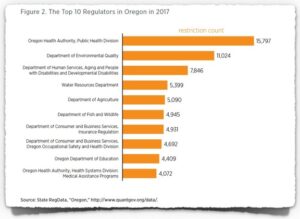
To analyze this unnerving trend, the Mercatus Center at George Mason University created a tool known as State RegData – a platform for analyzing and quantifying state regulatory text by looking for words and phrases like “shall,” “must,” “may not,” “prohibited,” and “required.” These are the phrases typically used to signify legal constraints and obligations. The tool identified 167,401 restrictions in the 2017 Oregon Administrative Rules containing roughly 14.8 million words.

It would take an individual about 821 hours—or almost 21 weeks—to read the entire Oregon code. That’s assuming the reader spends 40 hours per week reading and reads at a rate of 300 words per minute. For comparison, in 2016 there were over 1.08 million additional restrictions in the federal code. Individuals and businesses in Oregon must navigate all of these restrictions to remain in compliance.

These rules represent a flanking maneuver against private, consensual, free-market capitalism. Capitalism is defined as private ownership and control over the means of production, where the surplus product becomes a source of income for its owners. By contrast, socialism is defined as social ownership of the means of production so that the surplus product accrues to chosen groups within the larger society.

If “ownership” means the right of an owner to organize and dictate the application of various resources – be it capital, equipment, or labor – then today, we have surrendered that decision-making authority to the state. The state now has the power to rule, organize, and manage (or own) nearly every business.

Agencies can subtly control the means of production through their regulatory requirements – employment, emissions, wages, schedules, margins. Government can over-see and run a business through rules and regulations without suffering from unsightly legal or economic issues that would typically surround a hostile takeover. In this way, bureaucrats and commissions can execute ghostly control over all aspects of any business via the machinery of the state.

As our last budget cycle proved, this has immediate benefits for the state enterprise. However, in the long-run, it is terrible for businesses, their customers, employees, futures, longevity and prosperity.

Daniel Webster, a statesman, lawyer, orator, and Secretary of State for three Presidential administrations recognized our problem and summarized our dilemma like this,

Good intentions will always be pleaded for every assumption of authority. It is hardly too strong to say that the Constitution was made to guard the people against the dangers of good intentions. There are men in all ages who mean to govern well, but they mean to govern. They promise to be good masters, but they mean to be masters.”

Well said!

If we don’t stand for rural-Oregon values and common sense…  Who will?

Dennis Linthicum
Oregon State Senate 28

‘Let it burn’ approach to wildfires creating a disaster for our forests

Oregon State Legislature sent this bulletin Wednesday, September 11, 2017 by devadmin

When it comes to forest policy the public sphere is often filled with proposals that our wilderness areas need absolute protection from human encroachment.

Locally, we see these same ideas flourish with claims that expanding the Cascade-Siskiyou National Monument would preserve biodiversity and protect these forests for generations to come.

The problem with this narrative is that current evidence runs contrary to this utopian hope.

How can I say that? Let’s play a thought experiment with our forests.

We’ll let the “protect the wilderness” experimenters loose on a million acres of Oregon forest. During the first year, there would be hikers, campers and just everyday folks enjoying the great outdoors.

After a couple of years, the wilderness would become extremely difficult to navigate without roads built and maintained by loggers. In subsequent years only the hardiest would bother to take the kids camping because of the danger and difficulty in navigating the wildlands of an overgrown and brushy forest.

Fuel loads grow

Without any human intervention, thinning efforts or grazing permits allowed, the fuel loads would build until lightning storms cause a mega-fire that is typical for unmanaged wilderness. The wilderness designation would dictate that lightning caused fires would be permitted to play out, as nearly as possible, their ecological role within a wilderness area. Meaning, “let it burn.”

So, after several years, the remaining forests would be marginal at best; wildlife habitat would be destroyed; streams and watersheds would be polluted with ash, dirt and debris; and downstream fish habitat would be fouled.

Tourism would see significant declines as people naturally avoid vacationing in smoke-filled Oregon. The carbon emissions from these mega-fires would harm our human populations and healthcare costs for particulate matter inhalation would be significant.

Now, let’s take a million acres and manage it for sustainable yield logging and maintain it in a way that would not only supply lumber, but also recreation, benefiting the public with areas for camping, hunting, hiking, picking berries, winter snow sports, and just enjoying the accessible wilderness.

This forested land would be managed by the loggers. They would harvest trees, thin forests, clear out brush, allow grazing, re-plant and work to keep wildfires contained because the forest would be their livelihood. They would cut, grade and rock roads for access and the public would derive enormous benefit from being able to recreate in these beautiful forests.

Benefits worthwhile

It would be sustained for generations, always giving the newly planted trees time to grow into usable timber. Our summer air would be breathable again and we would be able to enjoy all the natural beauty of our state. Tourism would naturally increase and inject prosperity into our communities as folks far and wide would be confident that their vacation would not be shadowed by smoke.

Additionally, as byproducts of sustainable-yield forestry, there would be high employment in milling operations, freight hauling, home construction, heavy equipment operators, hydraulic engineers and designers and thousands of other subsequent opportunities. This would generate tertiary benefits through the direct creation of wealth from the astute utilization of our natural resources.

I realize my forest scenarios may be a bit extreme but you need only look out your window to see the dire situation from 20 years of improper and unrealistic forest practices. Our communities pick up the tab and suffer the consequences of this “let it burn” policy through the destruction of assets, loss of watersheds and wildlife habitat, loss of recreational opportunity and degraded forest resources.

Unfortunately, we are already living in the scenario promoted by the “protect the wilderness” experimenters and it is not pretty.

Fires get worse

Up until the 1980s, the average duration of wildfires was just six days. The number of distinct fires or ignitions hasn’t changed over time but wildfires, today, are much larger and last much longer. Today, the average fire lasts 52 days, or nearly two months. The Chetco Bar fire is estimated to double the 52-day average, with nearly four months of burn.

Last winter was a record-setting winter for cold, snow and rain. The drought is over; our reservoirs and dams are full; rivers and streams are still flowing with snowmelt. Could it be that these extraordinary burn rates are directly related to policy and not to global warming?

The overall solution is not complicated — in fact it’s simple. Let’s allow balanced human wisdom, ingenuity, and expertise a voice at the table to bring common sense and local control back to our forest management.

Dennis Linthicum is the state senator from District 28, which includes all or parts of Jackson, Klamath, Lake, Deschutes and Crook counties.

FrankGUNstein Lives

Oregon State Legislature sent this bulletin Thursday, May 25, 2017 by devadmin

Apparently, Oregon is tired of being a continual runner-up to California when it comes to restrictive gun control laws. The Oregon Senate recently released a lengthy 26 page bill composed of absurd and unnecessary regulations which will negatively impact the 2nd Amendment rights of law-abiding citizens.

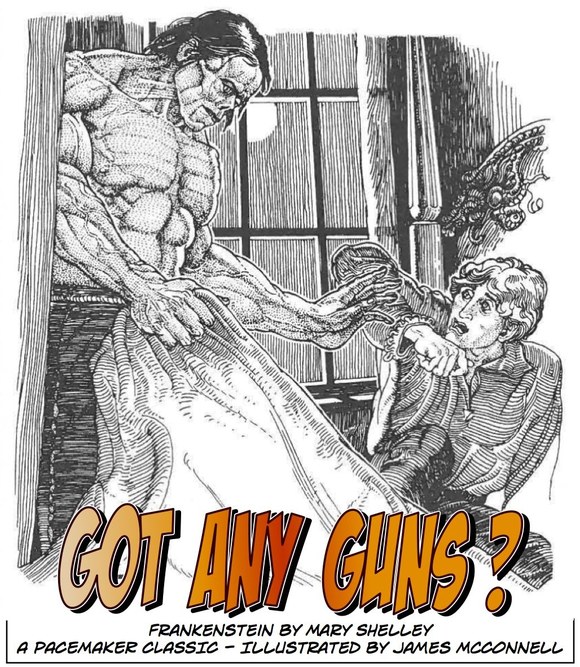
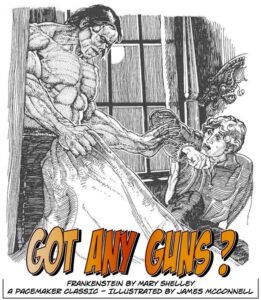
This bill (SB 1065) was thrown together in a surreal Frankgunsteinian fashion. Like Frankenstein, the only thing this bill needed was an electrifying jolt of sincere disregard for the constitutionally codified natural rights of Oregon’s citizens.

Oregon’s three leading Democrat gun grabbers, Sen. Prozanski (D-Eugene), Sen. Burdick (D- Portland), Rep. Williamson (D-Portland) introduced this villainous version of an omnibus, anti-gun bill. This bill includes legalese from several previous anti-gun bills that either died in committee or were set aside to be resurrected during the remaining weeks of this 2017 legislative session.

SB 1065 combines SB 764 and SB 797 plus portions of seven previous gun bills that never made their way forward (SB 495, SB 546, SB 549, SB 670, SB 804, SB 854 and SB 903).

Although this bill is a 26 page abomination, the metro-Democrats at least provided us with a delightful name for their legislation. The bill says, “this 2017 Act shall be known and may be cited as the Oregon Firearm Regulation Modernization Act.”

As usual, this very pleasant, forward-looking and enlightening language masks the true design of the legislation. Samuel Adams, in similar similar circumstances, noted, “It will bring an everlasting mark of infamy on the present generation, enlightened as it is, if we should suffer [our liberties] to be wrested from us by violence without a struggle; or be cheated out of them by the artifices of false and designing men.”

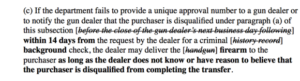
To wit, here are a few lines of text from the 1,150 lines smashed into this debacle:

In this section, it is easy to see the gradual and evolutionary mutations that happen under the guise of improving public safety. There is no statistical evidence documenting the benefit of an additional 14 days for the background check. Additionally, there is no evidence that more time is required. After all, they are using the internet for criminal background data aggregation.

The public is led to believe that more time would allow the security experts to do their job more thoroughly. Yet, information overload bogs down most government systems.

Remember,  the FBI knew of Omar Mateen and interviewed him on two different occasions. Mateen is the man who killed 49 and injured more than 50 others at a gay nightclub in Orlando, FL. The FBI surveilled Mateen and they followed leads that he knew Boston Marathon bombers Tamerlan and Dzhokhar Tsarnaev. Mateen’s co-worker reported that information directly to the FBI.

According to a 2016 report published by The Intercept:

 “The bureau forces agents to close assessments because agents are pursuing thousands of assessments nationwide under a policy to pursue any and all leads, no matter how ridiculous they are. The caseload can be overwhelming for FBI offices.”

In any similar situation, how would Oregon’s State Police (OSP) wade through this overload? Will this eventually lead to funding increases for staffing, newer computer systems and evermore surveillance gear?

The complexity of the problem comes from believing that the state can protect everyone, all the time. They simply cannot. Security cannot be obtained by trading away our civil liberties. Evil can’t be stopped by disarming those who contribute most to public safety – the public.

Also, with regard to SB 1065, the restrictions apply to all firearms. Not just handguns. This includes every self-defense weapon, hunting rifle, varmint rifle, waterfowl and quail-gun.

A complete disregard for the public’s interest is inherent in SB 1065’s language. These lines of text describe that, “if the department fails to provide a unique approval number to a gun dealer,” then no transfer can legally take place.

“Fails to provide.” What does that mean? Didn’t want to; never got to it; misplaced the paperwork; computer glitch; all of these would be failures.

Firearm dealers carry a Federal Firearms License (FFL) that enables them to engage in the sale and transfer of firearms. Currently, federal law allows a licensed firearm dealer to release a firearm after three business days if they have not received any additional correspondence after being notified of  a “delay” when conducting the initial background check for a firearm transfer. This bill would increase the wait time in Oregon to 14 days.

Today, a deferral from OSP does not necessarily mean a transfer to the recipient is prohibited, but rather that a determination has not yet been made. Would the “failures” clouded in SB 1065’s language be considered out-right “denials?”

Oregon Firearms Federation made this statement, “This bill does many other bad things and has serious technical flaws, but its clear intent is to create more obstacles and impediments to lawful firearms ownership.”

SB 1065 is proof positive that bad bills, or legislative mutants, can be brought back to life by a jolt of legislative juice from the Democrat majority.

Remember, if we don’t stand for rural Oregon values and Common-sense –
No one Will.

Send an eMail Today!

Best Regards,

Dennis Linthicum
Oregon State Senate 28

Slip-Sliding Away…

Oregon State Legislature sent this bulletin Thursday, May 18, 2017 by devadmin

Common-sense seems to be slipping away from our public consciousness. With common-sense no one needs a biology expert, scientist, certificate or license. With common-sense one can understand plain self-evident truths and you don’t even need a PhD.

The government, or the statists, have layered on so many controls that more and more of our independence is falling away. Under their dominion, we rarely have the freedom to live out our own lives as we see fit. The safety of the collective is deemed more important than the freedom of the individual.

Government intervention is growing more and more burdensome. As a result, people have become complacent. Their reluctance is only natural. After all, who can fight the voluminous regulations? This in turn, causes people to forego using their own common-sense. They see common-sense as a tool that no longer works in the modern world.

In fact, it doesn’t work because the vast majority of the rules and regulations were never constructed with any sense in mind. People end up just going along to get-along. Common-sense is missing today because it is now more advantageous to suffer the idiocy while at least making ends meet. This is a dangerous place for our society.

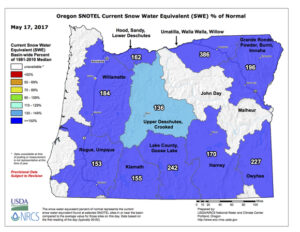
For example, take the water shut-off at Crater Lake.

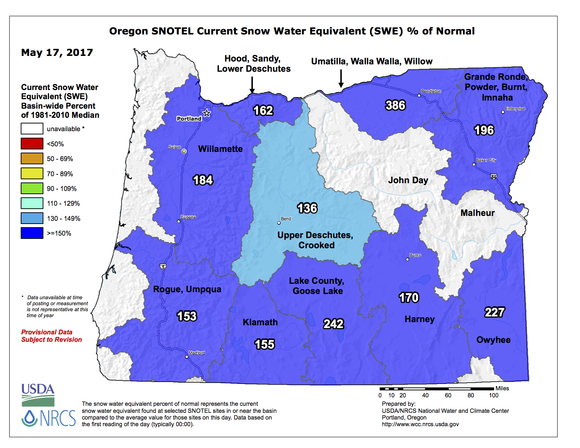
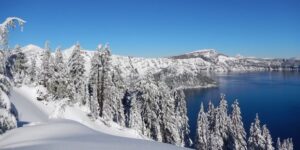
The current snow-level is still between 100 and 120 inches. Parking is difficult due to the piles of snow in the parking lots. The park received more than 570 inches of snow in 2017. Yet, people will be informed that the park is experiencing a water shortage!

Tourists and Oregonians visiting Crater Lake will struggle making sense of the scene at the rim. The lake is beautiful, blue and full, the skyline is magnificent and the air is fresh and clear. However, the Rangers will inform them of the severe water shortage. They will be told to greatly limit their water consumption. The park will instruct our visitors to use non-flush toilets, take short showers, wash camp dishes, dry-brush teeth and clean the kids – all with their own dainty-wipe. Does this make sense?

Everyone is aware that these restricted conditions are due to a Tribal water call which included Annie Creek. Annie Creek, which normally supplies the park’s water, is a tributary of the Wood River and Upper Klamath Lake watershed affected by the call.

A priority call allows a water-right holder who has a senior priority claim to secure his water first. This may require other secondary water-right holders to undergo water volume restrictions or other regulations, so that priority rights can be met. This current call simply doesn’t make logical sense, since current stream-flow volumes are off the charts and there is more water in our rivers, tributaries and reaches than in the past several decades.

Never-the-less, this call, as senseless as it is, leads Crater Lake National Park to find an alternative water source.

The park typically uses about 36,000 gallons a day in May and that use will increase as summer visitation spikes in July and August – Chiloquin to the rescue!

The City of Chiloquin has contracted to pump 2.5 million gallons of water out of their groundwater well, place it into tanker trucks, drive it 40 miles round-trip while traversing several thousand feet of elevation to fill water storage tanks at the park.

The cost of buying water from the city of Chiloquin is nearly $40,000, while the cost of hauling the water will be closer to $400,000 for May & June. The absurdity hits the fan when one realizes that the rivers are flooding, snow is piled high, an existing aquifer is being tapped, millions of acre-feet of water are flowing into the salty Pacific, and the public will probably expend over $1,000,000 to accomplish – nothing

Common-sense is becoming harder and harder to find. Common-sense is getting smothered under the laws, rules, regulations, proceedings, motions, and summaries of the strategies. We will lose ourselves to the villains of this world if we can no longer approach an issue with forthright virtue and honor.

This recent water call is obviously not about common-sense regulation, it is about control.

Regulations are a necessary part of life. Regulation comes from a Latin word meaning rule, i.e., a standard, norm, or law. Regulations govern us from the day of our birth. We are regulated by our physical and mental capabilities, our family life, our parents, our church, our job experiences and much, much more. So, regulation per se, is not bad

However, control is another matter. Control, comes from a French word meaning a register, roll, or catalogue.  This is why the Federal Registry is named as such. It is a giant rulebook of controls and it is constantly growing. Last year it grew by 80,000 pages and the total cost for compliance is in excess of $4 trillion dollars. This would be greater than the GDP of all but four other nations.

Regulatory growth is the unfortunate bureaucratic habit which can destroy the very resource that it tries to protect. It has become an administrative juggernaut of senseless rules for the purposes of control and the gradualistic accumulation of these regulations, combined with our collective loss of common-sense, may be our undoing.

Remember, if we don’t stand for rural Oregon values and common-sense –
No one will

Best Regards,

Dennis Linthicum
Oregon State Senate 28

Gun-Grabbers in Salem or Firearm Safety?

Oregon State Legislature sent this bulletin Thursday, April 13, 2017 by devadmin

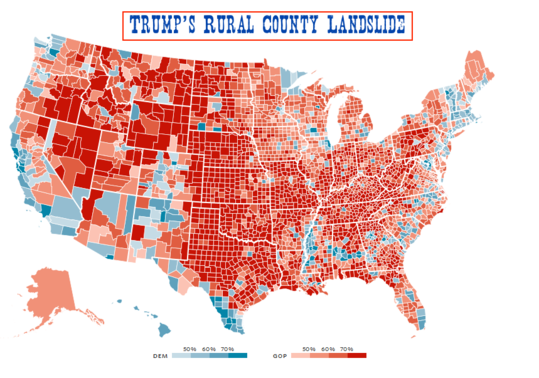
Why did Trump win most of the rural counties across Oregon and the US?

From the map, we can see the election results. Trump won the rural/red counties comprising most of the US and Oregon, while the blue cities went to Hillary, centered in the Northwest around Portland and the Tri-County metro-area. (Click image to enlarge interactive map)

It should be obvious that rural and metro areas are different.

Naturally, the larger populations in the cities means more effort is required in regulating people, traffic and behaviors. But, the nanny-state mentality has had a profoundly negative effect on societal norms. Every little problem gets directed to the state. People don’t solve their own problems rather they rely on someone else to do it – someone from the state. In turn, civic responsibility is weakened while the quality of community and family-life is being eroded.

The rule-makers and societal organizers don’t seem to recognize that one size won’t fit all. The standards have become so detailed, intricate and complex they no longer address universal truth. Instead, they serve special interests. Because of this, those who work in the state’s bureaucracy are giving their all, but the system is not serving the people it is supposed to serve.

This metro/rural divide is bubbling to the surface in my Judiciary Committee. Control is being sought over every-aspect of our lives – cigarettes, wood-stoves, left-lane driving, dogs in the pickup, dogs in the cab, lane-splitting for motorcycles, and our Constitutional Right to Bear Arms.  These proposed laws are said to be “necessary” as safety measures – the safety of our children, family, friends, dogs, cats, animals, insects, trees, and mother earth.

Since “control” is the watchword in the city, it is only natural that our city neighbors believe every person within your sphere of influence requires protection from your firearms. So…

Gun-Grabber Day will be next Monday, April 17

Several bills on Monday will focus on a myriad of issues regarding possession, personal management, buying and selling firearms. If you value your firearms and your 2nd Amendment right to keep and bear arms, then please get involved.

(Click here for Location and Agenda)

Send an email to every Democrat in the House and Senate. Phone every Democrat in the House and Senate. The pro-2nd Amendment Republicans are in the minority and we will need a few Democrats to vote with us in order to stop these bill.

Light up their phones and clog their inboxes with emails, otherwise there is great potential that we will slowly lose our legal protections regarding our Constitutional Rights.

“Necessity is the plea for every infringement of human freedom.
It is argument of tyrants.
It is the creed of slaves.” 
— William Pitt, in the House of Commons – November 18, 1783

Best Regards,

Dennis Linthicum
Oregon State Senate 28