
You Gotta Watch Your Wallet…

Oregon State Legislature sent this bulletin Monday, February 20, 2017 by devadmin

In 1946, Henry Hazlitt wrote a wonderful book, Economics in One Lesson. This small, easy to read book is still widely available and ought to be read and contemplated by all. The reason is simple. Hazlitt uses easy to understand stories to gently eviscerate the public policy mistakes that the know-it-alls and political wonks use to separate taxpayers from their wallets.

Meanwhile, the policy-wonks in Oregon’s majority party are hard at work trying to stuff the Governor’s budget with money straight out of your wallet. They seem to be only looking at this current budget-cycle and not ever contemplating the long-term health of Oregon’s economy, it’s families and businesses.

One example is the crazy idea to put a $1000 tax on any car purchased before 1997. Yikes! There is another idea for a $.05 tax on every wholesale pound of coffee sold. Hearing this, I can imagine that ODOT is trying to re-engineer their GPS milage tracking device to also include a tax on every sip that you enjoy from your Dutch Bros Kicker cup.

Another shameless tactic which is fast spreading throughout Oregon’s counties is using government to provide “affordable housing.” Proponents claim this can be partially accomplished by rent control. This economic fallacy of rent control is continually embraced by pundits, politicians, editorialists, news reporters and academics as a requirement for economic development. HB 2004 is the rent control bill currently making it’s serpentine way through the twisted logic of Salem’s hallways.

Here is a portion of the bill’s contorted control language:

Thomas Sowell wrote, “History alone should be able to tell us what the actual consequences of such laws have been, since they have been around for thousands of years. Anyone who has taken a course in Economics 1 should understand why those consequences have been so different from what their advocates expected. It is not rocket science.”

The advocates make claims like, “this will ensure stable housing for workers,” or “it will stop the landlords from gouging tenants,” and finally, “land-owners should not be making tons of money during a housing crisis.”

In Oregon, the reason there is a lack of affordable housing is there is a lack of housing. This means housing is not being built. Why not? One of the main reasons is  because of existing laws which prevent housing from being built. This is a particular problem in Oregon where designated Urban Growth Boundaries (UGB) are a major component of the zoning, planning and building requirements.

High and unaffordable housing costs are not the problem, they are a symptom. The real problem is a shortage of houses.

I can illustrate this by using an example of an ice cream shop. With low cost ice cream and cheap treats, everyone wants some. If the ice cream supply were limited because of some legal requirement or some unforeseen circumstance then the local ice cream shop would quickly. Some would label this a “shortage.” However, if store owners can raise prices the will slow demand for the product.

Owners don’t do this because they are meanies and they want to gouge ice cream lovers.They do this to slow demand and their stabilize inventories. The higher price makes people think twice, reconsider their resources and/or needs and weigh any options. Just like the housing market, as prices rise, inventories stabilize and more treats are available on the street (or in the freezer.)

The high cost of housing is not something that needs fixing. Rather it is the supply of housing that needs fixing. You know that local housing is in short supply because it is becoming more expensive. When bidding wars break-out among home buyers, as is currently happening, it is a sign of a shortage. This is a not a sign of an outbreak of unbridled greed among wealthy landlords.

Supply and demand is one of the first things taught in introductory economics textbooks and you will find great examples in Hazlitt’s book. If only I could get some folks here in the capital to curl up with Hazlitt’s book, too. Now that would be an accomplishment.


Also, please let your voice be heard with regard to Oregon’s upcoming budget (2017-2019). Without any viable increases in the State’s income, non-critical services will require budget cuts over the next two years. Representatives need to hear whether your wallet is up for grabs, or not.

  • Here is the Full Roadshow schedule.
  • Here is the backgrounder on the current state of the budget, and Co-Chair’s proposed budget framework for 2017-2019.
Session will begin with a Budget Bang! – Part II

Oregon State Legislature sent this bulletin Thursday, February 2, 2017 by devadmin

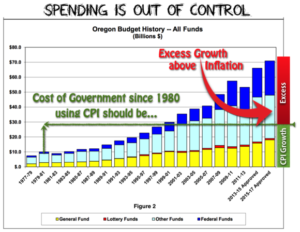
Last weeks article highlighted that the Governor’s released budget had everyone in media gasping for breath because of a $1.7 billion shortfall. Yet, Oregon is expected to receive $1.5B more revenue this biennium than last. That is an increase of 15 thousand million or 1,500,000,000 extra dollars in the state’s coffer.

I pointed out that Oregon’s budget has increased eight-fold since 1980 and then I posed some thoughtful questions:

  • Did our state’s service requirements or population grow by eight-fold?
  • Did your school district attendance grow by eight-fold?
  • Did your own personal salary or wages grow eight-fold since 1980?
  • Did the value of your home grow by eight-fold?

If you are like me, you are probably having trouble identifying anything in our lifetime that has grown as rapidly as government.

This has occurred mainly because we have allowed government to absorb responsibilities that previously belonged to families and individuals. Government has done this quite stealthily.

It starts with people who want to help. They become politicians. Politicians get elected to the legislature. Legislators have a job to do – legislate. Yet, even if the legislature, their committees and constituents propose solutions that sound reasonable, it doesn’t mean the legislation will work reasonably.This is exactly where we are today – Legislators are legislating and government is growing.

Our unique American form of government was designed to protect the rights of the people and ensure their individual freedom. Oregon’s constitution does not provide a mandate to micromanage, interfere and legislate away citizen’s individual choices and freedoms on a daily basis.

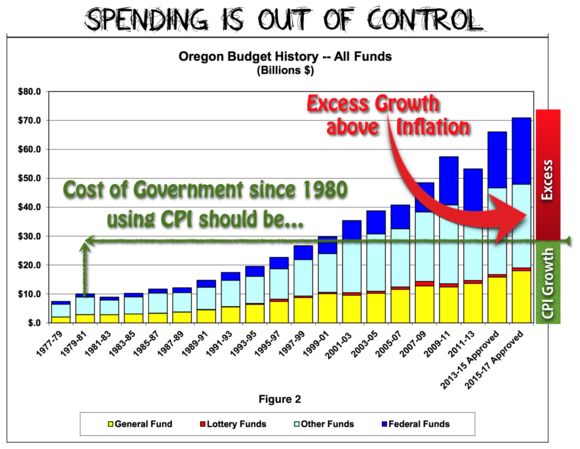
How much would government services cost if we had constrained government by the Bureau of Labor and Statistics – Inflation Calculator?

Using the inflation calculator, for example, $10B in 1980 is the equivalent to $29.1B today (cf., Figure 2). This means $50B dollars of the current $80B budget is in excess of the cost of inflation.

Even accounting for an increase in Oregon’s population which has grown by only a factor of 1.54 since 1980 levels, not an 8X increase, the $29.1B number would only increase by $15B, not $50B.

Again, why is Oregon’s budget pegged at nearly $80B?

Are Oregonians really that much more needy? Do we need that many more state bureaucrats shuffling paper and creating regulations?

The problem rests with the baseline budgeting methodology where after funding our last biennium’s base of operations no one has enough resources available to seek answers to different questions.

There will never be a change to any part of an agency’s inner-workings if the agency will automatically receive the same, or better, for doing the same ol’, same ol’. This is partially why Oregon’s graduation rates stay so abysmally poor – same ol’, same ol’.

ORS 291.210, requires the Legislative Fiscal Office (LFO)  to develop a projected tentative General Fund/Lottery Funds budget for the 2017-19 biennium.  A couple of bullets from that document are below:

  • State personal services growth is projected at 9% for the biennium, including step increases, roll-up of current collective bargaining agreements and management salary packages, health benefit costs, Pension Obligation bond payments, and an increase in the PERS rate.
  • Standard biennial inflation of 3.7% for services and supplies and 4.1% for medical costs.
  • Backfill of 2015-17 one-time funds with General Fund, or fund shifts, that change 
funding sources for programs between the two biennia, total a net $626 million. This is primarily in the Human Services and Education program areas, and includes $328 million related to an increasing state responsibility for Affordable Care Act costs and other federal match changes.

These are all growth items.

We don’t face a revenue problem, we face a problem with government growth and spending. Oregon’s legislature must be willing to address our state’s spending problem and this will mean breaking through factional barriers.

Otherwise, we really are just kicking the can down the road.

We all recognize there is more squeezing that needs to be done in the state’s budget. But, if the Governor has her way, the squeeze is going to happen with our wallets. Oregon’s Governor put forward a budget proposal that is “too expansive.”  As legislators we must be committed to squeezing government, not the hardworking taxpayers wallets.

Please remember–if we do not stand up for rural Oregon values and common-sense, no one will.

Best Regards,

Dennis

Senate District 28

Economic Tsunami

Oregon State Legislature sent this bulletin Wednesday, January 30, 2019 by devadmin

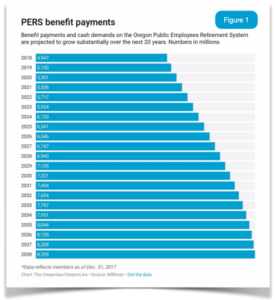
Last year, Oregon’s Public Employee Retirement System (PERS) extracted roughly $1,400,000,000 ($1.4 billion) in contributions from tax-payers to fund state employees’ pension benefit programs. Over that same period, it paid out $4,700,000,000 ($4.7 billion) in pension benefits to state employees. (See Figure 1.)

Any bookie would recognize a lame horse when they saw it. Namely, PERS had a negative cash flow of $3,300,000,000 ($3.3 billion) during that one-year period and the problem is getting worse.

One would think that a negative operating cash flow of this size, shape and demographic velocity would be seen as a bad omen and everyone would be worried. Yet, no serious reforms can even get traction because everyone is bogged down in language about fairness, safety, inclusion and the need to fulfill promises.

Yet when the trestle bridge gets overloaded because everyone wants off the island at the same time, a lot of people will get hurt.

In this environment it’s hard to project the details lying dormant within the blue-sky assumptions undergirding the PERS system. Even more difficult to grasp is the catastrophic potential that these assumptions mask when market events slowdown causing liabilities to balloon.

In a recent Oregonian article, Allen Alley, a past gubernatorial candidate, inventor and technology investor, suggested that policymakers should start looking at the actual cash flowing out of the system. Alley calculates, that the 4.1 million tax-payers will owe $225,000,000,000. ($225B) for state employee retirement benefits over the next three decades.

Although PERS, as an issue, is always present, it is treated like a heavy punching bag in the corner at the gym–it gets ignored. Unfortunately, our governor’s top two policy goals aren’t related to PERS. They are revenue, staff, and policy issues that grow government and eventually worsen the tax-payer burden while ignoring the economic reality barreling straight at all municipal, county and state governments across the US.

All public sector retirement plans, and most private sector plans, carry unheard of levels of unfunded actuarial accrued liabilities (UAAL). The public pension crisis has been intensifying for quite some time and state governments are unwilling to go to the bag. This is mainly because governors, senators, representatives, county commissioners and city council members get elected on “present day promises,” not “future unintended consequences.”

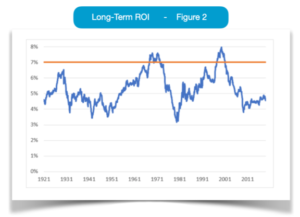
For many years, annual returns for employees and their benefit accounts were pegged at 8-percent per annum. These promises were made during a brief period when that rate seemed  reasonable but would have long-term unintended consequences. Additionally, this return-on-investment (ROI) was guaranteed by tax-payer pickups during years with lower returns.

The folly of this strategy becomes clear in a Bloomberg article, which looked at long-term returns (50-year periods) and noted average returns, for pension-fund-like portfolios, are well below 6-percent and have only generated returns of 7 percent or greater twice since 1871. (See Figure 2.)

The article continues, saying the problem is worse today for two primary reasons: 1) “Cumulative returns are lower than the averages;” 2) “An extended period of bad returns cannot be made up even with astronomical returns later.”

Bloomberg goes on to explain that the compounding of these return projections is the real fly in our collective soup bowl. According to Bloomberg most funds can never keep up with their actuarial demands following a market downturn. The capital lost and the compounding interest required on the remaining capital is too great. This would be true, even if the pension was already fully funded, which Oregon PERS is not. Following market retractions, “there is no chance existing assets are enough to pay already-contracted liabilities.”

The proverbial spilled-soup comes when one realizes that once the base value of assets starts to decline there is no scooping it back up. The shrinking asset base can’t keep up with the demand pressure from the actuarially accrued increases in liabilities. Additionally, as payouts create greater shortfalls, the overall asset base shrinks even more, further inhibiting the fund’s ability to ever get ahead of the curve.

Bloomberg goes so far as to say, “Worrying about the next five decades is pointless, because there’s also no chance the current system will survive long enough to discover what the next 50-year average returns will be.”

This is a truly dire situation created by more than 50 years of unrelenting government growth sanctioned by elected representatives. It is unconscionable to not address this inadequacy when there are thousands of folks who will be negatively affected by this tragedy if we fail to act.

Alley claims that his calculation of $225B doesn’t even account for any new employees coming into the system but focuses only on existing employees. “As a CEO of a company, you think about cash,” he said. “What’s the check I have to write and where’s that money going to come from?”

Rest assured, there are no worries in that quarter… the political majority can easily figure out how to use our slowly deteriorating social contract and government’s misused power of coercion to their own advantage. As the noted 19th-century philosopher Pierre-Joseph Proudhon outlined, the tax-payers can expect to be:

fleeced, exploited, monopolized, squeezed, hoaxed, drilled, registered, counted, taxed, stamped, measured, numbered, assessed, licensed, authorized, admonished, prevented, forbidden, reformed, corrected, punished regulated, enrolled, indoctrinated, preached at, controlled, checked, estimated, valued, censured, repressed, fined, harassed,  judged, condemned, or deported…

Without a momentous shift toward slowing the growth in government our PERS dilemma will only worsen. Additionally, significant and serious modifications to new employee standing is the only mechanism that can begin to stem the potential economic tsunami resulting from a market downturn. Without these changes Oregonians will face far more turmoil than the political elites ever imagined.

Remember, if we don’t stand for rural Oregon values and common sense – No one will!

Dennis Linthicum
Oregon State Senate 28

Session will begin with a Budget Bang! – Part I

Oregon State Legislature sent this bulletin Tuesday, January 24, 2017 by devadmin

Oregon’s Legislative Session starts on February 1st and the biggest topic will certainly be the budget. Gov. Kate Brown released a recommended budget last month that has everyone in media gasping for breath because of a $1.7 billion shortfall.

The governor is quoted as saying, “The budget includes significant cuts at a level I find absolutely unacceptable…”

I agree–the budget proposal is unacceptable.  It is unacceptable because it merely supports the status-quo by presenting ever-growing government, more regulations and increasing taxes as the only reasonable budget expectation.

Yet, Oregon is expected to receive $1.5B more revenue this biennium than last. that is an increase of $1,500 million or $1,500,000,000 extra dollars in the state’s coffer. The story that Oregon has a shortfall is fiction. We have a budget that has grown beyond any semblance of normal.

The budget proposal has been created by assuming that Oregon’s current service levels or baseline of operations should be the standard for next year. The baseline budgeting process starts with current programs intact and then adds cost of living adjustments (COLA) combined with increases in service level goals.

Using “baseline budgeting” ideology as the operating standard doesn’t identify programs  that are inefficient or unnecessary. It also fails to address or support any significant technological choices that might transform the lives of Oregonians. It only instills more of the same for the future. This is not how our future should be planned.

During the governor’s inauguration speech there was a reference to our Oregon Trail heritage. The governor said, “And we now have two modern-day Oregon trails to choose from. One trail is to continue the endless process of slicing and squeezing, of diminishing our hopes and expectations, and shrinking our dreams of what it means to be an Oregonian. The other trail is to follow the advice of Governor McCall.  To not be guided by regionalism and factionalism.”

This is good advise.

Let me wade past the rhetoric and imagine trying to use our illustrious Oregon Trail heritage as the historic baseline mark on the landscape.  Think of the transformative technologies that have occurred. Now, ask yourself which of these modern technologies you would be willing to ignore because you were wed to the old stuff you brought from Missouri. Your Conestoga wagon, for example.

The reason baseline ideology can’t properly assess the potential efficiencies that might be gained through alternatives is because the baseline receives the funding not new ideas.  A requirement when trying to address maximum utilization from limited resources requires flexibility in weighing and ascertaining the value of various approaches.

A more flexible management approach would provide a credible rationale for reallocating resources by focusing on a systematic review and justification of the funding and performance levels in current programs.

However, if this sounds too complicated then let’s just drive our wagon down the well traveled trail of common-sense.

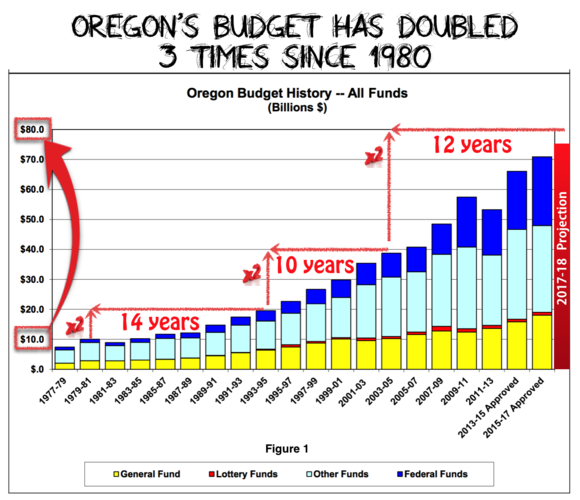
Since 1980, Oregon’s budget requirements have ballooned by eight-fold.  This means it has doubled three times, 2 x 2 x 2 = 8 (cf., Figure 1). In 1980 Oregon’s budget was near $10B and today the budget projection is approaching $80B.

Noticing this eight-fold growth, let’s ask some thoughtful questions:

  • Did our service requirements grow by eight-fold?
  • Did our state’s population grow by eight-fold since 1980?
  • Did your city’s population grow eight-fold?
  • Did your school district attendance grow by eight-fold?
  • Did your own personal salary or wages grow eight-fold since 1980?
  • Did the number of seniors living in your community grow by eight-fold?
  • Does your computer/cell-phone or TV cost eight-fold more than it did in 1980?
  • Did the value of your home grow by eight-fold?
  • Is criminal activity in your neighborhood up eight-fold?

Even if a couple of these questions come out within a reasonable close-call, my question is still valid: Should the cost of government services have risen eight-fold since 1980?

Please remember–if we do not stand up for rural Oregon, no one will.

Best Regards,

– Dennis

Senate District 28

Cultivate Liberty

How was your Independence Day Celebration?

You probably never gave a thought to Hillary’s crimes, the $19 trillion dollar national debt, local unemployment, the unbridled money printing schemes of the Federal Reserve, the bad science and policy oozing from every corner of the federal bureaucracy or whether your conversations were being recorded – Good for you!

Our day was full of fun and festivities. It included family, friends and friends of friends.  Our celebration, like America’s in general, was sidetracked by other details – the parade, decorations, food and drink, who picked up the sparklers, where’s the best fireworks show?

For Diane and I, our attention was also proudly divided between a love of America’s exceptional triumph in Liberty and a joyful celebration our first grandchild’s one-year birthday.

Others of you may have had equally worthy distractions and I caught myself wondering about the future and how I might infuse a realistic dose of Freedom’s requirements into our modern hectic lives.

John Adams wished for the same as he wrote to his wife, Abigail:

“I am apt to believe that it will be celebrated, by succeeding Generations, as the great anniversary Festival. It ought to be commemorated, as the Day of Deliverance by solemn Acts of Devotion to God Almighty. It ought to be solemnized with Pomp and Parade, with Shews, Games, Sports, Guns, Bells, Bonfires and Illuminations from one End of this Continent to the other from this Time forward forever more.”

In this correspondence Adams is referring, interestingly enough, to July 2nd, not July 4th.

Why July 2nd? Adams knew that the real meat of the event happened with Richard Henry Lee’s resolution on July 2nd:

“Resolved, That these United Colonies are, and of right ought to be, free and independent States, that they are absolved from all allegiance to the British Crown, and that all political connection between them and the State of Great Britain is, and ought to be, totally dissolved.”

Even this Resolution was brought to the floor thirty days earlier, on June 7, 1776, for discussion and debate. I will argue that June 7th, July 2nd or July 4th are dates when Liberty rose to take the standard but Liberty had been cultivated in  hearts and minds for centuries.

Bushels of fruit do not magically spring into the marketplace.  Land must be acquired, cleared, prepared, planted, irrigated, nourished and protected. Then the crop has to be harvested, sorted, packaged, and freighted to distribution centers. Now, you might already be dreaming of fresh produce for your upcoming family picnic. However, your market must still put it on display, price it and sell it. Then, and only then, can you tootle over to the market, purchase, prepare, share and enjoy this bounty.

The same is true for our American concepts of Liberty, self-governance, individualism and the consent of the governed. These ideas need a lot of thought, preparation, watering and cultivation to bear fruit.

Unfortunately, we, in modern America, are a little too accustomed to shopping at Costco. Americans expect Liberty to be stocked in a never ending supply of jumbo-sized, shrink-wrapped packages.  “But you must remember, my fellow-citizens, that eternal vigilance by the people is the price of liberty, and that you must pay the price if you wish to secure the blessing.  It behooves you, therefore, to be watchful in your States as well as in the Federal Government.”[1]

Liberty takes effort – a lot of effort. Let us never forget that our Freedom belongs to us.

What are we willing to do today to support our Tree of Liberty? – Clear, till, plant, weed, water, protect or distribute?

“Those who expect to reap the blessings of freedom must, like men,
undergo the fatigue of supporting it.”

–Thomas Paine: The American Crisis, No. 4, 1777


[1]  Andrew Jackson, Farewell Address, March 4, 1837

Sure Guardians of Liberty

Last week, Diane and I joined with hundreds of others to hear KrisAnne Hall in Prineville, OR.
KrisAnne is an attorney and former prosecutor who travels the country teaching the Constitution and the history that gave us our founding documents. She spent all day (in three different meetings and settings) connecting a vast array of historical events and painting a poignant picture. Her presentation did a wonderful job of “connecting the dots.” She used history to powerfully stress the fact that ideas have consequences.

It reminded me of the famous saying, “Every good tree bears good fruit, but the bad tree bears bad fruit.” (Mt. 7:17) And so it is with ideas – good ideas produce good results and bad ideas, bad.

Today, more and more people are wondering about the limits of government because they are challenging the bad ideas that come from big government. This is good news. Our culture needs people who are willing to consider these things.

FDR and his “New Deal” brought the Socialist/Progressive ideas to Main Street America. He promoted a big, fatherly government watching over its citizens, regulating their economic affairs, protecting them from fear, want, and hunger while insuring their “general welfare.” During the Great Depression these ideas sounded promising. However, across America today we see the destructive results of government overreach.

America was built on the solid foundation of constitutionally limited government, individual liberty, and free market economies.

The prevailing sentiment today is overwhelmingly in support of regaining America’s traditional approach to self-governance, family and freedom.

The small minority of people spouting today’s confused claims for socialistic betterment can only do so with other people’s resources and money. This  is where the average person awakens. It always happens when you feel someone’s hands in your own pockets.

Yet, the minority keeps claiming it will be better if we would just let the controllers control us. I disagree. The evidence is in and the results stink.

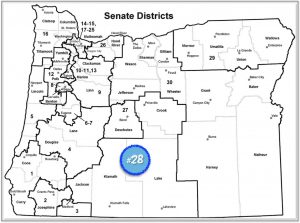
KrisAnne gave one example that particularly hit home, since I am on the campaign trial in Oregon’s 28th Senate District.  She quoted James Madison’s words,

the State Legislatures will jealously and closely watch the operations of this Government, and be able to resist with more effect every assumption of power, than any other power on earth can do;”

It was Madison’s sincere belief that the State Legislatures were “to be sure guardians of the people’s liberty.”

Although quotes like this seem outmoded because they were made 230 years ago they are still relevant and directly applicable.

Take ObamaCare for example. We don’t need to put the House, Senate and Presidency into the hands of Republicans to repeal it because we can void it at our state’s legislature.
The same goes for the recent attempts to destroy the clean energy hydroelectric facilities on the Klamath River. This issue does not rightfully belong to FERC, Senators Merkley, Wyden, Feinstein, or Boxer but rather it belongs to the people of Oregon and California.

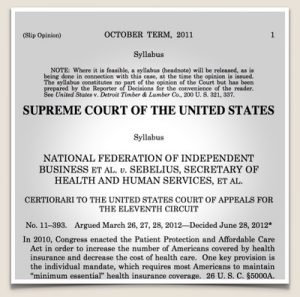
Chief Justice John Roberts told us as much in his opinion for the first ObamaCare Supreme Court challenge – NFIB v. Sebelius. Justice Roberts made it clear and he firmly reiterated the idea that our state governments have the duty to defend the powers they retained under the U.S. Constitution.

Justice Roberts wrote, “In the typical case we look to the States to defend their prerogatives by adopting ‘the simple expedient of not yielding’ to federal blandishments when they do not want to embrace the federal policies as their own.”

Justice Roberts then added , “The States are separate and independent sovereigns. Sometimes they have to act like it.

As your next State Senator, I will be proud to defend Oregon’s prerogatives, while jealously and closely watching for, and resisting, every assumption of power by any agency or body that has not been delegated that authority under our US Constitution. <See more at ElectDennis.com>

Oregon has a way to go, but we will prevail!

My thanks to KrisAnne Hall and all of those across Oregon, and in Prineville, who realize that “We the People” are the solution to Oregon’s problems.

“If once [the people] become inattentive to the public affairs, you and I, and Congress, and Assemblies, judges and governors shall all become wolves.”
– Thomas Jefferson


It’s True – I Did

Last week a local newspaper made note of the fact that I filed as a candidate for Oregon’s Senate District #28. If you haven’t heard the news, it’s true – I did.
The ideals and traditions that have made America great will be the same principles grounding my candidacy. These are the principles for Life, Liberty, and the freedom of our individual pursuits.

Allowing Oregon’s citizens the right to work toward these ideals will be my goal. Pursuing these freedoms will do more to help Oregon than any of the results oozing from progressive legislators.

Several of the future economic deformations headed toward Oregon families are: **

  • more unemployment due to minimum wage increases;
  • increased tax penalty for the working poor who bump up through the state and federal income tax tables (which are not adjusted for inflation);
  • annual increases scheduled for agricultural pumping costs;
  • increases in household electric rates exceeding $190 per year;
  • grid distortions caused by the green energy fleecing of Oregon taxpayers.

Our American traditions are being lambasted, altered and undermined by collectivist ideals. These arbitrary and capricious ideals mask the nature of modern governments.

The history of mankind is filled with stories of oligarchs, tyrants, and dictators. Their arbitrary forms of government have been the general rule. Restrained government is our American exception.

Oregon needs a Rebirth of Liberty – the liberty and spirit that embodied our American Institutions. As Americans, living in Oregon, we can use the elements from our past and return to a system that will protect our future.

These elements are well known. They show themselves in our courts and town halls. They weave through our neighborhoods and blossom in our relationships. They are what remains of our nation’s individualism, voluntarism, constitutionalism, government by law, representative government, limited government, natural rights, moral order, private property, thrift, industry, and competition. Unfortunately, these enduring principles and American traditions have been chased from history.

These principles comprise what our founding fathers meant by their use of the word “liberal.” They meant “liberal” as in “liberated.” They birthed the tradition of representative government, self-governance and individual Liberty. This is the only legitimate replacement for the historical authoritarian tradition.

The Founders did away with the hierarchical political values brought from Europe. Their desire was to start the American form of government on an obvious (but never before tried) idea about dispersed control. They started with equality among people and finished with active consent as government’s limiting boundary.

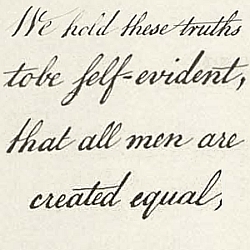
“We hold these truths to be self-evident, that all men are created equal, that they are endowed by their Creator with certain unalienable Rights, that among these are Life, Liberty and the pursuit of Happiness.”

These are not new thoughts. They should be well known to all American’s and anyone who has ever dreamed of coming to America.
Yet, the newspaper I mentioned earlier identifies me as one who is a, “prolific writer with a pretty easy-to-find track record of strong anti-government views.”

They ask their readers, “Is this the right person to become the legislative ‘face’ in Salem?”

What do you think?

  • Do you still admire our Nation’s Founders?
  • Do you believe in Liberty over Security?
  • Do your believe in fighting for your Rights?
  • Are you an “anti-government extremist”?

All of the Founders of our great nation would have been characterized as “anti-government extremists.” I am proud to be associated with such good company. But they were not “anti-government” they were anti-authoritarian. They, in fact, created a historic enterprise; a government that was “a more perfect union.”

They each had a prolific thought-life that has been the admiration of generations. They were not afraid of picking up a quill and scribbling out their ideas. They were so committed to their treason that those who signed declared, “[F]or the support of this Declaration, with a firm reliance on the protection of divine Providence, we mutually pledge to each other our Lives, our Fortunes and our sacred Honor.”

Today’s progressive movement has thrown aside our American tradition in favor of a Utopian dream fulfilled by big government authoritarians. To the dismay of liberty loving patriots all over Oregon, the progressive movement is wielding it’s majority with thoughtless abandon.

Together we must return to the ideals that guided the men & women who fought the tyranny of the ruling power during the late 1700’s. Men like George Washington, Thomas Jefferson, Sam Adams and women like Abigail Adams, Mercy Otis-Warren and Penelope Barker.

My hope is that our generation will provide the catalyst for the Rebirth of Liberty. Join with me and renew your commitment to Oregon and America. Together, we can, “mutually pledge to each other our lives, our fortunes, and our sacred honor.”


** I will explore these bulleted issues over the upcoming weeks…

Government Bias Corrupts

A recent link from Dennis Prager’s, Prager University Instagram account spawned some thoughts that are worth sharing.

In this 10 second teaser, Prager paints government as the rain cloud which provides the water for the land and crops. This quick graphic also shows roots springing up. The implication is that these roots are weeds, or the corrupt entanglements of crony-capitalism, rather than beneficial crops. [See complete video here]

Like the water cycle in our natural world, the rain water coming from Prager’s government cloud originates elsewhere. The question to be asked is, where does this bounty originate?

  • Does it come from only the richest reservoirs?
  • Does it originate from only the largest lakes and salty oceans?
  • Does it evaporate from our yards, lawns and tea-cups?

The rampant socialism flooding through Washington, DC and our state capital (Salem, OR) promotes the idea that only the wealthy will pay the burden. Yet, we all know that while large lakes release enormous volumes of water vapor they also have the capacity to capture equally large volumes of the returning rain.

By comparison your tea-cup doesn’t have much capacity.

The most insidious part of this equation is that while government pretends neutrality, it is always biased. Government is always biased because it is made, “of the people, by the people and for the people.” People are biased–you and I, your senator, your representative, your governor and your president.

This is part of our humanness. We each have our own likes, dislikes, dreams and preferences. We have been gifted with our own natural tendencies, inclinations, skill-sets and wholesome individuality. This is not a bad thing.

This conforms nicely with our Founders love of individual liberty and natural law. They wrote extensively about everyone deserving fair and equal treatment under the law. Their era was filled with robust discussions regarding methods for ensuring equality through public participation and constitutional limits on power and authority.

Our constitutionally federated republic was designed to set people free and to constrain excessive government control.

Without Constitutional constraints on government, we face the naked possibility that “might makes right”.  We can witness this across the US, at every level of municipal, county, state and federal government. The most obvious examples surface in legislation for healthcare, minimum wage, solar and wind energy subsidies, climate change and education.

Former US congressman and budget director for the Reagan administration, David Stockman, insists that economic controls are nothing but a malignant cancer resulting from statist ideology and shameless pursuits for political power.

In Oregon, our raincloud has been loaded with highly combustible energy policies, restrictive gun-control measures and minimum wage boondoggles. Unfortunately, Oregonians will be paying the price for this destructive rain.

How can I make this claim?

It’s easy, follow the money. Look at whose cups are getting filled.

For example, with the minimum-wage, Democrats claim that higher prices and low wages are the two things crushing those earning minimum wage salaries. Do they think raising the minimum wage will lower prices? If prices do rise (to cover the increases in wages) will the poor be exempt from the new higher cost of a burger and fries? Does this solve the cost-of-living conundrum? How many low-wage earners will lose their jobs as businesses strive to control costs?
Additionally, for all the media time spent on social justice and wage-inequality, this legislation makes wage inequality the “Law of the Land.” The progressive voting block, centered in Portland, gets enormous wage increases compared to those elsewhere in the state. Why? What happened to the supposed concern for “equal pay for equal work?”

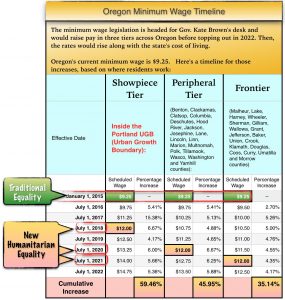
Portlanders, in the Governor’s “Showpiece” Tier will race to a mandated minimum hourly wage of $12.00, by 2018. While the “Peripheral” Oregon Tier will not receive that wage until 2020, and the poor folks on the “Frontier” won’t arrive in Nirvana until 2021.

This is not humanitarian equality, this is nothing but pandering and vote-seeking. Government gets the bounty while the lowest person on the totem-pole gets sacked.

Stockman documents in his book, The Triumph of Politics, “Public policy [is] not a high-minded nor even ideological endeavor, but simply a potpourri of private interests parading in governmental dress.”

Government cannot accomplish what it claims without 1) gathering resources, 2) feeding itself first (with 60% of the resources gathered), and 3), designating a special-interest group for the remainder. Yet, just like the rainfall, the moisture must come from somewhere.

These policies will not help Oregonians. These are gross misrepresentations masked in humanitarian language and masquerading as some glorious fount of governmental blessing.

“The fundamental source of all your errors, sophisms and false reasonings is a total ignorance of the natural rights of mankind. Were you once to become acquainted with these, you could never entertain a thought, that all men are not, by nature, entitled to [equality.]” —Alexander Hamilton, 1775

Recommended Books…


Politically Mandated Punishments

The idea of government in America had a glorious beginning. America’s foundational concept was that men, by right, ought to be free. Self-governance was the goal. Centralized forms of government should be pre-determined and limited. The original 13 colonies developed a compact to serve certain, specified national interests.
The main interest of that federal compact was to secure individual rights. The rights of the individual are foundational, eternal and set the stage for our nation’s premiere document–The Declaration of Independence.

These rights are self-evident endowments from our Creator. They carry enormous weight because all men are created equal. Five unalienable rights are identified:

  • Life,
  • Liberty
  • the Pursuit of Happiness
  • the Right of the People to alter or to abolish a faulty or failed system, and
  • the Right to institute new Government, laying its foundation… in such form, as to …most likely effect their Safety and Happiness.

Our founders weren’t suggesting that governments should be done and undone like disposable diapers. They were aware that mankind is, “more disposed to suffer… than to right themselves by abolishing the forms to which they are accustomed.”

Yet, this is where we find ourselves. We are suffering under the weight of the modern Leviathan, 1)  because we have slowly become accustom to government controls and 2)  because many people profit from the corruption pulsating throughout the system.

Our original American designs have been transmogrified from institutions that were engineered to secure our rights and ensure our freedoms. Now they have become organizations that demand our strictest obedience and compliance with what is acceptable to the so-called “majority.”

This follows the same technique that was used by Lenin in the 1917 Bolshevik Revolution. At the time, in Russia, there were many factions seeking government power and control. One group was the Russian Social Democratic Workers’ Party, which was a Marxist organization. It was a small party and it was split amongst two competing subgroups: the Mensheviks (“minority”) and the Bolsheviks (“majority”).

The Bolsheviks actually represented the “minority” because they were the smaller of the two factions. They successfully acquired the name “majority” after an internal party-wide campaign to acquire the name.

The Bolsheviks represented the small faction led by Lenin. Lenin successfully used this “minority” to organize his violent and revolutionary opposition to the czarist government. They propagandized, campaigned and used violence to spawn factions among the populace and they created enormous divisions across regional boundaries.

Across our nation we can witness, daily, these same destructive tendencies that fomented the minority sponsored Bolshevik revolution. In America, we can see the echo of these progressive redefinitions, where ideas shed their traditional meaning to correspond to the latest populist ideology.
Ten years before the Bolshevik revolution, American author, J. Allen Smith wrote his own progressive redefinition as follows, “True liberty consists not in divesting the government of effective power, but in making it an instrument for the…prompt enforcement of public opinion.”

This redefinition is nothing more than an attempt at spit and polish on the arbitrary chains stemming from some arm of bureaucratic control.

Look at recent events in Oregon.  Have these people been heard, treated fairly, set free or shackled?

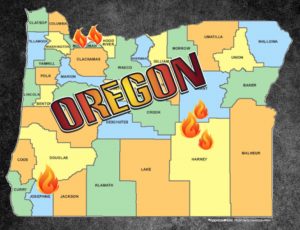
  • the occupiers of the Malhuer Wildlife Refuge, Harney Co.
  • the $400,000 fine and re-sentencing of Dwight and Steve Hammond, Harney Co.
  • the $135,000 fine against Sweet Cakes by Melissa, Multnomah Co.
  • the firing of Harmony Daws, from Sparkling Palaces, for being elected as president of a pro-life group, Multnomah Co.
  • the harassment of Jessica Morton after false charges were made and her innocence proven, Josephine Co.
  • the killing of LaVoy Finicum, Grant Co.

Shackles are shackles and the bigger the government, the bigger the problem.

President Woodrow Wilson was a big government guy. During his presidency he felt that businesses had gotten the upper-hand and that more government interference was needed as a legitimate check. He knew big industrialists who were, “afraid of somebody, are afraid of something. They know that there is a power somewhere so organized, so subtle, so watchful, so interlocked, so complete, so pervasive, that they had better not speak above their breath when they speak in condemnation of it…” This accurately describes the fear that most Americans have of their own government.

Wilson continues in his progressive double-speak and identifies what he helped to successfully engineer:

“We have been dreading all along the time when the combined power of high finance would be [combined with] the power of the government….We have come to be one of the worst ruled, one of the most completely controlled and dominated, governments in the civilized world–-no longer a government of free opinion, no longer a government by conviction and the vote of the majority, but a government by the opinion and duress of small groups of dominant men.” – — President Wilson, 1913  [edit added]

Political power means leveraging the government machinery for purposes of control. Political control allows for politically mandated punishments but this has nothing to do with justice. This is why we have not seen any mainstream media outrage at the $135,000 fine levied against Sweet Cakes by Melissa. After all, it was “legally” assessed by an official bureaucrat. This means bureaucrats throughout the system “possess far more power over people than could be justified by any social contract–unless people are presumed to have implicitly contracted for their own destruction.”*


* Bovard, James, Freedom In Chains: The Rise of the State and the Demise of the Citizen, (St. Martin’s Press, New York, 1999) p. 211


Recommended Books…


A Warning to the West

[vc_row][vc_column][vc_custom_heading text=”The Gulag”][vc_column_text]In, The Gulag Archipelago, Aleksandr Solzhenitsyn recounts his first-hand experiences  of life under the iron fist of a 20th Century government. His story records the thoroughly modernized tactics of a small, centralized group of  authoritarians whose goal was total control of its own citizens. As Solzhenitsyn describes the lay of the land, we see it isn’t only about calling for tanks, guns and ground troops but it also included the bureaucratic masses. As his story progresses, the bureaucratic regulators turn out to be some of the most unprincipled and perfidious weapons.

Under the leadership of Joseph Stalin, the administrative system of the state was enriched with resources and empowered with the facade of legality. The result was a multi-tentacled Russian monster that grew from its simple task of administrative enforcement to a full-fledged police state complete with surveillance and population management.

American Similarities

The political similarities embedded in our own nation’s growing surveillance state cannot be missed. Common-place  jurisdictional overreach, strangling regulatory regimes and unrelenting administrative takings all bear witness to unbalanced authoritarian rule.

Solzhenitsyn discloses one illustration of the supreme accuser, or Prosecutor General, who,  “had the right to intervene in any judicial proceeding.” He characterizes the nature of this office as having the power to “pardon[s] and punish[es], at its own discretion without any limitation, whatever.”

This invokes a chilling reflection of the recent re-sentencing that Dwight and Steven Hammond received. A jury of the Hammond’s peers in Harney County, suggested reducing the original minimum sentencing requirement. The judge, the defense and prosecution teams were all convinced that a reduced sentence was justified.

Federal Judge Hogan, also in Harney Co., explained that sentencing the Hammonds to the mandatory minimum, “would shock the conscience.” He further thought that it would violate the constitutional prohibition against cruel and unusual punishment, because five years behind bars is “grossly disproportionate to the severity of the offenses here.” In fact, both “the judge and jury found the fire had arguably increased the value of the land for grazing.”

Then, why the re-sentencing? Maybe, there is a “supreme accuser,” or someone who can fix the problem posed by a jury who supported individuals over bureaucrats.

The “Fixer”

Small details like needing a “fixer” can be arranged with a quick phone call because our Congress has so thoroughly debauched the Constitutional standards that were created for our protection.

On Oct. 7, President Obama appointed a new U.S Attorney for the State of Oregon, based in Portland, 300 miles from Harney County, Ms. Amanda Marshall. Although she had no experience with the federal system, she showed the gumption necessary to accomplish the goal. It was her duty to use the color of law as a disguise for politically motivated appellate action, calling Judge Hogan’s punishments “unlawful.”

Notice, the claim wasn’t that the sentence was “unjust,”  “inappropriate” or “inequitable.” The local community understood the true relevancy of any monetary damages and they knew government intrusions when they occurred. The Hammond’s peers proved best at harmonizing the defendant’s acceptance of responsibility, criminality, and/or misconduct. This is why our US Constitution requires, “The Trial of all Crimes … shall be by Jury.” Local community sentencing provides for truly just criminal punishment, criminal deterrence, and rehabilitation.

So, the “unlawful” nature of the penalties simply means that the Hammonds were not yet crushed. Solzhenitsyn reminds us, the “meat grinder of political interrogation” was designed too crush – body and soul. Over and over, the law is used to demonstrate that the defendant is wrong – in his views, his conduct, his life, and his relationships.

Solzhenitsyn forges a perspective where, “the engine room of the law,” spews out a “scrunched- up wad”  that was once a man. The goal was, “To crush him once and for all and to cut him off from all others, once and for all.”

Now you have some insight into why the Bundys and so many good hearted Americans are in Harney Co. They are fighting the unconstitutional use of administrative law. Law, which by nature, ensures the illegitimate power of the federal bureaucracy.

U.S Attorney, Amanda Marshall has shown us her allegiance. Her allegiance isn’t to securing our liberty, our rights, or our communities protection and justice. Her allegiance is to power and power alone.

Unfortunately, there are thousands in the regulatory state who serve the naked interests of an all-powerful bureaucracy. These warped statist ideas slowly alienate every American, regardless of one’s race, gender, religion, country-of-origin or walk-of-life. This includes people across the political spectrum, both the left and the right, because absurd regulations negatively impact everyone.

Unless “we the, still free, people” step forward and challenge the illegal power that pretends legitimacy, it will continue to metastasize and thereby destroy our freedoms. Thomas Jefferson fought against this authoritarian tendency throughout his life. He wrote, “To take a single step beyond the boundaries thus specially drawn around the powers of Congress, is to take possession of a boundless field of power…”
This boundless enrichment by the ruling class was why our founders established the strict separation of power, the Bill of Rights, and our Representative from of consensual government.

Rev. Samuel Williams, summarized it well, in 1774:

“In a despotic government, the only principle by which the tyrant is to move the whole machine … is fear, by the servile dread of his power.”

The men and women in Harney County are standing together with those who oppose administrative tyranny. They are standing for our founder’s vision where men have inalienable rights and governments are instituted among Men, deriving their just powers from the consent of the governed.

Recommended Books…


[/vc_column_text][/vc_column][/vc_row]