Who is Your Nanny?

Oregon State Legislature sent this bulletin Wednesday, april 6, 2019, by devadmin

Legislatures all across the nation are now besieging their citizenry with innumerable laws, regulations and rules designed to bring full fruition to Roosevelt’s 1941 “freedom from want, and freedom from fear” congressional address.

Senate Bill 754 is known as the “Vaping and Tobacco Ban” measure. It was , and it sounds fairly simple. It increases the minimum age from 18 to 21 years for the legal purchase of tobacco, nicotine and vaping products.

I think the legislature gave it’s best shot at offering 18 to 21-year old adults an entirely new freedom – “freedom from responsibility.”

Oregon’s statists see an enormous political opportunity. Like Franklin D. Roosevelt, it must tickle their fancy to dream about growing the state as they create a new, formerly unrecognized class of constituents. The new group will be a bevy of individuals who formerly were law-abiding citizens but will soon become law-breakers in need of ever-more services.

The nanny-state will squeeze another three years of control over a group which they deem in need of protection. If we read between the lines, the nanny-staters are hoping this “freedom from responsibility” will enable more state intervention for many years to come.

The claim is that this legislation is needed because these adults aren’t capable of making their own choices. Or, maybe, it is needed because evil shop-owners are “in it for the money” and should be fined for burdening future taxpayers with unsustainable healthcare costs.

The latest science purports that those with brains under 21-years old are not running at full capacity. Apparently this immature state of the human brain will be seriously harmed by exposure to nicotine and therefore the state needs to jump in to protect these defenseless creatures.

The questions are, 1) can these adults make decisions for themselves? or, 2) can we relieve them from responsibility and assign blame elsewhere?

Socialism demands that less than 21-year-olds aren’t capable of good decision-making, they therefore need state-intervention. Socialism also demands that businessmen and businesswomen be held accountable as greedy capitalists.

Even in this legislation, the only legislated answer takes place in penalizing  businesses. The small business will be forced to wear a crown of thorns made up of various fines, penalties, enhanced regulatory efforts and more stringent control over their enterprise for daring to fill a market demand for tobacco products.

The bill imposes a $50 fine on the poor clerk who makes a mistake of selling this new contraband to a minor. Then, there is a simultaneous fine of $250 for the manager on his clerks’s first flub. The manager’s fine goes up to $500 on the next mistaken sale. The clerk will continually get knocked about with the $50 fine for each and every occurrence. Additionally, the store owner, will get a $500 fine for the clerk’s first mistake along with the manager’s $250 fine and then the fine jumps to $1,000 for the owner, while the manager is fined his $500 and the clerk is fined $50 again.

Clearly, shop owners are smart enough to ensure this won’t happen. At least not in any traceable amounts. Why not? because, if caught, the fines are so stiff. Perfect right?

No!

There are somewhere between 16,000 – 18,000 Oregonians that are currently between the ages of 12 and 21 who have self identified as smokers. Two questions, 1) Where are the 12 -18 year olds currently getting their illicit smokes? 2) How does raising the legal smoking age to 21 change the reality that 12-18 year olds can currently acquire cigarettes while being “underage”?

We all know the answer. They will simply buy them from their 21 year old contraband dealer rather than their former 18 year old supplier.

I’m all in favor of drawing a line but the line ought to be a red-line and it ought to meet consistency requirements for soliciting universal acceptance of what adulthood means. The people targeted by this legislation can vote, go to war, bear children, abort children and go through sex-change operations all while under the age of twenty-one. I’m not advocating for any of these things but these highlight the inconsistencies that the legislature has created.

Additionally, I would argue that the long-term medical costs and consequences from each of the above named activities is every bit as serious as the long-term cost of care associated with tobacco usage.

It is hard to imagine how Oregon’s youth will ever mature into responsible adulthood when the legislature is continually stripping them of key facets of their autonomy. After all, when does an adult exercise good judgment? Does it really happen the day following their twenty-first birthday?

I believe the real issue is one of human dignity.

  • What does it mean to be free?
  • What does it mean to guide one’s own future, to be responsible for one’s own choices and actions?
  • Will these new-found criminal offenses make Oregon a healthier, happier, more prosperous place for raising our families? 

Every time the nanny-state intrudes into the middle of our families, then our individual liberty and personal responsibility is diminished. The gradual accumulation of small, seemingly insignificant legislated tyrannies will destroy the very foundation upon which our free republic was built.

This is not new. The history of the world is rich with similar circumstances spanning all periods of human history. In fact, here in America John Adams warned the colonialists about the potential danger arising from seemingly legitimate Parliamentary actions. He wrote, “Be not intimidated… nor suffer yourselves to be wheedled out of your liberties by any pretense of politeness, delicacy, or decency. These, as they are often used, are but three different names for hypocrisy, chicanery and cowardice.”

Best Regards,

Dennis Linthicum
OR State Senate 28

Who Grants Our Rights?

Oregon State Legislature sent this bulletin Wednesday, April 4, 2018 by devadmin

A well regulated Militia, being necessary to the security of a free State,              the right of the people to keep and bear Arms, shall not be infringed.”

It has been well over a week since the “March for Our Lives” organizers staged an impressive protest back east. Social media antagonists and pundits are all quite impressed with what they pulled off because of the scale and the speed of its orchestration. The speakers, microphones, TV cameras, staging and bus transportation to and from the event make it obvious that this was more than a gathering pulled off by high-school students. This protest was clearly staged for the media and was not an organic grass-roots movement.

That Washington, D.C. rally was pulled off by progressive, well-heeled elites who have captured the minds of young people. In Saul Alinsky’s playbook, Rules for Radicals, Alinsky notes, “there are no rules for revolution,” meaning anything goes. However, at the heart of the agenda to capture idealistic and disenchanted young people, I see extremely corrosive tactics being used against individuals.

What we are witnessing is an ideological revolution. The main speakers continually called for the elimination of some of our nation’s constitutional guarantees. However, those guarantees, unbeknownst to the uninformed, are aimed at telling Congress what government can and can’t do. These are the rights that, “shall not be infringed.”

Throughout the Bill of Rights, certain congressional actions are prohibited while the rights and freedoms of the people are held whole and intact. We can see this in the language of several amendments where phrases, such as: “Congress shall make no law”, rights “shall not be infringed”, and certain rights are “reserved to the States respectively, or to the people.” By implication, this means that the God-given rights of the people will always remain intact, while congressional power can be, and is, appropriately limited.

This constitutional methodology was designed to check, balance and limit government power while allowing ordered liberty to reign among the people. Interestingly, the Constitution was a compact among the states which was ratified by the individual states, themselves. It was not put into place by a massive election campaign across the original colonies. This means a popular vote across the nation can’t undo it, either.

As the Constitution was crafted by the Founders, it was not designed to sustain a strong national government, nor a heavily centralized power or national authority. Rather, these rules were written to guide future generations in their duty to “secure the blessings of Liberty,” ensuring that no one would be above the law and everyone is subject to all laws, equally.

To accomplish this, the central government was given a list of enumerated powers. In Federalist No. 45, Madison, known as the Father of the Constitution, added more details:

“The powers delegated by the proposed Constitution to the federal government are few and defined. Those which are to remain in the State governments are numerous and indefinite. The former will be exercised principally on external objects, as war, peace, negotiation, and foreign commerce; with which last the power of taxation will, for the most part, be connected. The powers reserved to the several states will extend to all the objects which, in the ordinary course of affairs, concern the lives, liberties, and properties of the people, and the internal order, improvement and prosperity of the State.”

This last sentence is the one that most state gun-grabbers quote with glee. Some mistakenly believe that this means that their state governments can be manipulated to outlaw guns out of concern for the affairs and lives of their constituents.

This is not entirely true. Remember, God-given rights always remain in effect; they can’t be taken away by the majority, the legislature, the courts, or the mob. Restraints on government, both federal and state, must come from elsewhere.

It is essential to have an understanding of where our rights originate and where government authority, power and jurisdiction ends. We will never be able to defend our rights or labor for the return of lost rights if we do not know who granted those rights in the first place.

Our modern state is trying to assert ownership over all people, all concerns and all environments. Many Oregonian’s now realize that these formulations lack any reference to transcendent moral standards. It turns out that these new jurisdictional demands are simply the preferences made by those currently in power. If these laws are not grounded in eternal or transcendent moral value, then these laws will simply perpetuate injustice.

In fact, a transcendent moral understanding is what gives power to the only coherent argument against slavery.

Slavery is wrong, regardless of how many voters might vote in favor of slavery. If there were a national ballot measure seeking a pro-slavery initiative, it could never be right, or legal, regardless of the voting majority’s opinion. There would be no need to submit the measure to the Supreme Court attesting to the unconstitutional nature of the measure. It would be wrong because man has no authority over the laws of God which tells us that every human being carries infinite worth and value.

In closing, all of our God-given rights carry natural limitations. These limitations are not set by government power, authority, or by a vote of the people. These limitations are defined by the boundaries of natural law given to us outside of government power.

As Samuel West said in 1776, “The highest state of liberty subjects us to the law of nature and the government of God. The most perfect freedom consists in obeying the dictates of right reason and submitting to natural law.”

Our right to keep and bear arms does not give any person the right to violate any other person’s God-given right to life or liberty. Nor does the right to keep and bear arms allow one person to violate the private property rights of another person. These checks, balances and limitations are built into the structure of every right by natural law. Individuals each carry these rights as inherent and absolute rights.

As Jefferson told us,

“God who gave us life gave us liberty. Can the liberties of a nation be secure when we have removed a conviction that these liberties are the gift of God? Indeed, I tremble for my country when I reflect that God is just, that his justice cannot sleep forever.”

Remember, if we don’t stand for rural Oregon values and common-sense, No one will.

Senator Dennis Linthicum signature

Dennis Linthicum
Oregon State Senate 28

Land of Liberty?

Oregon State Legislature sent this bulletin Monday, April 1, 2019 by devadmin

Every perceived problem seems to get a new law drafted. The state tries to mandate solutions to even the smallest problems. Yet, their solutions rarely work as intended.

People aren’t allowed to solve their own problems they are forced to depend on the state’s bureaucratic experts. In turn, the individual is diminished, while the state is emboldened. Civic responsibility is weakened, and the quality of community and family-life is eroded.

C.S. Lewis noted in his preface to the Screwtape Letters, that we,

live in the Managerial Age, in a world of ‘Admin.’ The greatest evil is not now done in those sordid ‘dens of crime’ that Dickens loved to paint. …  it is conceived and ordered (moved, seconded, carried, and minuted) in clean, carpeted, warmed and well-lighted offices, by quiet men with white collars and cut fingernails and smooth-shaven cheeks who do not need to raise their voices.”

Lewis goes on to describe how his symbolism pictured, “an official society held together entirely by fear and greed.”  In essence, fear of the government’s regulations (and its regulators), with their ever-growing threats of fines and/or imprisonment causes people to be protective, suspicious and secretive. After all, who can know what traps have been set?

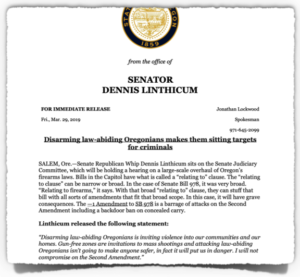
In the Senate Judiciary Committee, on April 2, a slew of anti-Second Amendment proposals is scheduled for public hearing.  These proposals are trumpeted as “necessary” for “safety”, but we all know that’s a ruse. In this case, the forty-four-page amendment to SB 978 is an full-scale barrage against the Second Amendment including a backdoor ban on concealed carry.

This law violates the inalienable right of all Oregonians to defend themselves and their families. Disarming law-abiding citizens is inviting violence into our communities and our homes. Gun-free zones are invitations to mass shootings and attacking law-abiding Oregonians isn’t going to make anyone safer. In fact, it will put us in danger. I will not compromise on the Second Amendment.

SB 978, on Tuesday, April 2nd, will focus on a myriad of issues regarding possession, personal firearm management, and the buying, storing and selling of firearms. If you value your firearms and your Second Amendment right to keep and bear arms, then please get involved.

(Click here for Location and Agenda)

Send an email to every Democrat in the House and Senate. Phone every Democrat in the House and Senate. The pro-Second Amendment Republicans are in the minority and we will need a few Democrats to vote with us in order to stop these bills. Light up their phones and clog their inboxes with emails, otherwise there is great potential that we will slowly lose our legal protections regarding our Constitutional Rights.

Necessity is the plea for every infringement of human freedom.

It is the argument of tyrants.

It is the creed of slaves.

— William Pitt, in the House of Commons – November 18, 1783

Remember, if we don’t stand for rural Oregon values and Common-sense – 
No one Will.

Best Regards,

Dennis Linthicum
Oregon State Senate 28

Top-notch Deception

Oregon State Legislature sent this bulletin Tuesday, March 21, 2017 by devadmin
If a Democrat House member gets his way, the Oregon Water Resources Department (OWRD) will load stiff economic, land and water management problems right into the lap of Oregon’s farmers, ranchers, cattle and dairymen.

All water right holders will find themselves in a swamp-like slough of muddy ground composed of fees, regulatory efforts and exceedingly stiff fines – up to $500 per day. All of these water bills (HB2705, HB2706, HB2707) enlarge government efforts through needless regulation and direct intervention in land and water use.

The happy story masking each of these bills is beneficence, but they really promote a future that is nothing-less-than a government controlled Utopian vision.

Look at the language in HB2705, the Legislative Assembly declares that:

“(a) Water use data is a fundamental tool to ensure efficient management, ensure effective water distribution and help plan for future water needs; and (b) The measurement and reporting of water use benefits all water appropriators and is critical to the effective management of the water resources of this state.”
There is nothing, necessarily, wrong with any of these statements, but the question remains, who will be controlling, cataloging, regulating and managing? And finally, who will be benefiting and how?

All of these things sound perfectly wondrous, so let’s continue reading. The next section of HB2705 shines some light on the details. It reads:

“It is the policy of this state to: (a) Actively promote measurement and reporting of water use by water appropriators; and (b) Encourage federal, state and local government coordination and cooperation in providing financial support to water appropriators for water use measurement and reporting.”
This is top-notch deception.

The phrase “to promote” would not mean “to force”, would it?

That is what the bill requires – force. Why doesn’t the legislation inform the public of this fact? In all honesty the text should read, “(a) Actively force measurement and reporting of water use by water appropriators,” because that is what it does.

Additionally, in the next sub-section, the phrase “encouraging” is nothing but legislative live-bait to make this design sound helpful. There are no details about funding, or financial support anywhere in this bill. It only shows up in the preamble to assure stakeholders that OWRD could be reasonable.

Over the years, Americans, and particularly Oregonians, have been slowly acclimated to similar Utopian visions. We have been led to believe that by some government action this improvement could be made; or by some government sponsored innovation this would be better, or with these regulations some version of effective management could be accomplished.

We are continually told that with some commission, study, or with a little more data the government could improve the conditions of your life, nursery, farm or ranching operation. Over the years these socialist policies have been universally painted with glorious sounding titles – a Square Deal, a New Freedom, a New Deal, a Fair Deal, a New Frontier, and a Great Society.

Now, we are being led to believe that government will “ensure efficient management, ensure effective water distribution and help plan for future water needs.” That language is directly from HB2705.

The truth is, this government entity knows what it doesn’t know. The plan is to force you into providing it. The state doesn’t have any intimate knowledge of your farm, ranch, or agricultural operation and therefore, they can’t easily control or regulate it. But, they hope to control and regulate you.

HB 2705 will force you to provide them with the necessary details and the Water Resources Commission will set the rules which you will be required to follow.

The user or water appropriator does all of the work and bears all of the costs. Remember, in legislative legalese, the word “shall” means “must.” The text reads:

SECTION 3:

(1) A water appropriator shall…

(2) A water appropriator shall…

SECTION 4:

(1) A water appropriator shall…

(2) A water appropriator shall…

However, OWRD is responsible for one thing – issuing fines:

“SECTION 5. The Water Resources Department may assess a civil penalty for violation of section 3 or 4 of this 2017 Act, not to exceed $500. For a continuing violation, each day the violation continues is a separate violation.”
Welcome to OWRD’s vision for your Utopian future…

It should be obvious that these bills were crafted without the critical engagement of impacted water users and stakeholders. These bills don’t offer any benefits to Oregon or the typical water user in my District.

These bills will impose significant costs on already struggling farm, ranch and ag families and the collected monies are not allocated toward meaningful areas of need.

What to do…

I urge water right holders to e-Mail, write, or call, each member of the House Energy & Environment Committee to share their thoughts and suggestions.

The best way to make an impact is to attend the hearing in-person:

March 22nd, 2017 – Wednesday
Hearing Room-D, at 3:00 p.m.
Salem Capital Building
900 Court St. NE
Salem, OR 97301
It is important that you send your statements to each member of the committee. Also, please send your statement to the committee, as an official part of the record. Written, or e-Mailed testimony must be submitted prior to the hearing. Please state at the top whether you are for or against the bills and share your reasons why.

Rep. Reschke serves on the House Energy & Environment committee and has stated his opposition to these bills. Please notify his office if you are planning to attend.

Copies of these bills can be found on the Oregon Legislative Information System (OLIS) at these links:

HB2705
HB2706
HB2707
Please join me in opposition to these bills. They will be heard this Wednesday, March 22, 2017, in the House. These bills may move to the Senate following their House hearing. If you happen to read this article after the March 22, 2017 meeting, please write to your Senator to voice your opinion on these burdensome bills.

If we don’t stand for rural Oregon values and common-sense – No one will…

State Senator Dennis Linthicum

District 28

The More Numerous the Laws…

Oregon State Legislature sent this bulletin Wednesday, March 21, 2018 by devadmin

As I travel, meet and talk with my constituents in Senate District 28 several items always come to the top of our discussion lists. Most people express continued concern for a standard litany of issues: the degradation of our traditional American culture; the need for fewer regulations and obstacles for business; freer markets with fewer tariffs; and a return to our American constitutional roots.

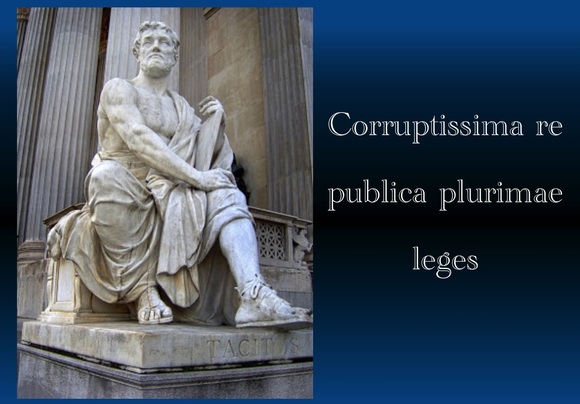
Stop and think for a minute. People want more freedom, smaller government, lower taxes and yet every year the legislature meets and passes hundreds of new laws. Why do we need all of these laws? An Ancient Roman Senator and historian, Tacitus, made the claim, “The more numerous the laws, the more corrupt the state.”

I think he understood humanity’s fallen nature correctly.

The 2018 legislative “short-session” scuttled perfectly legitimate efforts aimed at reigning in Oregon’s governmental enterprise. Bipartisanship became the media watchword while the Democratic leadership silently pursued their own progressive political agenda. For those of us in South, Central and Eastern Oregon, this is just a glimpse of what will happen in 2019 if there are no substantial changes in Oregon’s House, Senate or Executive offices.

This well-orchestrated short session circumvented attempts at meaningful change. It also sandbagged citizens by limiting their participation in condensed committee schedules. Therefore, substantial policy issues were forced through without transparency or the time necessary to pursue alternative solutions. Despite these challenges, I and my Senate Republican colleagues effectively stopped numerous hyper-partisan, tax and spend boondoggles from becoming law in 2018.

In particular, two bills which I adamantly opposed were HB 4001 and SB 1507. These two Cap and Trade bills were only used for political posturing and represent the worst of the Democrat’s agenda. They both have insurmountable problems. First, they would burden taxpayers with a minimum of $700 million dollars in extra taxes, annually. Second, neither would make a discernible difference in global greenhouse gas emissions.

Additionally, without any Republican support, the Democrat majority passed SB 1528, which will create a whopping 30% tax increase on Oregon’s sole proprietors, small and family owned businesses and LLC’s.  This partisan tax scheme will force 192,000 small businesses to pay $258 million in 2018 taxes while protecting large multinational corporations who are able to game the system.

Another bill which I supported, HB 4016, never made it out of committee. Environmental groups and tribal interests spoke against this straight-forward and common-sense fix for the Klamath Irrigation District (KID). This bill would have allowed temporary transfers within the KID district boundaries to other land within their boundary.  In KID these place of use changes would have allowed the district to remedy original mapping and boundary errors without exceeding the water right in the original claim.

As I have written in the past, I was a Chief Sponsor of HB 4005 which passed. This bill is intended to help grapple with the high costs of prescription drugs and the harm that patients and consumers experience by exposing the details behind cost increases for pharmaceutical products. This bill only requires reporting for drugs costing more than $100 per month that increase by more than 10% on an annual basis.

I sponsored HB 4100 which also passed. This bill enforces property rights for facilities that provide equine therapy or counseling activities in areas zoned for exclusive farm use (EFU). This will allow specific therapeutic service providers to continue utilizing our abundant natural resources, domesticated livestock and nonclinical rural environments for creating healthy, wholesome and meaningful interactions for their clients.

Another common-sense bill which I sponsored was HB 4008. It passed, making calculations of projected future earnings based on race or ethnicity of a plaintiff inadmissible. Since, we believe that all people carry enormous potential and are each endowed by our creator with certain inalienable rights, it seems only logical that any civil calculations for projected future earnings reflect those beliefs.

I sponsored and supported HB 4036, which passed. This bill allows home-schooled and public charter school students to participate in various types of interscholastic activities, including sports, band, choir and technical education programs. School Districts can determine the costs and may charge participating students within limits  set by the bill.

My deep appreciation for the lessons of history and the dangers of unconstrained government, will continue to inform my perspective. Only a constitutionally limited government can enable its citizens to reach their fullest potential by defending them against the bureaucracies’ perpetual tendency toward fiscal irresponsibility.

Oregon’s unrelenting drift toward collectivism will eventually swallow us, our families and our businesses without liberty-minded citizen’s and leaders standing up for our individual freedom. Legislators need to be constantly reminded of the ancient words from Tacitus, “The more corrupt the state, the more numerous the laws.”

Best Regards,

Dennis Linthicum
Oregon State Senate 28

Positively Diabolical

Oregon State Legislature sent this bulletin Thursday, March 9, 2017 by devadmin
Last summer I re-read C.S. Lewis’ novel, The Screwtape Letters. I am in Salem, for the state legislative session, and I am haunted by an image from that work.

The Screwtape novel is a satirical fantasy which places characters in plot-settings that mimic a typical human life, complete with all its temptations and failings.

The book has a unique format. The story is revealed through a series of written letters rather than the typical first-hand personal interactions which occupy most novels. The letters and notes which flow back and forth between the various parties reveal the heart and soul of Lewis’ main characters. The principal correspondent is Uncle Screwtape, He is a Senior Tempter and serves as the Undersecretary of his department in what Lewis envisages as a sort of infernal and devilish Civil Service.

Screwtape’s letters are posited as advice for his young nephew, Wormwood. Wormwood is a devil-in-training. He is a cohort, if you will, charged with the misguidance of only one man, or patient, as he is known in these instructional posts from the underworld

I would encourage you to find some time to read it. I think you’ll find Lewis’ story and style refreshing and his insight into human nature spot on. (Even though Lewis published this story in 1942.)

One of the more affecting descriptions of this novel comes from Lewis, himself. In Lewis’ original preface, he tells us of a humorous anecdote where a country clergyman had written saying that “much of the advice given in these letters seemed… positively diabolical.

And, it is.

Lewis continues with his introduction to this story by describing his sentiments and his purposeful use of certain symbols for Hell. I’ll note, also, that Lewis confesses to us that he likes bats better than bureaucrats. This sets the stage, for us, where his symbols make for ripe pickings when describing the growing legalese twisting through the marbled corridors of Oregon’s capital.

Lewis writes:

“We live in the Managerial Age, in a world of ‘Admin.’ The greatest evil is not now done in those sordid ‘dens of crime’ that Dickens loved to paint.

“It is not done even in concentration camps and labour camps. In those we see its final result.

“But it is conceived and ordered (moved, seconded, carried, and minuted) in clean, carpeted, warmed, and well-lighted offices, by quiet men with white collars and cut fingernails and smooth-shaven cheeks who do not need to raise their voice.

“Hence, naturally enough, my symbol for Hell is something like the bureaucracy of a police state or the offices of a thoroughly nasty business con­cern.

In our lifetimes, we have made drastic policy reversals while striving to advance the seemingly more tolerant positions. Look at health care. Big changes are under-foot in how our culture views health care. Many of today’s policies are incoherent when compared with our age-old ideals that have been codified in law and medicine.

For example, you know the Hippocratic oath by it’s simplicity – ”First do no harm.” Yet, ever since government, through political self-will, has gained control of our lives by leveraging the healthcare industry for power, control and profit, it has become rare to hear the common-sense understanding of the age-old Hippocratic school.

The Hippocratic oath is simple and easy to understand. In the 1800 and 1900’s the latin phrase for this oath was popularly nuanced as, “I will utterly reject harm and mischief.” In modern parlance the tweet-able phrase has two tenants, 1) always help, and, 2) never harm.

But our modern culture has become flooded with a new, yet all-too-common, sort of sterile, bureaucratic tyranny. That combined with the complexities of modern law, and the desire to draw bright-lines around specific situations distorts our clear view of the underlying moral concepts.

One example of that distortion recently came across my desk while reviewing the 2017 Senate Bill, SB 494. Read the irony in the current statute, ORS 127.505, Sec. 9, §(8),

–– “Health care” means diagnosis, treatment or care of disease, injury and congenital or degenerative conditions, including the use, maintenance, withdrawal or withholding of life-sustaining procedures and the use, maintenance, withdrawal or withholding of artificially administered nutrition and hydration.

Given this definition, “health care” can mean either treating and caring for a patient, or it can mean withholding nutrition from a patient. In other words, in one breadth we are saying that starving and dehydrating a patient is recognized as “health care.”

Truly, this language was, “conceived and ordered (moved, seconded, carried, and minuted) in clean, carpeted, warmed, and well-lighted offices, by quiet men with white collars and cut fingernails and smooth-shaven cheeks who do not need to raise their voice.” The men and women who dreamed this up had thoroughly blanched hearts hidden beneath their suits, ties, and starched-shirts.

As I understand political theory, human flourishing should be considered as a first principled and a primary aim. Only a well-ordered political community and a well-educated citizenry can achieve that aim. This, then, requires virtuous citizens and virtuous leaders. Without these two foundational supports we will never be able to achieve the liberty we seek, nor the human flourishing we long for.

If we don’t stand for rural Oregon values and common-sense –– No one will.

The Ever-expanding Universe of Laws

Oregon State Legislature sent this bulletin Wednesday, February 8, 2017 by devadmin


 “There ought to be a law…” 

Have you every seen something silly or ridiculous and muttered to yourself, “There ought to be a law?”

You and I might say, “There ought to be a law?”  when we see something that we think is ironic, unexpected, or just plain nuts. But, most of the time we realize that people have the freedom to make their own personal choices, even if the house color that they happen to choose isn’t our own favorite color.

Fundamentally, we are each faced with living, and cooperating, in a world with thousands of choices. We must be willing to allow others the same opportunity for free and independent action, unless an individual’s freedom impinges on someone else’s freedom or their personal property.

This is probably easiest to understand in the sense of property. I’m free to purchase and drive my car under obedience to the rules of the road. These rules have been established over time to create what I call “Ordered Liberty.” It is ordered so that there is a smooth  and safe flow of traffic. I have the freedom to go where I wish, when I wish, and the only constraint is that I pay attention to others, allowing them equal freedom while all of us follow the rules.

This may sound like common-sense, and it is, but things quickly go haywire when the legislature gets a little too cocky for our own good. You see, we send men and women to Oregon’s Senate and House and we call them legislators.

As legislators, they feel their job consists of being able to legislate, i.e. to make laws. So, when they get to Salem, what do they do.

They do their jobs, they legislate…

I think this has turned out to be detrimental to Oregon and it’s citizenry.

Why do I think that?

Because we have so many laws and so many regulations that no one can keep track, except the bureaucrats who are payed for their rule making efforts. They also write the enforcement measures, discover the appropriate fee schedule, determine the stiffness of the fines and/or penalties they adjudicate any grievances to determine whether or not they have done their jobs correctly.

Jefferson noted this danger, even during our nation’s earliest years. He said, “An elective despotism was not the government we fought for…”  He continues, describing the nature of a truly free and representative government by adding that it would be one, “in which the powers of government should be so divided and balanced among general bodies… as that no one could transcend their legal limits without being effectually checked and restrained by the others.”

Oregon’s legislature is so busy making new laws, that there isn’t time to focus on the principles of good governance or self-governance.

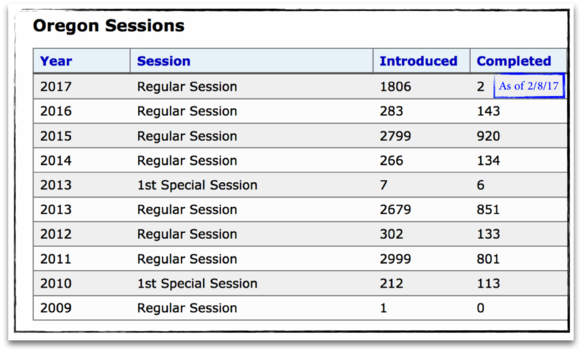
To date, in the 2017 session, the Legislature has introduced 1,806 measures.

Just how many laws do Oregonians need to ensure that their liberty is protected?

This growth essentially represents the problem with government – that is, it has an uncanny, but natural propensity for growth. It turns out it is worse than germs growing in a lab petri-dish. It is really more akin to our ever-expanding universe.

The American astronomer, Edwin Hubble, discovered in 1929 that the distant galaxies were moving away from our Milky Way system. His observation was generalized into a universal law, known as Hubble’s law, where science can measure the speed and rate of expansion of the universe by observing a redshift in light emanating from distant objects.

It appears our government is experiencing this same natural redshift tendency. It even follows Jefferson’s pattern where the black-ink on our budgetary pages experiences a natural shift towards red. Jefferson described the process, where there is a consistent multiplication of public offices, increases in expenses beyond income, and the growth and entailment of a public debt. This is exactly the path set forth by the governor’s budget.

Additionally, the numbers above only represent the number of acts or measures, not the number of pages within the bill. Some of these bills are short while others are several hundred pages in length. The real impact on law-abiding citizens includes not only these laws but also the administrative costs for creating and enforcing subsequent rules and regulations.

For each of these laws, the bureaucracy creates and writes the regulations and then formulates the rules regarding fines, punishments and enforcement measures. These rules and stipulations might span several thousand more details all spelled out in mind-numbing legalese.

It turns out Oregon doesn’t need any more Legislation. We need some de-Legislators who will lesson the burdens placed on Oregon’s businesses, families and individuals.

Please remember –– if we do not stand up for rural Oregon and common-sense, – no one will.

What’s up for the 2018 Session?

Oregon State Legislature sent this bulletin Thursday, January 25, 2018 by devadmin

Here’s a look-see…

PERS unfunded liabilities are looming ever larger, high-school graduation rates, OHA budget over-runs, carbon emission debates, over-spending tendencies, school choice, criminal incarceration rates, marijuana problems and the opioid epidemic.

Additionally, we will be dealing with Clean Air Oregon, Carbon Cap and Trade, a potential constitutional referendum on unanimous juries, electric rate-payer protection, pharmaceutical drug transparency act and a limit on late-term abortions.

Myself and my fellow Legislators have got our work cut-out for us.

Aside from these and other issues, the Senate President added me to two new committees. Additionally, the Governor appointed me to a Special Task Force dealing with the rash of Opioid deaths by overdose.

Opioid overdoses plague rural and urban communities, alike.

Opioids such as morphine and fentanyl are the preferred clinical treatments for moderate to severe pain because of their strong analgesic (pain-relieving) properties. Effective pain management is one of the greatest challenges of modern medicine.

The increases in opioid deaths highlights the need for safer analgesics. Opioids, typically, cause death from respiratory depression induced by an overdose.

It is estimated that more than 100,000 adults suffer from chronic pain in the United States alone, and that this costs up to $635 billion per year in medical treatment and lost workforce productivity. The most commonly used drugs for pain management can have numerous side effects. For example, some cause cardiovascular complications, gastrointestinal bleeding, and renal disease.

Aside from these medicinal side-effects, opioids are extremely addictive. Opioids, both prescription and illicit, are the main driver of drug overdose deaths. Opioids were involved in 42,249 deaths in 2016, and opioid overdose deaths were five times higher in 2016 than 1999.

Oregon’s own statistics mirror the national averages. In Oregon, the opioid overdose death rate in 1999, was 2.1 persons per 100,000, while in 2016 the rate was 11.9 persons per 100,000. However, Oregon is at the high-end of the scale with regard to opioid prescriptions. There are 82.2 – 95 opioid prescriptions for every 100 people in Oregon.

A dedicated coalition is needed among the medical and pharmaceutical industries. Prescribers will need to focus on accurate data collection of distribution systems and product tracking to curb opioid abuse. Over the long-term, researchers are ever-hopeful for scientific breakthroughs in academic and pharmaceutical research for the treatment of chronic pain.

More items for investigation will be Oregon’s mandatory minimums on controlled substances, our prison and incarceration systems, local community-based re-habilitation efforts, staffing and budgetary requirements for state and local law enforcement.

Incarceration rates mandated by Oregon’s sentencing guidelines costs taxpayers hundreds of millions annually.

The biggest single problem with the system, as it is engineered today, is that it costs too much and is largely ineffective because the incarcerated individuals are rarely rehabilitated.

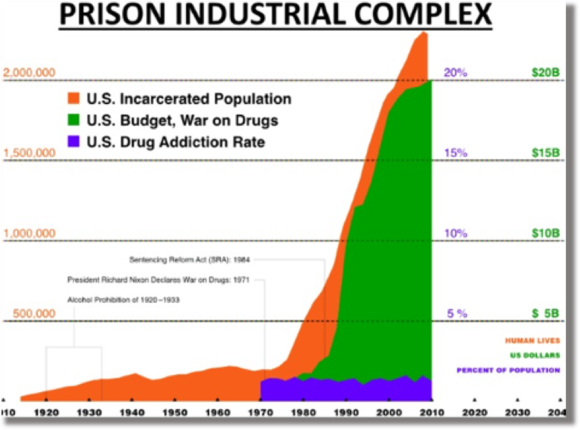
Here is a graphic summarizing what we see for all 50 states. (I will try to acquire Oregon specific data for next time.)

As shown in the chart above, drug addiction rates in the US (purple area/scale) are essentially unchanged from the time the War on Drugs was launched by Richard Nixon in 1972. Back then it was somewhere between 1-2% of the adult population. Today, it remains nearly the same, after 50 years of following the same formula.

Meanwhile the budgetary requirements for the nationwide system, including public safety, corrections, parole and probation has soared from a reasonable amount (green area/scale) to $20 billion in 2010 and $32 billion in the most recent year (FY 2017).

At the same time, the US prison population has exploded from 400,000 to more than 2.3 million (orange area/scale).

The current system knows no boundaries and is the perfect tax and spend machine. The licit and illicit drug industries continue to harness the power of the market by supplying drugs that are no longer scarce but remain extremely valuable and extremely dangerous.

The results are broken homes, damaged lives, homelessness and a rash of opioid over-dose deaths.

So, we clearly have our work cut-out for us.

“No government at any level, or at any price, can afford, on the crime side, the police necessary to assure our safety unless the overwhelming majority of us are guided by an inner, personal code of morality. And you will not get that inner, personal code of morality unless children are brought up in a family – a family that gives them the affection they seek, that makes them feel they belong, that guides them to the future, and that will build continuity in future generations. . . . the greatest inequality today is not inequality of wealth or income. It is the inequality between the child brought up in a loving, supportive family and one who has been denied that birthright.”

                                                                – Lady Margaret Thatcher, from her speech,                                      “The Moral Challenges for the Next Century,” March 5, 1996.


Remember, if we don’t stand for rural-Oregon values and common sense – No one will!

Best Regards,

Dennis Linthicum
Oregon State Senate 28

Gunsmoke and Mirrors

Oregon State Legislature sent this bulletin Tuesday, January 22, 2019 by devadmin

After the recent elections, the Democrat Party has a “super” majority in both of Oregon’s Legislative chambers. They also own the Governor’s office. This means they have a 60% majority in the legislature and can pass any tax or spending increases without pesky Republicans getting in the way.

While their goals may appear noble, admirable or desirable since they defy logic, science, and fiscal rectitude they cannot provide Oregonians with a viable future. They can only lead to a larger, more rapacious state government. Nevertheless, the majority appears willing to use a gunsmoke and mirrors campaign to mask attacks on our Constitutional rights while promoting their own Utopian agenda.

They desire a world where wealth and prosperity are abundantly available and evenly distributed. But nothing in the universe is equally distributed; not height, weight, melanin, academic abilities, artistic aptitude, creative genius or mechanical inclinations.

Today’s Utopians want free universal healthcare but keep driving the costs higher and higher while the care gets worse and worse. They want low-cost or free college education for today’s students who will end up paying for it tomorrow. They also promise jobs galore and high-tech employment for everyone, yet the market has no way to efficiently respond to this temporary, abnormal and artificial flood of competing job-seekers.

At the heart of the matter is an age-old collectivist vision delivered by government control. If you think I’ve gone overboard, read what the Utopian Robert Owen wrote in 1816:

Society may be formed so as to exist without crime, without poverty, with health greatly improved, with little, if any misery, and with intelligence and happiness increased a hundredfold; and no obstacle whatsoever intervenes at this moment except ignorance to prevent such a state of society from becoming universal.1

The reason Utopian dreams don’t work in the real world is because they don’t account for scarcity, human resourcefulness, compassion or commerce.

Human-beings are our only true source of wealth.

Wealth does not come from our state’s untapped natural resources or from state government. It does not come from our rivers, forests or land. These things become productive resources only through the innovation, creativity and genius of working people. Without the rich contributions of hard-working Oregonians, we would never have had lumber, crops, beef, concrete, wine, milk or cheese.

Only men and women can supply the creative genius to turn natural resources into usable goods that improve the well-being, quality and health in our lives. This means however, that Oregon must be willing to allow people to create and keep the rewards that flow from their voluntary engagement in the free-market system. Confiscating the fruits of a person’s labor will naturally remove their desire for work.

While this may sound like common-sense, I fear our governor has missed this point. The Democratic-socialist party’s legislative agenda includes enormous disincentives for productive labor, capital formation and investment.

History tells us that increasing a tax, like the “sin taxes” on inhalant products, cigars and cigarettes will decrease their consumption. Yet, no one asks what might happen to the productive industries for malt beverages and wine when taxes are applied to those products. Also, imposing higher taxes on personal, corporate, and out-of-state income will decrease the activities that produced that income, not the other way around. The same negative consequences will impact our transportation industries as higher boating fees, aviation, diesel, and gasoline fuel taxes are bandied about.

Lastly, increasing our property taxes is supposedly the price we have to pay to live in Oregon.

What’s left to tax or regulate out of existence? Ohh, yeah, …  our 2nd Amendment rights! The gunsmoke and mirrors gang is just getting started.

Their propaganda message is, “Oregon’s children are only safe in gun-free zones.” In other words, your home must become a gun-free zone. However, we know that gun control laws only work for law-abiding citizens, which by default means only law-breakers and criminals will own firearms.

Guns are not the biggest problem which citizens, and/or children, face with regard to their lives, health and safety. Have you seen the statistics for opioid overdoses or automobile fatalities? Recently, economist Antony Davies and political scientist James R. Harrigan, reported that Americans are artificially tied up in knots over violent crime—particularly crimes committed with “assault weapons.”

They note, “This concern, statistically speaking, is fairly irrational. You are far more likely to be killed by being beaten or stabbed than you are to be killed by any kind of rifle, ‘assault’ or otherwise.” Their timely podcast goes through the actual numbers, here.

Liberty and respect for the individual demands that we act in the interest of the individual – not in the interest of the state.

If we don’t stand for rural Oregon values and common-sense – No one will!

Best Regards,

Dennis Linthicum
Oregon State Senate 28

Saving Thousands of Millions

Oregon State Legislature sent this bulletin Tuesday, January 1, 2019 by devadmin

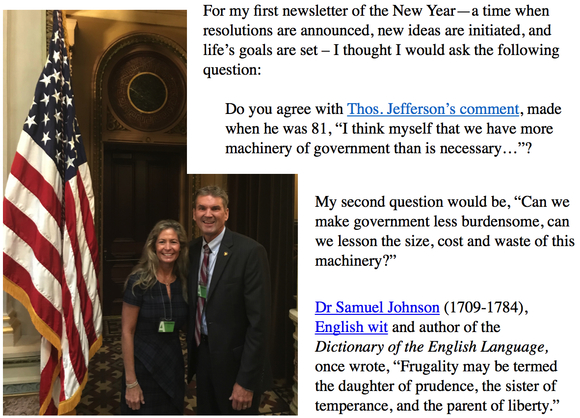
Johnson continued, “He that is extravagant will quickly become poor, and poverty will enforce dependence and invite corruption.”

Frugality, in the dictionary, is simply economy. For the individual this means exercising prudent techniques for saving so that resources are not wasted but used judiciously to serve the most appropriate hierarchy of needs without needing to beg or borrow.

For our state, the definition would apply; except, the sources of revenue would no longer be classified as voluntary contributions (begging or borrowing) but would become forced contributions through taxation and debt-bonding.

Likewise, the state that is extravagant or wasteful will quickly impoverish itself and its citizens. Additionally, in their poverty, the citizens will be forced into dependence and the state will experience corruption throughout its domain.

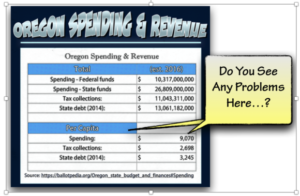
Let’s look at some numbers. During the 2015-17 biennium, Oregon’s Department of Administrative Services (DAS) processed nearly $8 billion worth of procurement services. That’s big money! That is 8,000 million dollars’ worth of goods and services. Wow! Especially when you consider that Oregon only has 4.1 million residents.

That’s right! Oregon spent 8,000 million dollars on 4.1 million people. That’s just under $2,000 of stuff for every man, women and child of every category, background, country of origin, make or model.  That’s just stuff; the total outlay for all goods, services, salaries, wages and benefits came to about $9,100 in 2016, on a per capita basis.

On the other-side of the accounting ledger Oregon only collected $2,700 in taxes on a per capita basis. This is what any normal person would call living beyond one’s means. The federal printing press barely helps reduce our overall shortfall, even though that contribution is an amazing 30% of all state revenue.

Recently, the Secretary of State’s (SOS) office auditors found Oregon missed opportunities to save 5 percent to 20 percent of the state’s procurement budget. That means Oregon missed the opportunity to save 1,600 million dollars ($1.6B) on state purchases.

The audit reveals that Oregon’s current procurement systems lack the information necessary for procurement specialists to effectively evaluate spending with regard to possible opportunities for cost savings.

Understandably, the DAS specialists buy lots of stuff for many disparate agencies. They purchase for Capital Finance and Facilities, Fleet Services, Operations and Maintenance, Building Security, Custodial, Landscape, Repair and Maintenance, Planning and Construction Management, IT, Real Estate Services, Interiors, Leasing, Land transactions, Surplus Property, and Enterprise Goods & Services.

This extraordinary range of goods and services crosses multiple agency boundaries and the state’s procurement services could be effectively streamlined if there existed a single data-store for this information. The audit found that of the $8 billion spent in procurements in 2015-17, the state only has purchase-level data for about 12.5% of the transactions, or roughly $1 billion.

What about the source level information on the other 87.5% of the state level procurements reviewed by the auditors? Obviously, the auditors found this to be subpar.

SOS Dennis Richardson’s office suggested that the statewide implementation of an eProcurement system should be implemented and would provide the additional data needed to perform a full spending analysis. It is no surprise that understanding the capital cost of an asset, including its full-life cycle costs – maintenance, operating and disposal costs, along with supplier bidding and contract opportunities could result in hundreds of millions in potential savings.

After reading this audit report, several small-government proponents in Oregon State Legislature called for swift procurement changes. Sen. Kim Thatcher (R-Keizer), issued a press-release stating, “the state needs to modernize its 1990s-era system. Oregon could have saved $1.6 billion had it previously implemented the system, meaning if Oregon succeeds in implementing OregonBuys ahead of the next biennium, the state could prevent the need for any new taxes being pushed to fill a supposed budget gap.”

Rep. Bill Post (R-Keizer), echoed those thoughts, “Had the system been previously implemented in the last biennium, it could have potentially saved billions of taxpayer dollars.”

My own statement was, “We should not be raising taxes until the government’s procurement system is fixed. Some in the partisan supermajority seem to view Oregonians as ATMs rather than constituents.”

Obviously, taking people’s hard-earned money away from their families and communities, only to push loads of cash into a broken vending machine of a government, is not only senseless, it is immoral. As a legislator, I have a duty to my constituents, and I will continue to be a strong voice for government accountability and change this upcoming session.

In an era of rising taxpayer dissatisfaction, higher expectations and rapidly changing economic conditions, high-performance sourcing, procurement, and supply chain management services are crucial to our state.

Our state’s ungainly combination of legacy systems, spreadsheets, email, and yellow sticky-notes has burdened taxpayers with unnecessary costs. Many of these problems can be relieved with advanced digital technologies for sourcing and procurement. The lack of technological integration and automation in our state is a legacy built over the past 30 years. It is time for leadership so that we can make Oregon great again.

It’s time for Governor Kate Brown to trim expenses, reduce unnecessary burdens and pursue budgetary and tax moderations. These steps would empower Oregon’s citizens to live within their means while enjoying the abundance that comes from the sweat of their own brow, the strength of their hands and the creativity and innovation of their minds.

Remember, if we don’t stand for rural Oregon values and common-sense, no one will!

Best Regards,

Dennis Linthicum
Oregon State Senate 28