Short Session Swindle

Oregon State Legislature sent this bulletin Thursday, January 9, 2020 by devadmin

A recent Wall Street Journal book-review, When the Earth Had Two Moons, by Erik Asphaug, starts with,

“If you visited the surface of the Earth 4.5 billion years ago, you wouldn’t recognize it. The newly formed planet was still cooling from its recent coagulation. There was a hot rocky surface (probably; we don’t know for sure), volcanoes (again, probably) and a steamy atmosphere (maybe). It seems unlikely that even the smallest thing resembling life was yet present, though, really, we don’t know. … We can be forgiven for not knowing what the surface of the Earth was like before this moment, as nothing survived that day intact.”

The reviewer’s thoughts are remarkable because, 1) there is a frank admission of uncertainty and 2) there is a profound recognition that our planet is always changing.

This WSJ book-review affirms my argument that the anthropogenic global warming (AGW) crowd and the tax and spend proposals we see cascading through various legislatures have put too much weight into stasis. The environmental balance that we witness today will not be the balance of tomorrow. The T. Rex and Mastodon are proof of that. It is one thing to recognize that the barred owl is a more successful survivor than the spotted owl but does this warrant shot-gunning the former to preserve the latter? This policy is not rational or scientific, it is a moral argument that demands an appropriate moral response.

Scientists have extensive knowledge of the Earth’s most recent 4,000-year period of glacial expansion and retreat. Historical references to the Little Ice Age and the Medieval Warming Period, are quite robust. Documentation particularly notes the improvement in mortality rates, farming, horticulture, livestock management, population growth and cultural achievements across most known cultures during the warmer periods of human history.

If this is fact, then why the political clamor? Why does the public at large expect the state, or federal government, to control or dictate the best type of energy that should be available? All our choices – nuclear, ethanol, diesel, low-octane rotaries, natural gas, fuel oil, solar, wind – all have drawbacks and benefits. Why not let the market decide?

Government mandates are blunt force instruments that shrewdly coerce compliance through costly fines, penalties and taxes without having the bandwidth to assess alternative technologies and innovative approaches that might solve our problems. Unlike the private sector, government is not an ingenious inventor. Economic data suggests that government is too costly, too inefficient and bureaucratic while being prone to corruption, misdirection and fraud.

The results seen on the street rarely match the political hype. Missed targets and cost overruns abound while with every election cycle the public gets promised newer, bigger, grander and longer-term, yet, more costly and unsustainable programs.

I would prefer an approach which more closely resembles the paradox witnessed throughout world history. A situation where free people enjoy the rewards of their hard work and where disseminated freedom leads to increased human well-being, societal growth and creative problem solving. Free people are creative people.

So, why the relentless drive to force Oregonians into a new proposal for a look-alike HB2020 Cap and Trade Carbon Management scheme? I am convinced it is nothing more than scare-mongering in order to tax Oregonians. It is nothing more than a cleverly worded grab and run, tax and spend, swindle.

The proposed legislation will grow the state, empower the political elites, raise taxes and redistribute the wealth of the most productive without even slightly impacting worldwide carbon emissions.

If you think I’m out on limb, look at this map with regard to existing, planned and currently under construction, coal-fired electrical production facilities and ask yourself, “Given the world’s population demographics, will taxing Oregon families and businesses impact the behavior of the heaviest carbon polluters?” Can Oregon’s population make up for emissions from expansive fires in California, Russia, or Australia, or, volcanic activity through-out the world?
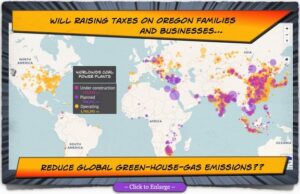
Clearly, no.

The Democrat super majority should have asked this same question when they outlawed plastic straws and single-use plastic bags, “will it make a difference or is it just a costly hassle?”

People and their personal choices can make big differences. Personal responsibility and stewardship are the appropriate tools for each of us to use in our personal and public lives. I’m not making the claim that everything is peachy, and people aren’t wasteful or thoughtless when it comes to environmental concerns. Instead, I’m making the claim that government mandates never represent a balanced, efficient or rational choice due to the conflicting interests that guide public policy.

For example, I can remember when paper bags were outlawed to “save the trees.” The legislated solution was a floppy, thin, shapeless, “single-use” bag that never had any groceries in it by the time you got home because they were strewn about the car.

These constantly changing perspectives on right, wrong and which bag is the correct bag, shows that government policy can be irrational. Politicians make decisions based on limited knowledge with biased information. Paper bags were banned because legislators believed the environmentalist rhetoric about diminishing forests. Now there is a new emergency because people have been so diligent in following the law and not using paper.

Yet, the real solution would have been to allow free choice in the marketplace. Some folks would have used paper, others plastic, some would tend toward variations on recycled products while clever stewards would have developed the inexpensive reusable bag two decades sooner. Was it helpful to force people to use nothing but plastic only to berate them and force a nickel charge for buying the next version of the correct bag?

Yet, reality does not appear to inform the super majority. Free market solutions are lost to AGW fanaticism, as though state power is the only goal. Thus, we see the ‘politicizing’ all areas of our lives and society. Success hinges on being able to implement all-encompassing and ever-more complex social experiments where results become difficult to recognize and evaluate.

Additionally, the true societal costs are never properly accounted for as profound economic and community distortions, dislocations, and malinvestments pile onto the balance sheets of families and businesses.

The Climate Policy office holders will not be the people’s representatives as they will be appointed by the Governor and represent the statists’ interests, instead. They will have near universal control over Oregon businesses through rulemaking, unlimited taxing authority, penalty assessments, discretionary enforcement and other extensive economic burdens that will never make headlines. Oregonians know better, as we’ve seen unfettered giveaways and compliance incentives before, like the $1.2 billion Business Energy Tax Credit (BETC) scandal.

The super majority continually reaches for near-tyrannical mandates that are wasteful and extremely expensive to Oregonians without ever accomplishing any measurable goals. Therefore, I will do everything in my power to stop any HB2020 look-alike  which will subvert our individual liberty and bankrupt businesses, whether small or large, in the metro area, or in the rural heartland of Oregon.

Remember, if we don’t stand for rural Oregon values and common-sense, no one will!
Dennis Linthicum
Oregon State Senate 28

Only 9,000?

Oregon State Legislature sent this bulletin sunday, april 1, 2019 by devadmin

Last week Governor Kate Brown pulled a PR stunt by asking for a special legislative session. The Governor’s press release expressed her desire to clean-up Oregon’s adaptation of a pass-through law by including only the smallest of Oregon’s small businesses.

The Governor’s statement is cleverly worded to make it sound like she will be stepping up to rescue small businesses, and sole proprietorships. Her claim is that a simple fix would give these businesses access to the same tax breaks afforded larger businesses.

The Governor said, “We have an obvious inequity in Oregon’s tax system that is prejudiced against thousands of small Oregon businesses, and a simple change can fix it. I’m simply not willing to let these main street businesses — entrepreneurs, mom and pops, and start-ups — go through another tax year with unfair tax treatment as compared to their larger competitors.”

Doesn’t this message sound grand, generous and legitimate?

The Governor can apparently conquer inequity, solve the Democrat Majority’s long-standing prejudice for extracting taxes from hard-working Oregonians and provide well-deserved tax relief.

Hoooooray!

The governor’s statement continues by bragging this will help, “an estimated 9,000 sole proprietorships [who] could qualify and use this new opportunity to reinvest more of their profits into their businesses and employees.”

Only 9,000? Who are we kidding?

Recall, Oregon’s tax gulag recently imprisoned 192,000 of Oregon’s small businesses (mom and pop operations, sole-proprietorships, and “Schedule-C” filers) through Senate Bill 1528.

“Schedule-C” filers represent self-employed owners of small businesses who utilize the Form 1040 (Schedule C). This is the form used by businesses to complete income tax information for the federal government.

More importantly, this form is also known as “Profit or Loss from Business” and it documents exactly what the State of Oregon is interested in – your profits. Oregon is rapacious when it comes to scraping the last morsels off the plates of their small-business inmates.

The Oregon Department of Revenue estimated that SB 1528 would deny 192,000 “Schedule-C” filers their eligible for a 20% reduction on their Oregon income taxes. Although these businesses would qualify under federal tax-law they become trapped in an environment where it would be legal, except it’s not. This is exactly what SB 1528 from the 2018 legislative session was designed to do. It was engineered to disconnect Oregon’s tax code from Trump’s recent federal tax relief efforts.

With an effective state tax rate of 7.7%, these hardworking Oregonians already pay a higher tax rate than large Oregon C-corporations. In my view, SB 1528 represents the Democrat Majority’s official assault against small business owners and operators.

Here is another item that you may not realize: all revenue bills are constitutionally obligated to originate in Oregon’s House of Representatives. House bills are numbered with an HB prefix while Senate bills carry the SB prefix. Obviously, SB 1528, is a bill for generating tax revenue which started, unconstitutionally, in the Senate.

Additionally, raising revenue or increasing taxes requires a two-thirds majority to pass. SB 1528 passed by a simple majority without a single Republican vote.

The increased taxes on these 192,000 small businesses will be nearly 40 percent of the estimated $258 million in increased tax revenue pinched during the 2018 session. That means nearly $103 million will not be available for those local and family owned businesses to reinvest in their enterprises. That will be money that is no longer available for employees, benefits, or business expansion. For the young family running a small, sole-proprietorship, it could mean bread, milk and cheese which can no longer be afforded.

It seems that the language about solving the state’s tax-inequities quickly evaporates like green-house-gas emissions right into the night sky when we realize that this is  $103 million which will no longer be spent in our local communities but funneled into Salem’s grimy machinery.

Meanwhile, large multinational corporations will be allowed to hustle the system with special tax credits. Oregon’s inequitable tax-program allows its highest income earners to buy tax credits to offset their tax liability. This means that wealthy Oregonians will enjoy these tax savings at the expense of the small business owner who can’t afford to purchase these credits, let alone a box of Mac ’n’ Cheese for the kids.

In the typical fashion of the classic redistributionist, this scheme transfers general fund dollars to Oregon’s top 1% income earners while stealing federally allowed tax deductions from mom and pop businesses.

High-income investors have the financial resources and the means to lobby for these quirky tax rules. They can arrange to successfully game the tax system by using their Democrat allies who support complex giveaways hidden beneath layers of statist bureaucracy.

Gov. Brown could have exercised her leadership skills with a veto of SB 1528, but instead, she signed it into law. Typically, Oregon would copy federal tax breaks for businesses into state law. However, this year’s federal tax breaks have Trump’s signature all over them. In response, Gov. Brown reminded us once again why capitalist prosperity in America is so dangerously imperiled as she built her own version of a wall preventing Oregonians from accessing legitimate tax benefits.

Why? Because the Governor is on the ballot this November. The Governor’s claim that there is an “obvious inequity in Oregon’s tax system that is prejudiced against thousands of small Oregon businesses” will sell. It’s true. There is great inequity.

However, setting a mere 9,000 filers free does not make up for marshalling the other 183,000 tax-payers into Oregon’s scheme for preventing access to the Trumpian tax-breaks.

What gets missed is that the Democrat majority used unconstitutional and illegal means to create the initial problem and the Governor signed this into law. Despite claims about protecting small business, Gov. Brown and Oregon’s Democrat majority are masking their true objectives behind generous words.

They have accomplished their goal of raising an additional $1.3 billion in unneeded tax revenue over the next 6 years off the weakened souls of small businesses, local mom and pop shops and “Schedule-C” filers trapped within the state’s labor-camp boundaries.

The sad truth is, Oregon’s fiendishly unfriendly business environment will eventually push Oregonians to cut the wire, jump the fence and escape to more business-friendly states.

Remember, if we don’t stand for rural Oregon values and common-sense – No one will!

Who Will Pay?

Oregon State Legislature sent this bulletin Wednesday, april 1, 2019, by devadmin

The Oregon Department of Environmental Quality (ODEQ) invites the public to comment on the proposed section 401 water quality certification for the removal of the J.C. Boyle Dam, reservoir, powerhouse and all other infrastructure related to the existing Lower Klamath Project.

ODEQ will hold two public hearings on Tuesday, June 12 at 2 p.m. and 6 p.m. at Oregon Tech’s College Union Auditorium.  View the full public notice for details on the public comment period at: http://www.oregon.gov/deq/get-involved/documents/070618Klamathpn.pdf.


After reading the above announcement, several people asked the same question: Didn’t Congress refuse to fund the Klamath Basin Restoration Agreement (KBRA) and isn’t that story over?

The simple answer is yes! It should be over; but, it is not.

After KBRA/KHSA was rejected by Congress the “stakeholders” decided they didn’t need to abide by Constitutional requirements set in Article I, Clause 3 which holds that two states entering into an agreement need Congressional approval. Instead, dam removal and tribal interests convinced Gov. Brown (D–CA) and Gov. Brown (D–OR) that their two states could do it, alone. Typically state governments like to use federal funding sources because the Feds continually run enormous deficits, and besides, they can just print money.

Although, these two left-coast executives want to blow the dams, several legal and regulatory issues remain unsolved. In Oregon and California multiple levels of public comment are required depending on the project’s size. The Klamath River Dam Removal is the largest US dam removal effort ever contemplated and public comments are required.

The 401 Water Quality Certification program is designed to review and evaluate the water quality impacts of projects which require federal permits for activities that may result in a waterway discharge. Specific areas of interest will be water quality, turbidity and damage to spawning habitat from sediment held behind the structures, demolition debris, or bank erosion during the dam removal process.

Scientists report that the water in the upper reaches of the Klamath Basin is “severely impaired” therefore, it follows, that poor-quality water would subsequently flow downstream and become a part of the subject matter for review. This “severely impaired” water will spill into the Klamath River system more than 200 miles from the salty Pacific. Add to this, the volume of demolition debris and the toxic sedimentary loads stored behind the current dams and you have real problems.

There is estimated to be in excess of 20 million cubic yards of accumulated sediment behind these structures. The Draft Environmental Impact Statement did not investigate the seriousness of this potential problem, address any possible mitigation efforts or the costs associated with fixing these issues.

On Tuesday, June 12th, ODEQ needs to hear our voices. They need to be made aware of a realistic assessment of the potential problems and our concerns for costly overruns, damages, clean-up and/or mitigation efforts that are currently omitted from the feel-good narrative coming from dam removal promoters.

This water quality issue is not easily side-stepped because estimates suggest 20 million cubic yards of toxic sediment exist. That in itself is the equivalent of 1 million twenty-yard dump truck loads of silt, sediment and sludge which needs to be removed. Is ODEQ willing to dump that into the river system? Where else would this sludge get dumped? I can’t wait to hear the “NIMBY/NOMR” (Not-In-My-Back-Yard/Not-On-My-Reservation) crowds erupting with those realities.

As an aside, if your company owned 100 twenty-yard dump trucks it would take 10,000 round-trip excursions to remove and discharge that much debris somewhere on our pristine landscape. What is the cost for maintaining or repairing road damage after 10,000 round-trip dump runs? Who will pay for it? The tax-payers, that’s who.

Additionally, that much sediment would require a 20 ton or larger excavator spending 10,000 hours or more of excavator time on the fill-side, with who knows what on the dispersal side. Who is going to pay for that? The tax-payers, that’s who.

The easy answer seems to be, “Let it wash out to the Pacific Ocean,” then, only the downstream salmon fisheries will bear the burden from this harmful sludge. Sure, let that much sediment and debris clog the river, no problem. Look at where the mouth of this river systems meets the Pacific, how much debris would it take to fill this in? Who will pay for the dredging of the river after this happens. The tax-payers, that’s who.

Removal of the dams is a bad idea because grid capacity will be lost; reservoirs will be destroyed; boating, fishing and recreational opportunities will be diminished; land-values will be devastated; and flow regulating mechanisms will be demolished, aside from the resulting debris and sediment that will be washed down-stream. Without the dams and their respective reservoirs water won’t be available for flushing-flows or regulating the volume of dilution flows. The result will be degraded river conditions (low dissolved oxygen, increased primary productivity, elevated pH, unionized ammonia issues, destruction of spawning habitat, increased turbidity, etc., etc.

ODEQ partially recognizes these issues and has established a time compliance schedule of 24 months. This means the Klamath River Renewal Corporation (KRRC) gets to spend two years doing things that none of us could ever do. After all, they are paying a fee and getting their permit to pollute. The real question is what happens when this estimate goes awry? What corrective actions will be required? Who will pay for these efforts several years into the future? The tax-payers, that’s who.

The problem is that both governors have their hands clasped to the money-end of the environmental train that will needlessly waste and misallocate our respective state’s scarce financial resources. The story is composed of equal parts fairy tale and naiveté with a generous portion of political agenda lathered with public funds taken from future taxpayers.

I refer to future costs because today’s accumulated funding only amounts to $450 million. Part of the money, $200 million comes from PacifiCorp’s already collected customer surcharge and the other $250 million comes from California Proposition 1 Bonding. Yet, the original dam removal estimates were $1.4 billion, i.e., $1,400 million. How did the bureaucrats down in Dam Removal Central magically find $1 billion in cost savings?

They didn’t. They are just leaving those items out of the project’s current scope. Those extra costs will remain off the books and temporarily hidden. Think of it like a construction project change-order. The narrative will be, “We need this thing done…  we’re already well underway… it will only cost $xxx… and the world will be a better place for the children.”

Environmental-political activists know that legislative power is the key to successful political plunder. They gloss over the inconsistencies between their storyline and the science, forcing public policy on populations who disagree (deniers).  Apparently, this poses no problem because there is plenty of money to be made through legislated benefits and senseless government mandates. The needless destruction of useful technologies for capturing nature’s cleanest energy source – hydropower – is of no real concern because their agenda is being realized.

In closing, I strongly encourage you to join me and show up on June 12th. ODEQ needs to hear our voices, after all, we will get stuck with the bill.

Remember, if we don’t stand for rural-Oregon values and common sense – No one will.

Best Regards,

Dennis Linthicum
Oregon State Senate 28

Tomfoolery

Oregon State Legislature sent this bulletin Wednesday, april 1, 2019, by devadmin

The National Popular Vote (NPV) is another leg of the progressive movement that is rolling across the US. Simply put, it is part of the scheme to undermine our fair and balanced election process. Although the popular vote initiative sounds reasonable on its surface, the devil is in the details. The NCSL (National Conference of State Legislators) website states:

“The National Popular Vote (NPV) movement emerged in late 2006 and has slowly gain some steam since then.

“NPV seeks to ensure that the presidential candidate who wins the most popular votes nationwide is elected president. When a state passes legislation to join the National Popular Vote Compact, it pledges that all of that state’s electoral votes will be given to whichever presidential candidate wins the popular vote nationwide, rather than the candidate who won the vote in just that state.”

In a perfectly wild example, imagine if every single voter in Oregon cast a Republican vote for the President. Under NPV, after the polls close and the chads are counted and recounted, if a democrat candidate had a slim majority of votes nationwide, the state’s electors would be required to cast their vote for the democrat, even though not a single soul within the state affirmed that choice.

This is a clear violation of the principle of local control and the consent of the governed. Unfortunately, this twisted logic has Oregon’s democrats feverishly working to be the 16th “blue” state to pass an NPV bill (SB 870). It has already passed through the Senate and House, largely along party-lines and is now on its way to the Governor’s office.

The founders created a uniquely American scheme for electing office-holders at the national level. It was designed to disrupt the natural tendencies of mankind which have been witnessed in every age. To wit, regardless of national origin, religion, creed, sex or gender people exposed to power will be tempted by lust and selfish greed to amass more power.

Our nation’s founders wanted to preserve the principles of representation while building in constitutional safeguards for diluting unnecessary concentrations of power.  For example, they split the legislative body into two chambers, the House and Senate. Senators, representing the States, were elected to office by their respective State Legislatures. Unfortunately, this protection was undone in 1913 with the passage of the 17th Amendment.

Prior to the 17th Amendment, the Constitution specified that senators were elected by state legislatures. This construction gave state governments an equal say in the national body with regard to legislation, rules and regulations that would affect all states. Each state would have equal representation in the Senate with two Senators from each state.

The framers believed that in electing senators, state legislatures would cement their ties with the national government. The 17th Amendment changed this process to a direct election by the people of their state, essentially making it identical to the process for the U.S. House of Representatives. The fervor for NPV at the presidential level is an exact replica of the turmoil that hammered the nation during the debates around the 17th Amendment.

The House of Representatives was designed as the only chamber which had members directly elected by a vote of the people. Like our state’s House, this body was responsible for protecting the interests of the people and was the body that had budgetary power, being responsible for taxes and revenue.

The constitutional design had the president, or chief executive, elected by both houses of the legislature via their specific electors – the Electoral College. This arrangement created yet another filter on the proxies coming from the House and Senate and created a formidable obstacle to slow the quickened motives of ingenious men.

Additionally, the terms of office for these elected positions was purposely staggered across two-, four- and six-year spans with one-third of the Senate being elected every two years. In turn, the states generally dispersed their powers by having them exercised by municipalities, counties, and other local governments – local governance being the preferred choice.

The current NPV tomfoolery would ordain what the progressives falsely call “popular” rule but it is more akin to mob rule where everything is centrally orchestrated.

In the most recent 2016 election, the Electoral College proved to be a legitimate safety net for preserving the will of the people:

  1. There are 3,141 counties in the United States. Trump won 3,084 of them. Clinton won 57.
  2. There are 62 counties in New York State. Trump won 46 of them. Clinton won 16.
  3. Clinton won the popular vote by approx. 1.5 million votes.
  4. In the 5 counties that encompass NYC, (Bronx, Brooklyn, Manhattan, Richmond & Queens) Clinton received well over 2 million more votes than Trump. (Clinton only won 4 of these counties; Trump won Richmond) Therefore these 5 counties alone, more than accounted for Clinton winning the popular vote of the entire country.
  5. These 5 counties comprise 319 square miles. The United States is comprised of 3,797,000 square miles.
  6. When you have a country that encompasses almost 4 million square miles of territory, it would be ludicrous to even suggest that the vote of those who inhabit a mere 319 square miles should dictate the outcome of a national election.

Large, densely-populated, group-think cities (NYC, Chicago, Seattle, LA, etc.) shouldn’t be allowed to usurp the opinions of the rest of the country. The progressive movement toward NPV is a dangerous idea and runs contrary to our founders’ remarkable blueprint for preserving the Liberty for the people while tempering the ever-present lust for capricious power.

Thos. Jefferson spoke directly to this in 1798, writing, “In questions of power, then, let no more be heard of confidence in man, but bind him down from mischief by the chains of the Constitution.”

Finding freedom in the chains of our Constitution is what made America great in the first place … and …  it will Make America Great Again.

Remember, if we don’t stand for rural-Oregon values and common-sense, No one will.

Dennis Linthicum
Oregon State Senate 28

Fatal Conceit

Oregon State Legislature sent this bulletin sunday, april 1, 2019, by devadmin

 Oregonians are keenly aware that there has been trouble brewing in Salem’s marbled halls. Metro-centric Democrats have achieved super-majority standing in both Legislative Chambers. While in the minority, Republicans, like myself, have sound fiscal and legitimate policy perspectives, and like all minorities, we deserve to be heard. But that has not been the case this legislative session when my colleagues and I have been run over and bullied time and time again! Our ideas are ignored, and our voices remain muted.

    The game has been rigged, especially for important bills like HB 2020, the carbon tax bill. The Democrats claim this is an emergency, and everyone needs to pitch their money into the pot. Yet, the committee hearings were slanted towards the proponent’s perspective. “Invited testimony only”–sessions were scheduled and packed with “expert panels” whose goals were to enlighten the masses and give credence to only one-side of the discussion.

    Even the typical “public-hearing” got the squeeze and this happens across all committees. For example, during testimony for a bill dealing with water rights (SB 977-1), farmers and ranchers, some of whom traveled 5 hours to testify, were given 60 seconds to explain their position. The pretense is that the only solution that can save us, our resources and our planet is the government’s solution. Of course, this necessarily means giving the government control over us, our resources and our planet.

    Thomas Jefferson wrote, “The time to guard against corruption and tyranny, is before they shall have gotten hold of us.” Therefore, the perfect response, is to deny the Democrat super-majority a quorum for advancing their one-sided efforts. As the Republican Whip for the minority party, I think denying quorum is an effective tactic and a perfectly appropriate decision for Republicans.

    Our action has elicited claims that, “Republicans aren’t doing their jobs and should return to work.” Think about it, would the presence of a couple of Republican “NO” votes make HB2020 less onerous or costly? Would those Republican “NO” votes cause the well-connected cronies to lose their exemptions or their windfall profits?

    No, the game has been rigged and the turmoil and angst that the Democrats are displaying is due to Republican Senators successfully derailing their runaway government-growth train. Continued support for ramming HB 2020 down the line comes from those scurrying for the largess they’ve been promised. After all, $550 million during the first year can buy a freight load of support, flattery and sycophancy.

    On a more fundamental note, what makes any person believe that the law would become more legitimate if an extra 11 Senators were forced to sit in the Chamber wearing their prison garb?

    The Democrat super-majority is advocating for the round-up and capture of elected representatives by the Oregon State Police. Additionally, they are proposing to fine each of us $500 per day. Then, to drive the knife deeper into the wound, the Senate President scheduled floor sessions for Friday, Saturday and Sunday, which allowed the super-majority to levy an extra three days of fines. The sheer level of avarice is stupefying.

NEW TAXES, FEES AND BURDENS

To illustrate, let’s roll through the new taxes, fees and burdens placed on businesses and people. The Democrat super-majority initiated state-wide rent control, which dampens the supply of affordable housing and chases away real estate investors. This is quite ironic because their goal is to increase affordable housing within Oregon.

    Then, they banned plastic straws, followed by a state-wide ban on single-use plastic bags like those used at the grocery store. Remember, there was a time when paper bags were outlawed. Back then, the chant was, “Save the Planetban paper bags.” Today, we hear the same chant, “Save the Planet, ban plastic bags.” Which will it be, paper or plastic? Why is it so distasteful, to the super-majority, to allow the consumer to choose?

    Additionally, the progressives passed a gigantic tax and spend initiative, which instituted a Gross Sales Tax without a single Republican vote. House Bill 3427 was disguised as an education funding bill, but without a constitutional amendment, the funds can be spent anywhere. Officially called a Corporate Activities Tax, the effect of this Gross Sales gimmick will be felt across all business and trickle down to the paying customer.

    Not content with just tearing up real estate opportunities and “funding” education, the progressive Democrats pretend they can curb rising health care costs by raising $380 million in taxes from hospitals and health insurers. The idea that inflicting $380 million in additional taxes will lower the cost of healthcare is patently absurd.

    The cache of taxes raised by the Democrat super-majority in this legislative session will extract $750 per man, woman and child, or $3000 for a family of four, per year.

    When will it end? Now!

SOCIALISM ALWAYS FAILS

    First, it is time the Democrat super-majority returned freedom back to the people of Oregon. Second, the authoritarians ought to take a page from the Original Star Wars trilogy and realize that the more they tighten their grip, the more people will slip through their fingers.

    As F. A. Hayek argued, socialism has always failed due to internal errors in its assessment of factual evidence, logical assumptions and historical understanding. We have observed its gross failures many times during this past century. These failures have occurred across many nations, cultures and ethnicities and all point to the errors in the starting assumptions. Hayek notes this is the “fatal conceit” of the political class – the idea that rule-makers are able to shape the world around themselves, according to their legislative wishes and desires.

    The legislative mandates inside of HB 2020, the gas and emissions tax, are nothing but a blunt force, trauma inducing tool to force tax-payers into compliance while extracting their hard-won earnings into the pockets of the well-connected. This legislation is not about “climate change.” It is about money. Oregon has one of the lowest carbon emissions rates in America. This is just another way to grab billions of dollars out of the pockets of Oregonians.

   At America’s foundingJohn Dickinson writes about Spain, where money, for a single emergency, was needed. “The request was violently opposed by the best and wisest men in the assembly.” But they caved and, “this single concession was a PRECEDENT for other concessions of the like kind… until the people ceased to be free.” (emphasis in the original)

    Unlike those in Dickinson’s account, I will never cave.

    Thank you, for supporting the “Oregon 11,” as we stand for Liberty, freedom, sound policy, and fiscal responsibility!

Remember, if we don’t stand for rural-Oregon values and common sense – No one will!

Dennis Linthicum
Oregon State Senate 28

Land of Liberty?

Oregon State Legislature sent this bulletin sunday, april 1, 2019, by devadmin

Every perceived problem seems to get a new law drafted. The state tries to mandate solutions to even the smallest problems. Yet, their solutions rarely work as intended.

People aren’t allowed to solve their own problems they are forced to depend on the state’s bureaucratic experts. In turn, the individual is diminished, while the state is emboldened. Civic responsibility is weakened, and the quality of community and family-life is eroded.

C.S. Lewis noted in his preface to the Screwtape Letters, that we,

live in the Managerial Age, in a world of ‘Admin.’ The greatest evil is not now done in those sordid ‘dens of crime’ that Dickens loved to paint. …  it is conceived and ordered (moved, seconded, carried, and minuted) in clean, carpeted, warmed and well-lighted offices, by quiet men with white collars and cut fingernails and smooth-shaven cheeks who do not need to raise their voices.”

Lewis goes on to describe how his symbolism pictured, “an official society held together entirely by fear and greed.”  In essence, fear of the government’s regulations (and its regulators), with their ever-growing threats of fines and/or imprisonment causes people to be protective, suspicious and secretive. After all, who can know what traps have been set?

In the Senate Judiciary Committee, on April 2, a slew of anti-Second Amendment proposals is scheduled for public hearing.  These proposals are trumpeted as “necessary” for “safety”, but we all know that’s a ruse. In this case, the forty-four-page amendment to SB 978 is an full-scale barrage against the Second Amendment including a backdoor ban on concealed carry.

This law violates the inalienable right of all Oregonians to defend themselves and their families. Disarming law-abiding citizens is inviting violence into our communities and our homes. Gun-free zones are invitations to mass shootings and attacking law-abiding Oregonians isn’t going to make anyone safer. In fact, it will put us in danger. I will not compromise on the Second Amendment.

Gun-Grabber Day is Tuesday, April 2

SB 978, on Tuesday, April 2nd, will focus on a myriad of issues regarding possession, personal firearm management, and the buying, storing and selling of firearms. If you value your firearms and your Second Amendment right to keep and bear arms, then please get involved.

(Click here for Location and Agenda)

Send an email to every Democrat in the House and Senate. Phone every Democrat in the House and Senate. The pro-Second Amendment Republicans are in the minority and we will need a few Democrats to vote with us in order to stop these bills. Light up their phones and clog their inboxes with emails, otherwise there is great potential that we will slowly lose our legal protections regarding our Constitutional Rights.

Necessity is the plea for every infringement of human freedom.

It is the argument of tyrants.

It is the creed of slaves.

— William Pitt, in the House of Commons – November 18, 1783

Remember, if we don’t stand for rural Oregon values and Common-sense – 
No one Will.

Best Regards,

Dennis Linthicum
Oregon State Senate 28

Gunsmoke and Mirrors

Oregon State Legislature sent this bulletin Wednesday, january 24, 2019 by devadmin

After the recent elections, the Democrat Party has a “super” majority in both of Oregon’s Legislative chambers. They also own the Governor’s office. This means they have a 60% majority in the legislature and can pass any tax or spending increases without pesky Republicans getting in the way.

While their goals may appear noble, admirable or desirable since they defy logic, science, and fiscal rectitude they cannot provide Oregonians with a viable future. They can only lead to a larger, more rapacious state government. Nevertheless, the majority appears willing to use a gunsmoke and mirrors campaign to mask attacks on our Constitutional rights while promoting their own Utopian agenda.

They desire a world where wealth and prosperity are abundantly available and evenly distributed. But nothing in the universe is equally distributed; not height, weight, melanin, academic abilities, artistic aptitude, creative genius or mechanical inclinations.

Today’s Utopians want free universal healthcare but keep driving the costs higher and higher while the care gets worse and worse. They want low-cost or free college education for today’s students who will end up paying for it tomorrow. They also promise jobs galore and high-tech employment for everyone, yet the market has no way to efficiently respond to this temporary, abnormal and artificial flood of competing job-seekers.

At the heart of the matter is an age-old collectivist vision delivered by government control. If you think I’ve gone overboard, read what the Utopian Robert Owen wrote in 1816:

Society may be formed so as to exist without crime, without poverty, with health greatly improved, with little, if any misery, and with intelligence and happiness increased a hundredfold; and no obstacle whatsoever intervenes at this moment except ignorance to prevent such a state of society from becoming universal.1

The reason Utopian dreams don’t work in the real world is because they don’t account for scarcity, human resourcefulness, compassion or commerce.

Human-beings are our only true source of wealth.

Wealth does not come from our state’s untapped natural resources or from state government. It does not come from our rivers, forests or land. These things become productive resources only through the innovation, creativity and genius of working people. Without the rich contributions of hard-working Oregonians, we would never have had lumber, crops, beef, concrete, wine, milk or cheese.

Only men and women can supply the creative genius to turn natural resources into usable goods that improve the well-being, quality and health in our lives. This means however, that Oregon must be willing to allow people to create and keep the rewards that flow from their voluntary engagement in the free-market system. Confiscating the fruits of a person’s labor will naturally remove their desire for work.

While this may sound like common-sense, I fear our governor has missed this point. The Democratic-socialist party’s legislative agenda includes enormous disincentives for productive labor, capital formation and investment.

History tells us that increasing a tax, like the “sin taxes” on inhalant products, cigars and cigarettes will decrease their consumption. Yet, no one asks what might happen to the productive industries for malt beverages and wine when taxes are applied to those products. Also, imposing higher taxes on personal, corporate, and out-of-state income will decrease the activities that produced that income, not the other way around. The same negative consequences will impact our transportation industries as higher boating fees, aviation, diesel, and gasoline fuel taxes are bandied about.

Lastly, increasing our property taxes is supposedly the price we have to pay to live in Oregon.

What’s left to tax or regulate out of existence? Ohh, yeah, …  our 2nd Amendment rights! The gunsmoke and mirrors gang is just getting started.

Their propaganda message is, “Oregon’s children are only safe in gun-free zones.” In other words, your home must become a gun-free zone. However, we know that gun control laws only work for law-abiding citizens, which by default means only law-breakers and criminals will own firearms.

Guns are not the biggest problem which citizens, and/or children, face with regard to their lives, health and safety. Have you seen the statistics for opioid overdoses or automobile fatalities? Recently, economist Antony Davies and political scientist James R. Harrigan, reported that Americans are artificially tied up in knots over violent crime—particularly crimes committed with “assault weapons.”

They note, “This concern, statistically speaking, is fairly irrational. You are far more likely to be killed by being beaten or stabbed than you are to be killed by any kind of rifle, ‘assault’ or otherwise.” Their timely podcast goes through the actual numbers, here.

Liberty and respect for the individual demands that we act in the interest of the individual – not in the interest of the state.

If we don’t stand for rural Oregon values and common-sense – No one will!

Best Regards,

Dennis Linthicum
Oregon State Senate 28

Saving Thousands of Millions

Oregon State Legislature sent this bulletin Wednesday, january 2, 2019, by devadmin

Johnson continued, “He that is extravagant will quickly become poor, and poverty will enforce dependence and invite corruption.”

Frugality, in the dictionary, is simply economy. For the individual this means exercising prudent techniques for saving so that resources are not wasted but used judiciously to serve the most appropriate hierarchy of needs without needing to beg or borrow.

For our state, the definition would apply; except, the sources of revenue would no longer be classified as voluntary contributions (begging or borrowing) but would become forced contributions through taxation and debt-bonding.

Likewise, the state that is extravagant or wasteful will quickly impoverish itself and its citizens. Additionally, in their poverty, the citizens will be forced into dependence and the state will experience corruption throughout its domain.

Let’s look at some numbers. During the 2015-17 biennium, Oregon’s Department of Administrative Services (DAS) processed nearly $8 billion worth of procurement services. That’s big money! That is 8,000 million dollars’ worth of goods and services. Wow! Especially when you consider that Oregon only has 4.1 million residents.

That’s right! Oregon spent 8,000 million dollars on 4.1 million people. That’s just under $2,000 of stuff for every man, women and child of every category, background, country of origin, make or model.  That’s just stuff; the total outlay for all goods, services, salaries, wages and benefits came to about $9,100 in 2016, on a per capita basis.

On the other-side of the accounting ledger Oregon only collected $2,700 in taxes on a per capita basis. This is what any normal person would call living beyond one’s means. The federal printing press barely helps reduce our overall shortfall, even though that contribution is an amazing 30% of all state revenue.

Recently, the Secretary of State’s (SOS) office auditors found Oregon missed opportunities to save 5 percent to 20 percent of the state’s procurement budget. That means Oregon missed the opportunity to save 1,600 million dollars ($1.6B) on state purchases.

The audit reveals that Oregon’s current procurement systems lack the information necessary for procurement specialists to effectively evaluate spending with regard to possible opportunities for cost savings.

Understandably, the DAS specialists buy lots of stuff for many disparate agencies. They purchase for Capital Finance and Facilities, Fleet Services, Operations and Maintenance, Building Security, Custodial, Landscape, Repair and Maintenance, Planning and Construction Management, IT, Real Estate Services, Interiors, Leasing, Land transactions, Surplus Property, and Enterprise Goods & Services.

This extraordinary range of goods and services crosses multiple agency boundaries and the state’s procurement services could be effectively streamlined if there existed a single data-store for this information. The audit found that of the $8 billion spent in procurements in 2015-17, the state only has purchase-level data for about 12.5% of the transactions, or roughly $1 billion.

What about the source level information on the other 87.5% of the state level procurements reviewed by the auditors? Obviously, the auditors found this to be subpar.

SOS Dennis Richardson’s office suggested that the statewide implementation of an eProcurement system should be implemented and would provide the additional data needed to perform a full spending analysis. It is no surprise that understanding the capital cost of an asset, including its full-life cycle costs – maintenance, operating and disposal costs, along with supplier bidding and contract opportunities could result in hundreds of millions in potential savings.

After reading this audit report, several small-government proponents in Oregon State Legislature called for swift procurement changes. Sen. Kim Thatcher (R-Keizer), issued a press-release stating, “the state needs to modernize its 1990s-era system. Oregon could have saved $1.6 billion had it previously implemented the system, meaning if Oregon succeeds in implementing OregonBuys ahead of the next biennium, the state could prevent the need for any new taxes being pushed to fill a supposed budget gap.”

Rep. Bill Post (R-Keizer), echoed those thoughts, “Had the system been previously implemented in the last biennium, it could have potentially saved billions of taxpayer dollars.”

My own statement was, “We should not be raising taxes until the government’s procurement system is fixed. Some in the partisan supermajority seem to view Oregonians as ATMs rather than constituents.”

Obviously, taking people’s hard-earned money away from their families and communities, only to push loads of cash into a broken vending machine of a government, is not only senseless, it is immoral. As a legislator, I have a duty to my constituents, and I will continue to be a strong voice for government accountability and change this upcoming session.

In an era of rising taxpayer dissatisfaction, higher expectations and rapidly changing economic conditions, high-performance sourcing, procurement, and supply chain management services are crucial to our state.

Our state’s ungainly combination of legacy systems, spreadsheets, email, and yellow sticky-notes has burdened taxpayers with unnecessary costs. Many of these problems can be relieved with advanced digital technologies for sourcing and procurement. The lack of technological integration and automation in our state is a legacy built over the past 30 years. It is time for leadership so that we can make Oregon great again.

It’s time for Governor Kate Brown to trim expenses, reduce unnecessary burdens and pursue budgetary and tax moderations. These steps would empower Oregon’s citizens to live within their means while enjoying the abundance that comes from the sweat of their own brow, the strength of their hands and the creativity and innovation of their minds.

Remember, if we don’t stand for rural Oregon values and common-sense, no one will!

Best Regards,

Dennis Linthicum
Oregon State Senate 28

Our Dam Problem… Post

Oregon State Legislature sent this bulletin Wednesday, october 13, 2018 by devadmin

Below are comments which I submitted to Oregon Department of Environmental Quality with regard to their initial public review of a section 401 water quality certificate for the proposed removal of the J. C. Boyle dam on the Lower Klamath River. (PDF of actual letter is available here.)


TO: ODEQ Hydroelectric Specialist,

Current and future Oregonians are, and should continue to be, beneficiaries of the monumental achievements in water infrastructure that has created Oregon’s exemplary agricultural economy. The proposed removal of the four PacifiCorp dams, including the J. C. Boyle dam in Oregon, will destroy that very infrastructure.

Therefore, I stand alongside the majority of tax-payers and citizens in firm opposition to ODEQ’s approval of a water quality certification request for the J. C. Boyle Dam removal project.

The dam removal effort has too many uncertainties which bear negatively on long-term water quality, river habitat and fish spawning grounds due to the river dynamics and existing sedimentary buildup behind the dams.

These dams serve several environmentally beneficial functions by first, creating a series of reservoirs which diminish turbidity and improve water quality as water moves through the system. These reservoirs are essentially giant settling ponds for particulate matter, including erosional debris, dead algae, cobble-sized sediment, pebbles, and valley-fill alluvium.

Particulate organic matter, that originates from Upper Klamath Lake, basin agricultural return flows, municipal and industrial sources in the Klamath Falls area, is largely trapped by the J. C. Boyle reservoir.  The overall nutrient loads, including naturally occurring phosphorous rich material, settles behind the dam and never reaches the slower moving and shallower gradient portions of the river system. In turn, Copco 1, Copco 2 and Iron Gate Dam reservoirs also serve to keep sedimentary debris from flowing further downstream.

Although, all four reservoirs are known to have elevated organic loads, they still serve as excellent sedimentary traps. Current estimates range from 15 million to 30 million cubic yards of sediment behind all four dams. The J. C. Boyle dam, had an estimate that was originally 1.5 million cubic yards. Today the estimate has been forced into a range that is deemed politically acceptable, at 600,000 cubic yards. This number is still a ridiculously large volume of sedimentary debris to consider flushing into the California river system. Flushing this debris would be unconscionable and would cause catastrophic harm to the overall river environment, downstream fish populations, spawning grounds and riparian habitats.

Additionally, the toxicity of these enormous volumes of muck and sedimentary composites have not been sufficiently studied. Mining operations have long surrounded the river system throughout So. Oregon and No. California. A U.S. Geological Survey review of mine data (2005), highlights that these past operations released elevated amounts of toxic substances into the watershed, including arsenic, chromium, copper, lead, mercury, nickel, tungsten, uranium, and zinc.

Oregon has been tightening rules, initiating moratoriums and legislating outright bans on various small-volume run-of-river dredge mining operations for years. Therefore, ODEQ should have serious reservations about the complexities involved in this potential toxic stockpile and be less insistent on approving this certification. Otherwise, the citizens will recognize this current 401-certification process is a politically motivated, agenda-driven water quality charade reeking with double-standards.

The existing dams provide beneficial cleansing structures which allow the massive fresh-flow tributaries, and downstream volumes of low phosphoric, clean water from the western-slope to actually improve water quality as it travels the 250 miles to the Pacific Ocean.

ODEQ should never consider allowing this potential toxic debris into the river system. First, it will never make it to the Pacific Ocean because deep boulder pockets, gravel and cobble bars and the subsequent multiple confluence embankments and ridges that occur along the lower elevations will trap the overwhelming tonnage of debris.

Additionally, the downstream gradient is too shallow, and the river flows will never be sufficient to mobilize the debris field. ODEQ’s permit approval pretends to only be concerned about water quality in Oregon. This is indefensible because all of these toxins, muck and sedimentary debris will devastate the lower river.

The downstream impacts cannot be ignored. From River Mile 160 to the Pacific Ocean the gradient approaches a mere two percent (.1893) grade (Figure-1). The drop to sea level is only a 1600-foot change in elevation, which is only 10 feet per mile. ODEQ certainly knows the typical waste-water or home septic system would require a slope of 110 feet per mile to drain efficiently

While dam critics often complain that dam construction has altered the natural sediment transport processes reducing gravel bar and pocket gravel deposits and thereby reducing salmonid and lamprey spawning and rearing habitats, dam removal is not the solution

The purposeful disbursement of Oregon’s debris field into California’s portion of the Klamath River system would be an immoral act.

In fact, the debris flow today, with the dams in place, is too heavy for the current channelized flows to successfully push into the Pacific. Even with the benefit of increase flows used for dissolution and flushing programs, which are regulated by the dam structures, there is insufficient flow to clear the mouth of the river (Figure-2).

The J. C. Boyle dam:

•       Provides cool water for the continued operations of Iron Gate Fish Hatchery which releases 7 million anadromous fingerlings annually

•       Provides clean, renewable, low-cost hydroelectric power for 70,000 households

•       Reduces peak flood flows by 25 percent

•       Reduces algae blooms in the Lower Klamath River

•       Reduces river temperatures in the Lower Klamath River

•       Reduces river sedimentation and debris buildup in the Lower Klamath River

•       Provides for lakeside camping, hiking, fishing, boating and recreational opportunities

•       Provides river rafting and business opportunities

•       Provides reservoirs for bio-remediation, while trapping toxins and sediment

•       Allows for flow control and remediation techniques, such as flushing flows

These positive attributes provide enormous public benefit and sufficient reason for ODEQ’s denial of this step in the dam removal certification process.

In closing, there is another item that ODEQ must consider – Cost. Original cost estimates ranged from $1.4 billion and upwards. After 2010, when the US Congress first balked at funding the destruction of the Klamath Dams, there was an enormous effort to “find cost reductions.” The results offered nothing more than cost shifting and slight-of-hand congressional Gerry-rigging of payments from various agency-level accounts. Never-the-less, the public was told of a new cost estimate of $800 million, a reduction of $400 million. Today, the Klamath River Renewal Corp. estimates total cost at $400 – $450 million dollars, an estimated reduction of nearly $1 billion. It appears that if we wait a couple of more years the cost would be halved again!

I suggest, that a neat and tidy, $1 billion cost reduction from the original estimates with an overall price-tag of only $400 million cannot be legitimate, at least not using the same project scope and equivalent efforts. This begs the question, what items will be added to complete the dam removal project and who will fund future restoration and remediation efforts?

No doubt, tax-payers will end up paying the full-price. They will be burdened with millions of dollars of cost-overruns, future water quality issues, higher rates for base-load electricity, devastated habitat and riparian areas, and the destruction of private property, all because of an over-whelming, unfathomable mindset intent on destroying western civilization’s technological advances.

Oregonians should be the beneficiaries of the monumental investments, hard work and successful achievements made possible by our state’s water infrastructure. Oregon’s status as a modern agricultural and technological engine has been made possible by inexpensive base-load electricity and abundant, well-managed water resources.

Please ensure our heritage by denying approval for the 401 Water Quality Certificate for the removal of the J.C. Boyle dam.

Sincerely…


Remember, if we don’t stand for rural-Oregon values and common sense – No one will!

Dennis Linthicum
Oregon State Senate 28

What is this Oozing Behemoth?

Oregon State Legislature sent this bulletin Thursday, April 19, 2018 by devadmin

In my last article I shared from Whittaker Chambers’ autobiography, Witness. Today, I will pick up another observation from Whittaker that I will apply to most government institutions–federal, state, county, regional and municipal. Chambers discovered inconsistencies and discrepancies within the New Deal which puzzled him. He noted that the stated purposes of the policy initiatives did not necessarily match with the final results.

Chambers summarizes the tangled nature of the bureaucracy,

“It’s coalition of divergent interests, some of them diametrically opposed to the others, its divided counsels, its makeshift strategy, its permanently shifting executive personnel whose sole consistency seemed to be that the more it changed, the more it remained the most incongruously headed hybrid since the hydra.”

Anyone who has attended a “public meeting” knows the truth of his summary. There are always opposing views, some worth hearing, others not. How will the juggernaut be navigated? Who will guide the discussions? Which compromises will be investigated, which ignored?

The seeming contradictions and purposeful inefficiencies create tensions that would hamper any problem-solving exercise but, in a sense, it offers hope. People hope they can make a difference; they chime in to express their policy preferences. People board the bandwagon to have their voices heard or to get a seat at the table.

As Chambers mentions, the organizational dynamic of these bureaucratic shenanigans becomes quite advantageous for the state. The confusing agenda items and internal conflicts allow the   bureaucracy to shield itself from any close scrutiny while always drifting toward the collectivist panacea–socialism.

As a pluralistic society our culture extols the virtue of many pathways and the value of many interpreters with myriads of opinions.

However, if the goal of collective action is known to be compromise, then all parties must willingly accept compromise before coming to the table. By implication, it also means there is no truly correct path, no right or wrong, good or bad. All pathways may or may not get us where we need to go. Consensus decisions get accepted, however, because we have shifted our value system in favor of compromise over correct action.

Yet, how many of us compromise when doing the laundry, changing our motor oil or shaving our under-arms or faces? Do you find yourself arguing for compromise or doing the job correctly?

Do you leave a couple of quarts of dirty oil in the crankcase to avoid being dogmatic about your auto maintenance habits? Do you throw two scoops of detergent into the wash along with two scoops of dirt? Do you shave under one arm, but not the other? Why not?

Why don’t we approach science, education, math or healthcare with hearty doses of compromise?

Although this collectivist mentality has continually surfaced throughout man’s history, in the US it was perfected by Franklin D. Roosevelt. Amity Shlaes, author of the New York Times bestseller, The Forgotten Man, documents that in 1936 Pres. Roosevelt systematically figured out how to establish the modern political constituency.

This was the wedge in the door that has been so meticulously exploited in the identity politics movement. Roosevelt knew that he could promise something to small groups without creating animosity among others. He could strengthen unions in order to get union member votes. He could also appeal to artists, senior citizens or railroad workers by establishing specific offices, programs or bureaucracies to meet the needs of each constituent group.

In fact, Roosevelt’s federal spending, during the peacetime period of 1936, outpaced state and local spending for the first time in US history.  Shlaes notes that the results created, “the Roosevelt landslide of 1936 –but also the modern entitlement trap.”

However, our problem is not entirely an entitlement trap. Our real problem is that the bureaucratic machine has been engineered to live an immortal life. Government service industries live longer than presidential administrations. They live longer than governors, commissioners, supervisors or regional directors.

The leviathan doesn’t require any new ideas or agendas. It only needs more resources–men, women, money and machines. In other words, it needs continual feeding. Like Frankenstein, its agenda was laid out in statute at creation. It knows its job and knows what demands are at its doorstep. The leviathan only needs to stay warm and dry. It accomplishes this by fostering an environment that serves its survival.

The question comes down to us and our individual families. Are we willing to continue to fund and demand government services that don’t live up to their promises? Everyone should be willing to abandon those failed attempts, curtail the spending and focus our efforts in other directions. This would immediately slash the ever-consuming growth of the bureaucratic machine which needlessly absorbs more and more of our lives and resources.

Popular author and political journalist, P. J. O’Rourke, forcefully asks a similar question. He wonders,

“What is this oozing behemoth, this fibrous tumor, this monster of power and expense hatched from the simple human desire for civic order? How did an allegedly free people spawn a vast, rampant cuttlefish of dominion with its tentacles in every orifice of the body politic?”

The progressive-left’s answer comes directly from the progenitor of Marxism, German philosopher G.W. Friedrich Hegel,

“The State is the march of God through the world… The State must be comprehended as an organism… To the complete State belongs, essentially, consciousness and thought. The State knows what it wills… The State…exists for its own sake… The State is the actually existing, realized moral life.”

As the May Primary Election approaches, remember, the future is in our hands. Make your vote count. Vote against bigger government, excessive taxation and outlandish regulations.

Fight for the right things – Vote for Liberty. Remember, if we don’t stand for rural Oregon values and common-sense, No one will.

Best Regards,

Dennis Linthicum
Oregon State Senate 28