Naked and Poor

Oregon State Legislature sent this bulletin Wednesday, April 26, 2017 by devadmin

Hello Friends,

Last week, the co-chairs of the Joint Ways and Means Committee released their budget framework. Their budget claims to address the reality that, “we must grapple with the fact that Oregon is facing a $1.8 billion budget shortfall in the coming biennium.” But, it falls short of a successful take-down and there really is no serious grappling going on here.

Grappling would involve something more real, sweaty and contentious. It would be a battle where serious issues were actually addressed. “Grapple” is a high-energy, action word where one would expect to see significant headway when it comes to dealing with Oregon’s currently unsustainable trajectory.

It appears that the co-chairs don’t realize that Oregon has been in a tepid and barely measurable economic recovery. Our economy is one of the weakest in history in terms of job growth, although revenue is flowing into the state’s coffers. If we fall into another recession, the PERS unfunded liabilities will necessarily sky-rocket leaving Oregon with no tools or dry powder left.

At least the co-chairs have come to realize that Governor Brown’s budget has problems. Yet, they insist on classifying the problem as being a $1.8B shortfall.

This is not true. There is no shortfall.

Even with our tepid economic growth there is more revenue pouring into Oregon’s treasury than ever before. Never in Oregon’s history has so much money been available for government services.  The truth is our current biennium is expected to gain $3.1B more revenue than the previous biennium largely due to rising marginal tax rates and the economically destructive bracket creep across all income levels.

Our real problem is that government growth has outpaced revenue growth by the $1.8B shortfall. Clearly, this calls for a different mind-set when it comes to wrestling with Oregon’s sustainability.

Oregon’s problem is a spending problem.

Not only are we spending more than we receive from local taxpayers but nearly forty-cents ($.40) of every dollar ($1.00) spent by Oregon comes directly from federal funding sources. This means that 4 out of every 10 teachers is funded by the federal government. It also means, 4 out of every 10 state troopers, DEQ staff persons, university employees, parks & recreation staff, road department personnel, DHS staff, DAS personnel and more, is funded by federal dollars.

Now, in discussion, you might be told, this is not true because federal monies are typically silo-ed into specific areas like infrastructure, highways, criminal justice, prison systems and grants for employees, research projects and studies.

However, this masks what is going on. You see, if Oregon can save a dollar on infrastructure by using Uncle Sam’s dollar instead, then the dollar saved by Oregon can get shifted toward other services or personnel. Hence nearly 40% of Oregon’s entire budget, meaning all services, projects and expenditures comes from federal funding. This is clearly unsustainable.

Why?

The answer is it all comes from the same place – the taxpayer’s pocket

Governments, just like people, come into the world naked and poor. People either inherit resources or create money through hard work. In the private sector we see this occurring through competition, innovation, and invention. For government, the citizens with their ingenuity and wealth creation are the only source at hand.

What we are witnessing today, in the public sphere, is a cavalier attitude toward this ultimate source of wealth. The co-chairs budget statement even attempts to shift blame onto the backs of citizens for daring to prefer a smaller government that might actually live within it’s means.

The co-chairs belittle Oregon’s citizens for adopting Measure 5, by voter approval in 1990. Measure 5 reduced property taxes while shifting the responsibility for funding K-12 schools from local property taxes to the state general fund. This was a perfectly legitimate request from the citizens regarding how their money was to be allocated and spent.  Voters also passed Measure 50 which limited funding on local tax levies.

Besides unfunded PERS liabilities at $22 Billion, our Oregon debt load is $37.5 Billion, or about $9,300 for every man, women and child in the state. Unfortunately newborns and five-year-olds aren’t paying any taxes so someone else is on the hook for their share.

Now, while I’ve got you thinking about debt, add-in your city’s debt and unfunded liabilities, your county’s debt and unfunded liabilities, your mortgage, your credit card, auto and student loan debt and then top it off with your share of the federal debt ($20 Trillion) or, ~$61,000 per person.

There is only one way out. Prudence and wisdom dictate that we cannot continue to spend like debt is an economic elixir.

Voters passed Measure 5 and 50; they rejected Measure 97; their wishes need to be heard and respected. We must learn to be frugal – it’s our only hope.

Remember, if we don’t stand for rural Oregon values and common-sense
–  No one will!

Best regards,

Dennis Linthicum
Oregon State Senate 28
Misplaced Faith

Oregon State Legislature sent this bulletin Wednesday, April 11, 2018 by devadmin

I’d like to start with a recommendation. It’s been years since I’ve watched the classic movie, Ben Hur, with Charlton Heston. Although it comes to us from the late 1950’s, they produced a technological marvel that is still quite a masterpiece. The film swept 11 of the 12 Academy Award categories in which it was nominated, setting an Oscar record. So, if you didn’t get enough Easter Sunday goodies then I recommend getting a copy of Ben Hur.

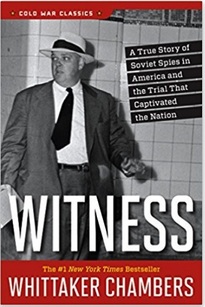
I also have another recommendation, in the way of a book. The book is Witness an autobiographical account of Whittaker Chambers’ political and spiritual odyssey into, and out of, communism. If you are not familiar, Chambers was the lead witness in the Alger Hiss case investigated by the House Un-American Activities Committee (HUAC). The HUAC was created in 1938 to investigate alleged disloyalty and subversive activities on the part of private citizens, public employees, and organizations suspected of having direct ties to communist operators.

Chambers was an Editor at Time Magazine for nearly nine years following 10 years as a member of the communist underground working in Baltimore and Washington, D.C. He narrates an insightful story of great personal intrigue, mystery and espionage that is unforgettable and is an immensely readable story of hope in our age of cultural unrest.

Chambers suggests that misplaced faith in government, science, education or materialism eventually leads many people to communism.  In their lives, people experience hardship, trouble, tragedy and sometimes bad-luck. They inherently understand something is not right with the world. People need a purpose in life. They need a purpose which goes beyond themselves where they can find meaning and identify with like-minded individuals. They have a natural desire to pitch-in and solve society’s problems.

Religion occupies this station for most people but when someone doesn’t feel any need for help from a higher power then they put their full faith into human institutions or ideologies. These ideological allegiances form the “isms” of our modern world, like progressivism, utopianism, pragmatism, collectivism, environmentalism, scientism with overtones of the class struggle, in elitism, egalitarianism, Marxism, socialism, and communism.

We have a tendency to forget that, groups follow leaders and concentrated power overtime degrades to become arbitrary, despotic and mindless. Even our own Constitution must be rigorously followed, or it will lose its guiding character because any power exercised by a majority can be just as tyrannical as that exercised by a minority. Ultimately, the weight of our human institutions must rest on their relationship to the individual.

Chambers takes time (800+ pages) to intimately identify the real problems of our modern world. He notes,

“religious rejection has taken a specifically political form, so that the characteristic experience of the mind in this age is a political experience. At every point, religion and politics interlace, and must do so more acutely as the conflict between the two great camps of men. … The most conspicuously menacing form of that rejection is Communism.”

The movement is particularly menacing because,

“The Communist Party, despite occasional pious statements to the contrary, is a terrorist organization. Its disclaimers are for the record. But its record of kidnappings, assassinations, and murders makes the actions of the old Terror Brigade of the Socialist Revolutionary party look merely romantic.”

Chambers goes on to tell us that, “The Communist Party respects only force,” while, “Only terror terrifies it.”  His keen insight on this issue helps us understand the full faith and fervor of the progressive-left, the Antifa movement, new identity politics and the daily assaults on our constitutional form of limited government.

Chambers was astonished when he realized that the men he knew never took the New Deal seriously as an end in itself. Instead, “they regarded it as an instrument for gaining their own revolutionary ends.” Chambers draws the conclusion that the surface manifestations of the New Deal, “concealed the inner drift of this great movement.” The drift toward socialism was carried along by sincere people who supposed themselves to be simple liberal-minded individuals striving for justice, equality, the working-man and revolution.

He labeled the New Deal as,

“a genuine revolution, whose deepest purpose was not simply reform within existing traditions, but a basic change in the social, and, above all, the power relationships within the nation. It was not a revolution by violence. It was a revolution by bookkeeping and lawmaking.”

This is why our national and state governments appear mired in inconsistencies. For 80 years we, too, have been gently guided along this path toward government control. We continually mistake self-governance as requiring more laws, more rules and a larger bureaucratic apparatus as the means to a better organized and more prosperous life. Yet the result is simply unwashed socialism.

Chambers concludes that the revolution of the New Deal was,

“made not by tanks and machine guns, but by acts of Congress and decisions of the Supreme Court … But revolution is always an affair of force, whatever forms the force disguises itself in. Whether the revolutionists prefer to call themselves Fabians, who seek power by the inevitability of gradualism, or Bolsheviks, who seek power by the dictatorship of the proletariat, the struggle is for power.”

In the first “Hundred Days” following his inauguration in 1933, Franklin D. Roosevelt persuaded Congress to pass many laws that brought new centralized planning and economic authority to the national government. However, the courts, following the dictates of the Constitution, realized that those initiatives were contrary to the founder’s intentions. Over the next 16 months, beginning in January 1935, the Supreme Court nullified eight of 10 major cases brought before them because of unconstitutional overreach.

After several years of political pressure some justices succumbed and changed sides while others retired, were removed from office, or died. All of their replacements were New Dealers. FDR’s policies brought an onslaught of collectivist activity into the halls of government. The public now takes for granted the unwieldy regulations, subsidies and habitual deficits which have plagued us ever since.

However, my letter today is about our future. We can learn from history. We can learn from our mistakes and our successes. We have the ability to change the critical spin of history, garner the support of our allies and lift the shield of faith in support of our Constitutional government.

Although our nation wants peace above all things, today we find ourselves in a struggle for our American heritage of Life, Liberty and our own just pursuits. As you consider ways for preserving our constitutionally federated Republic, remember – Freedom is always and everywhere preferable to slavery.

Best Regards,

Senator Dennis Linthicum signature

Dennis Linthicum
Oregon State Senate 28

Prairie Schooners and Paradigm Shifts

Oregon State Legislature sent this bulletin Tuesday, March 21, 2017 by devadmin

In our Senate Education Committee this week, Steve Buckstein of the Cascade Policy Institute shared a humorous video from a student who is currently being educated in a home school setting. The video emphasized that one size doesn’t fit all and different tools serve different purposes. You can see the video here: Shoes – success depends on having the right tools.

While this amateur Youtube video has fewer than 50 views it reminded me of another Youtube video from TED Talks. Several years back, educator and author, Ken Robinson, gave a TED Talk called, “Do Schools Kill Creativity?

I looked for it and was surprised to find that it is the most viewed talk in TED’s history, with 45.5 million views. I recommend watching it along with a couple other Ken Robinson videos. (If you only have time for one video then watch this one!)

These humorous and insightful videos all echo the same theme, namely, we are all different and our educational needs will be as different as each of us.

You and I are unique in our height, weight, size and shape. We are unique with our likes and dislikes and in our abilities, gifts and talents. We are as different as our DNA and fingerprints and we see the world differently based on our culture and family traditions, socioeconomic condition, national origin and many other things.

No one doubts the truth of these propositions. We know intuitively that each individual is unique in every way.

Across America our educational model was developed and fine-tuned during the Industrial Revolution. It mimics the factory mindset with parts following an assembly line for production and development. Oregon’s model follows the same standardized regime with standardized hours dedicated to specific subjects. With every individual exhibiting unique talent, gifts and skills this model is rigid and anachronistic.

As more people come to recognize the power of the individual our educational model will undergo transformation. This transformation will be part technological and part ideological. The millennials are the Uber-generation. They have glommed onto  technology that has spawned the sharing economy and they are intensely devoted to individual freedom while not being afraid of personal responsibility. They will want this same liberty for their kids.

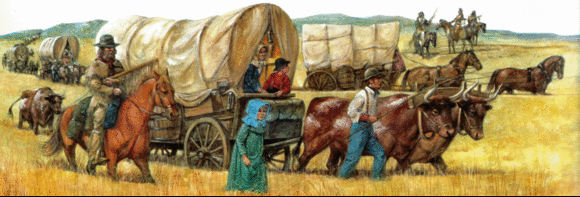
The current education model will not be able to provide this flexibility because the system resembles the Conestoga wagon of yesteryear. The Conestoga, or Prairie Schooner, like the horse and buggy, had a good run but was eventually replaced. Our current educational model is also likely to get replaced.

Using hindsight, it is easy to understand the Conestoga wagon and the changes that led to its natural demise. Yet, in the day, how many fireplace discussions were focused on that newfangled, noisy and sputtering jalopy? Certainly, there were naysayers and proponents. There were those who loved their horses. Also, there were skilled craftsman with lifetimes of dedication in the leather and wood working arts. These men and women were arrayed against newbies armed only with greasy hands, rags, and their Crescent wrenches.

We are at the same turning point for our current brick-and-mortar education model. The territorial monopoly of school attendance based on the neighborhood where you live will not be able to compete with up-coming technological advances. During the next decade, as new technologies burst into our classrooms and across school district boundaries, there will be a coincidental emergence of ideological freedom. Like an infant’s umbilical cord, the wires will be cut and Oregon will be required to alter its education model.

This will also happen because of the growing sense of angst over student performance and the age-old financial problems which torment the Department of Education. Everyone is aware that Oregon’s taxpayers cannot keep pace with the unprecedented growth in salary, wages and PERS costs. The gloomy prospects for sustained revenue growth combined with a massive flood of baby boomer retirees means we face a potential catastrophe.

After years of uncontested authority in their monopoly status, the heart and soul of our state’s education system has become weak. Currently, our state is ranked 49th in education and we will spend nearly $14,140 per student, including overhead and administration. That is an enormous amount of money on a per student basis. Yet, for all that money, graduation rates are dismal and below average test results are wreaking havoc in the fabric of every community, particularly among the under-privileged.

These are typical conditions setting-up what Thomas Kuhn called a “paradigm shift.”  Kuhn proposed that in any given framework an “existing paradigm” resists change while the current paradigm is strong and balanced. There is no need or incentive to look for alternatives as everything makes sense and nothing appears broken. However, as the framework becomes unbalanced (higher costs for lower scores), communities will demand more scrutiny and accountability. Their voices will be heard and this is when the “shift” will occur.

As the legislative body looks for solutions they will burden educators with more reporting and performance requirements. Goals will focus more on money over vision, tradition over innovation, form over substance, and certification over performance. These are the telltale signs that the existing paradigm is ripe for transformation.

Technology will be the key. School-choice and long-distance learning will be the agents that spawn the paradigm shift in Oregon’s education model. Then, we will create a more robust educational environment for all Oregonians.

My assessment may be uncomfortable for some and scary for others. But, just as autos, planes and trains replaced the Conestogas there will be gradual, but exciting, changes in our educational paradigm. Just like our pioneer forebears, we need to be courageous enough to embrace the possibilities – for the sake of a brighter future for every Oregon family.

 If we don’t stand for rural Oregon values and common-sense – No one will!

Best Regards,

Dennis Linthicum
Oregon State Senate 28

Has tolerance been abandoned?

Oregon State Legislature sent this bulletin Wednesday, March 6, 2019 by devadmin

The phrase “totalitarian” does not refer to the existence of concentration camps, the lack of food, or the severity of current economic conditions. Rather, “totalitarian” reflects the scope of control that a state exhibits over the broadest aspects of human life. Therefore, a totalitarian state seeks to absorb as much private life as possible into the sphere of state control.

In Oregon, one can see this surfacing with recent attempts at absolute gun control, outlandish carbon taxes, comprehensive 0 to 20 education programs and the denial of access to educational resources without first submitting to mandatory vaccinations.

What appears to be missing is a conceptual understanding of the individual, or individual freedom, outside of the boundaries established by law. Once laws are passed, state officials breach other spheres of influence and advocate for more regulations; in turn, liberty loses.

This ideology leaves the bureaucracy stranded with no place to rest because they do not recognize any natural limits to legislative, executive, judicial, administrative or bureaucratic power. Eventually, everything succumbs to the grasping hands of the state.

Never-the-less, thousands of concerned citizens, families, physicians, nurses, dentists and educators traveled to the capitol, last week, to demand medical freedom. They came from all walks of life to denounce a bill (HB 3063) in the House Healthcare committee. Under the bill, the state would deny all educational resources to students who have not undergone the mandatory vaccine regimen.

The proponents testified about fears stemming from a recent Portland, OR outbreak. Yet, the last confirmed measles death in US occurred in 2015, with the next most recent measles death occurring in 2003.

The fear of death from measles doesn’t hold a candle to the real threat faced by vaccine-injured children and the life-long trauma and health concerns that plague these young lives.

Any parent who wants his or her child to be vaccinated and protected against common communicable vaccine preventable diseases (VPDs), such as measles, polio, whooping cough, mumps, chickenpox, etc., can find such protection readily available throughout Oregon and the US.

So why does Oregon feel the need to withdraw education from children in Public Schools, Public Charter Schools, Virtual Public Schools and Private Schools if they choose to forego the vaccination regime? Has coercion replaced persuasion as the state’s tool of choice? Has tolerance for religious, ethnic or cultural perspectives been abandoned?

Moms know their babies better and more intimately than anyone else and when they testified in droves against mandatory vaccines – they shared compelling insights that we ignore to our own societal peril.

So, why are those parents who choose their own course of action labeled as the non-scientific? Can the pro-mandatory vaccine crowd claim a valid statistical or “scientific” fear when currently there are only 19 cases of measles per million persons in the entire world?

Opposition witnesses unmasked the state’s desire to push the absurdity of this type of “voluntary yet mandatory” exchange. They also posed questions that the one-size-fits-all gang could not answer – Do all people respond uniformly to the beneficial aspects of vaccines and are there absolutely no down-side risks or adverse reactions?

According to the U.S. Food and Drug Administration (USFDA), “Historically, the non-clinical safety assessment for preventive vaccines has often not included toxicity studies in animal models. This is because vaccines have not been viewed as inherently toxic.

This startling admission highlights that vaccines have not been evaluated for toxicity because of a predetermined belief in their non-toxicity, rather than because of scientific evidence.

This fact is probably why Congress passed the National Childhood Vaccine Injury Act (NCVIA) in 1986. The act provided a legal liability shield to drug companies for vaccine injury and death claims. Under the NCVIA, parents have to file claims in the vaccine injury court which receives about $0.75 from every vaccine sold. The court paid over $4 billion to parents with vaccine injured children, from 1986 to 2018.

During our Senate Health Hearing on SB 649, a different bill that would require vaccine ingredients to be disclosed to all vaccine recipients, we heard testimony regarding a lack of any sure evidence of vaccine harm caused by vaccine bundles.

That’s the point… until research is performed, reviewed, understood, disseminated and read, the risk-benefit calculus is still an unsolvable equation. Without doing this first, state policy will fast become an extended round of Russian roulette.

The claim that phenomenal progress has been made in Public Health arenas due to expanding vaccine coverage ignores other causal relationships.

Vital statistics show that around the world, fatalities from scarlet fever had become quite rare by the mid-20th century, without any vaccine. Additionally, mortality from infectious diseases such as measles and whooping cough had declined before the introduction of the corresponding vaccines (see Figure 1).

review of U.S. mortality data from 1900–1973 concluded:

Medical measures [such as vaccines] contributed little to the overall decline in mortality in the United States since about 1900—having in many instances been introduced several decades after a marked decline had already set in.”

Instead, the decline in infectious disease incidence and mortality during the last century represents a “miracle” which is more likely attributable to classic, long-term public health measures, such as, better waste managment, sanitation and better information about food and nutrition.

A recent study, in Italy, found a significant association between increased caloric intake and declining mortality while reflecting positive “progress in average nutritional status, lifestyle quality, socioeconomic level and hygienic conditions.”

These conditions arise from economic advantages produced by free markets and capitalism not through the forced manipulation of the weakest by the strongest.

Epidemiologists are typically inclined to give credit to vaccines, but in another study they recognized other unresearched factors were invloved, including changes in “human resistance and bacterial quality,” and other factors.

The idea behind HB 3063 makes Oregon’s smallest citizens lab rats and forces them into an unacceptable experiment.

The purpose of life is not to serve the state; rather, it is to develop into a full and flourishing human-being who is capable of independent choices, thoughtful analysis and has the ability to recognize Truth, Goodness and Beauty, while exhibiting virtue and positively contributing to one’s family and community.

Remember, If we don’t stand for rural Oregon values and common-sense, No one will.

Best Regards,

Dennis Linthicum
Oregon State Senate 28
Common Horse Sense

Oregon State Legislature sent this bulletin Tuesday, February 27, 2018 by devadmin

Here’s some good news from this short Legislative session.

In many of Oregon’s rural settings, you will find innovative equestrian training facilities that specialize in providing therapeutic programs for adults and children.

These programs allow children and adults of all abilities and backgrounds to develop horsemanship skills, fitness, empathy, and self-confidence. Additionally, these facilities may also provide therapeutic and clinical programs, including counseling services.

Counseling services in the rural environs widens access to the real world by providing the opportunity to get dirty, connect with animals and gain very specialized therapeutic training using the natural beauty, grace and gentleness of horses. The power of this environment for counseling gets leveraged because it bypasses the sterile, and sometimes threatening, clinical type setting.

Additionally, the typical outdoor farm and ranch setting provides more than just exposure to dirt and horses. Anyone who has spent time in Oregon’s rural landscape knows that there is typically a myriad of other animals on the property from dogs and cats to chickens, cattle, goats, sheep and pigs. All of this deepens the experience for the children and adult clients as well as the instructors and counselors.

Rural property is typically zoned as Exclusive Farm Use (EFU) land. This means that any business taking place on this land must be related to farm, ranch, or an agricultural enterprise. This zoning was designed to ensure that high-rise office centers or strip-malls didn’t get built in the middle of a potato field. However, this has sparked some bureaucratic confusion regarding the legality of providing counseling services on EFU land.

I was happy to support a Senate Committee bill, SB 1533, that will clarify a vague law restricting where and how equine therapy centers offer counseling services.

There are nearly 20 of these centers all over our state doing extremely valuable work. They work with Veterans who may be dealing with the after-effects of a battlefield injury or PTSD and they provide needed therapy and counseling to children and adults with physical, emotional or mental needs.

These therapeutic riding centers have all been caught in a bureaucratic quandary – how would one provide hippo-therapy in a clinical setting? This is the classic problem where the County Zoning Departments must simply follow the statutes even if they recognize that the rural setting is obviously the appropriate place for horses, therapeutic horseback riding and complementary counseling. This therapy has been found to be extremely valuable and is simply impossible in a downtown medical center or it’s parking lot.

This bill simply clarifies that facilities that offer equine and equine-affiliated therapeutic and counseling activities are permitted to operate on EFU zoned areas. Problems arose when some counties were interpreting the law so that as soon as a patient was no longer physically touching the horse, the therapy was no longer permitted because counseling services were not permissible on EFU land.

This bill brought some common horse sense to the situation and removed the ambiguity about whether a patient had to be in physical contact with the horse.

My daughter is a Licensed Therapeutic Riding Instructor at Healing Reins Therapeutic Riding Center, in Bend, OR. Healing Reins is one of many outstanding facilities. They average about 15-20 horses that they use for riding therapy with 8 Licensed Instructors and about 150 volunteers. Additionally, they currently have 3 Mental Health Counselors and 2 Physical Therapists on staff.  The barn and arenas are buzzing with activity six days a week 10-12 hrs. per day.

Therapeutic riding centers typically offer a variety of therapy and counseling services, including traditional physical therapy, equine assisted psychotherapy, eco-therapy and therapeutic riding to improve balance, listening skills and the ability to stay focused on a task. The children and adults bonding with their horse is truly magical.

Jeff Campbell, whose wife co-founded Healing Reins Therapeutic Riding Center in Bend, said, “This very important legislation will provide a valuable platform from which our therapeutic riding centers can continue to serve our fellow Oregonians most in need due to physical, cognitive, and emotional challenges without the constant concern of the rug being pulled from under us due to some ambiguities in the current exclusive farm use code

Campbell added, “Thousands of Oregonians across the state will continue to be effectively and seamlessly served in our centers, thanks to this valuable legislation.

SB 1533 received unanimous support from the Oregon Senate and now moves to the House for further consideration. Let’s pray that common horse sense will prevail during the remainder of Oregon’s 2018 legislative session.

Remember, if we don’t stand for rural-Oregon values and common sense – no one will!

Best Regards,

Dennis Linthicum
Oregon State Senate 28

How to Find God’s Glory in a Good Book

Oregon State Legislature sent this bulletin Thursday, December 26, 2016 by devadmin

In my last article about Biblical Truth and Careful Reading, I wanted to spark your interest in good books, authors, and your own personal meditation on the things that you read. God’s glory is all around us and we can discover it more readily if we read, meditate, discuss, share and live according to Biblical principles.

In Romans we read that God’s glory can be clearly seen throughout the world. The Apostle Paul writes:

“… because what can be known about God is plain to them, because God has made it plain to them. For since the creation of the world his invisible attributes – his eternal power and divine nature – have been clearly seen, because they are understood through what has been made. So people are without excuse.” (Romans 1:19-20)

If this is a true claim, that, “God is not hidden and God’s invisible attributes can be seen,” then it seems that Scripture is telling us that God is able to be discovered, so finding Christ in every facet of our lives shouldn’t be as hard as we might think.

Could it be that Biblical truth is, indeed, everywhere? Could it be that you and I are simply unfocused or too distracted to see it?

Our culture is constantly bombarding us with ungodly messages via the Internet, TV, magazines and movies, so becoming distracted is all too easy. One of the ways that I think we can learn to look for the divine in the midst of the seemingly mundane is by measuring our Biblical knowledge through our reading. Reading quality literature allows us to turn our focus back towards those things that are true, good, and beautiful.  You might be wondering, how? And, why books?

When reading a book, you are in charge. You become the director; you control the flow, tempo, volume, and texture of the voices. The author provided the details, but you’re in charge now. You get to tell the story. Think of a story told in movie, or video format. It will be told through the director’s eyes. It will be told with the speed, tempo and music that he envisions.

When you read a book that connection becomes your intimate opportunity. You gain control. You get to slow down, meditate and reflect on the characters in the story, and this is extremely important. This is where we avoid conforming to the patterns of this world and become transformed by the renewing of our minds (Romans 12:2). Our desire should be to fit every loose thought, emotion and impulse into the structure of life shaped by Christ (2 Corinthians 10:5). You can accomplish this by using God’s Word to help focus your mind as you contemplate what you’ve read.

After you’ve read a bit, stop and think about the characters, their circumstances and their interactions. Why did they say what they said? What decisions were made and why? How do you see God working in the story, even when there is no allusion to God’s active involvement? Do you see honor, integrity, or fallenness?

Take for example, Daniel Defoe’s Robinson Crusoe, a story oft mistaken as a children’s book. In the very first chapter, our hero describes his dilemma, “in which I do not heed my father’s advice”:

“[Facing perplexing circumstances] …my head began to be filled very early with rambling thoughts… my inclination… led me so strongly against the will, nay the commands of my father, and against all the entreaties of my mother and other friends…

“But one day… I went casually, and without any purpose… I consulted neither father or mother… without asking God’s blessing, or my father’s, without any consideration of circumstances or consequences, and in an ill hour, God knows.”

Now, in your mind’s eye, try to recall memories that echo these circumstances – self-centered desire and will, wise counter-counsel, obstinacy or casual enticement without appropriate consideration.  Are these events similar, or dissimilar, to anything you’ve experienced? Do these words describe a friend or family member’s recent situation?

Defoe’s crisp moral insights provide us with a timeless perspective encased in an engaging story. In fact, these paragraphs could easily be used to describe any of us in high school, or college. Or, maybe these words fit an episode in your life where you are currently perplexed.

Our goal should be to interpret what we read through a Biblical framework. We should think critically about the stories we hear and read through the prism of God’s Word.

For example:

  • Can you relate these paragraphs to any Bible verse?
  • Any from the New Testament?
  • Any from the Old Testament?
    • In your reading, do you recognize characters that relate positively to Biblical truth?
    • Do you find any encouragement in the realization that others have faced the same spiritual struggles that we face today? (Young Crusoe, in the mid-1600’s, faced dilemmas familiar to each of us.)
    • Your thoughts are worth sharing and discussing. Are you willing to engage others?

Even young Crusoe meditates on his experience, which I’m sure many of us can relate to, and he recounts his thoughts, as follows:

“I began now seriously to reflect upon what I had done, and how justly I was overtaken by the judgment of Heaven for… leaving my father’s house, and abandoning my duty; all the good counsel of my parents, my father’s tears and my mother’s entreaties came now fresh into my mind, and my conscience, which… reproached me with the contempt of advice, and the breach of my duty to God and my father.”

By reading a fictional story about a headstrong young man and his adventures at sea, I found pieces of wisdom regarding thoughts that I could take captive to Christ. These observations, in turn, become powerful reminders of my own personal journey as a believer.

I challenge you to give it a try with a good book. Endeavor to see Him in everything. Try using literature as a tool for focusing your thoughts and looking for God’s glory in all things. Then, watch and see how your view of the world changes. Your journey, relationships and conversations should reflect transformative qualities when seen in the light of His attributes.

In my next post, I’ll help you walk through more of these truths by using other illustrations from timeless literature. Along the way, remember to share your thoughts with others, as we continue this journey together, discovering the mind of Christ in all that we encounter.

Cultivate Liberty

How was your Independence Day Celebration?

You probably never gave a thought to Hillary’s crimes, the $19 trillion dollar national debt, local unemployment, the unbridled money printing schemes of the Federal Reserve, the bad science and policy oozing from every corner of the federal bureaucracy or whether your conversations were being recorded – Good for you!

Our day was full of fun and festivities. It included family, friends and friends of friends.  Our celebration, like America’s in general, was sidetracked by other details – the parade, decorations, food and drink, who picked up the sparklers, where’s the best fireworks show?

For Diane and I, our attention was also proudly divided between a love of America’s exceptional triumph in Liberty and a joyful celebration our first grandchild’s one-year birthday.

Others of you may have had equally worthy distractions and I caught myself wondering about the future and how I might infuse a realistic dose of Freedom’s requirements into our modern hectic lives.

John Adams wished for the same as he wrote to his wife, Abigail:

“I am apt to believe that it will be celebrated, by succeeding Generations, as the great anniversary Festival. It ought to be commemorated, as the Day of Deliverance by solemn Acts of Devotion to God Almighty. It ought to be solemnized with Pomp and Parade, with Shews, Games, Sports, Guns, Bells, Bonfires and Illuminations from one End of this Continent to the other from this Time forward forever more.”

In this correspondence Adams is referring, interestingly enough, to July 2nd, not July 4th.

Why July 2nd? Adams knew that the real meat of the event happened with Richard Henry Lee’s resolution on July 2nd:

“Resolved, That these United Colonies are, and of right ought to be, free and independent States, that they are absolved from all allegiance to the British Crown, and that all political connection between them and the State of Great Britain is, and ought to be, totally dissolved.”

Even this Resolution was brought to the floor thirty days earlier, on June 7, 1776, for discussion and debate. I will argue that June 7th, July 2nd or July 4th are dates when Liberty rose to take the standard but Liberty had been cultivated in  hearts and minds for centuries.

Bushels of fruit do not magically spring into the marketplace.  Land must be acquired, cleared, prepared, planted, irrigated, nourished and protected. Then the crop has to be harvested, sorted, packaged, and freighted to distribution centers. Now, you might already be dreaming of fresh produce for your upcoming family picnic. However, your market must still put it on display, price it and sell it. Then, and only then, can you tootle over to the market, purchase, prepare, share and enjoy this bounty.

The same is true for our American concepts of Liberty, self-governance, individualism and the consent of the governed. These ideas need a lot of thought, preparation, watering and cultivation to bear fruit.

Unfortunately, we, in modern America, are a little too accustomed to shopping at Costco. Americans expect Liberty to be stocked in a never ending supply of jumbo-sized, shrink-wrapped packages.  “But you must remember, my fellow-citizens, that eternal vigilance by the people is the price of liberty, and that you must pay the price if you wish to secure the blessing.  It behooves you, therefore, to be watchful in your States as well as in the Federal Government.”[1]

Liberty takes effort – a lot of effort. Let us never forget that our Freedom belongs to us.

What are we willing to do today to support our Tree of Liberty? – Clear, till, plant, weed, water, protect or distribute?

“Those who expect to reap the blessings of freedom must, like men,
undergo the fatigue of supporting it.”

–Thomas Paine: The American Crisis, No. 4, 1777


[1]  Andrew Jackson, Farewell Address, March 4, 1837

Sure Guardians of Liberty

Last week, Diane and I joined with hundreds of others to hear KrisAnne Hall in Prineville, OR.
KrisAnne is an attorney and former prosecutor who travels the country teaching the Constitution and the history that gave us our founding documents. She spent all day (in three different meetings and settings) connecting a vast array of historical events and painting a poignant picture. Her presentation did a wonderful job of “connecting the dots.” She used history to powerfully stress the fact that ideas have consequences.

It reminded me of the famous saying, “Every good tree bears good fruit, but the bad tree bears bad fruit.” (Mt. 7:17) And so it is with ideas – good ideas produce good results and bad ideas, bad.

Today, more and more people are wondering about the limits of government because they are challenging the bad ideas that come from big government. This is good news. Our culture needs people who are willing to consider these things.

FDR and his “New Deal” brought the Socialist/Progressive ideas to Main Street America. He promoted a big, fatherly government watching over its citizens, regulating their economic affairs, protecting them from fear, want, and hunger while insuring their “general welfare.” During the Great Depression these ideas sounded promising. However, across America today we see the destructive results of government overreach.

America was built on the solid foundation of constitutionally limited government, individual liberty, and free market economies.

The prevailing sentiment today is overwhelmingly in support of regaining America’s traditional approach to self-governance, family and freedom.

The small minority of people spouting today’s confused claims for socialistic betterment can only do so with other people’s resources and money. This  is where the average person awakens. It always happens when you feel someone’s hands in your own pockets.

Yet, the minority keeps claiming it will be better if we would just let the controllers control us. I disagree. The evidence is in and the results stink.

KrisAnne gave one example that particularly hit home, since I am on the campaign trial in Oregon’s 28th Senate District.  She quoted James Madison’s words,

the State Legislatures will jealously and closely watch the operations of this Government, and be able to resist with more effect every assumption of power, than any other power on earth can do;”

It was Madison’s sincere belief that the State Legislatures were “to be sure guardians of the people’s liberty.”

Although quotes like this seem outmoded because they were made 230 years ago they are still relevant and directly applicable.

Take ObamaCare for example. We don’t need to put the House, Senate and Presidency into the hands of Republicans to repeal it because we can void it at our state’s legislature.
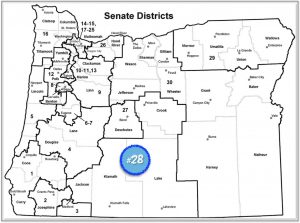
The same goes for the recent attempts to destroy the clean energy hydroelectric facilities on the Klamath River. This issue does not rightfully belong to FERC, Senators Merkley, Wyden, Feinstein, or Boxer but rather it belongs to the people of Oregon and California.

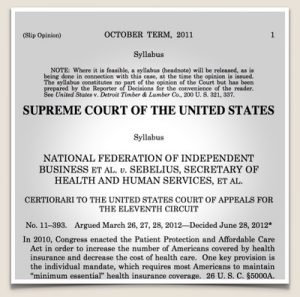
Chief Justice John Roberts told us as much in his opinion for the first ObamaCare Supreme Court challenge – NFIB v. Sebelius. Justice Roberts made it clear and he firmly reiterated the idea that our state governments have the duty to defend the powers they retained under the U.S. Constitution.

Justice Roberts wrote, “In the typical case we look to the States to defend their prerogatives by adopting ‘the simple expedient of not yielding’ to federal blandishments when they do not want to embrace the federal policies as their own.”

Justice Roberts then added , “The States are separate and independent sovereigns. Sometimes they have to act like it.

As your next State Senator, I will be proud to defend Oregon’s prerogatives, while jealously and closely watching for, and resisting, every assumption of power by any agency or body that has not been delegated that authority under our US Constitution. <See more at ElectDennis.com>

Oregon has a way to go, but we will prevail!

My thanks to KrisAnne Hall and all of those across Oregon, and in Prineville, who realize that “We the People” are the solution to Oregon’s problems.

“If once [the people] become inattentive to the public affairs, you and I, and Congress, and Assemblies, judges and governors shall all become wolves.”
– Thomas Jefferson


It’s True – I Did

Last week a local newspaper made note of the fact that I filed as a candidate for Oregon’s Senate District #28. If you haven’t heard the news, it’s true – I did.
The ideals and traditions that have made America great will be the same principles grounding my candidacy. These are the principles for Life, Liberty, and the freedom of our individual pursuits.

Allowing Oregon’s citizens the right to work toward these ideals will be my goal. Pursuing these freedoms will do more to help Oregon than any of the results oozing from progressive legislators.

Several of the future economic deformations headed toward Oregon families are: **

  • more unemployment due to minimum wage increases;
  • increased tax penalty for the working poor who bump up through the state and federal income tax tables (which are not adjusted for inflation);
  • annual increases scheduled for agricultural pumping costs;
  • increases in household electric rates exceeding $190 per year;
  • grid distortions caused by the green energy fleecing of Oregon taxpayers.

Our American traditions are being lambasted, altered and undermined by collectivist ideals. These arbitrary and capricious ideals mask the nature of modern governments.

The history of mankind is filled with stories of oligarchs, tyrants, and dictators. Their arbitrary forms of government have been the general rule. Restrained government is our American exception.

Oregon needs a Rebirth of Liberty – the liberty and spirit that embodied our American Institutions. As Americans, living in Oregon, we can use the elements from our past and return to a system that will protect our future.

These elements are well known. They show themselves in our courts and town halls. They weave through our neighborhoods and blossom in our relationships. They are what remains of our nation’s individualism, voluntarism, constitutionalism, government by law, representative government, limited government, natural rights, moral order, private property, thrift, industry, and competition. Unfortunately, these enduring principles and American traditions have been chased from history.

These principles comprise what our founding fathers meant by their use of the word “liberal.” They meant “liberal” as in “liberated.” They birthed the tradition of representative government, self-governance and individual Liberty. This is the only legitimate replacement for the historical authoritarian tradition.

The Founders did away with the hierarchical political values brought from Europe. Their desire was to start the American form of government on an obvious (but never before tried) idea about dispersed control. They started with equality among people and finished with active consent as government’s limiting boundary.

“We hold these truths to be self-evident, that all men are created equal, that they are endowed by their Creator with certain unalienable Rights, that among these are Life, Liberty and the pursuit of Happiness.”

These are not new thoughts. They should be well known to all American’s and anyone who has ever dreamed of coming to America.
Yet, the newspaper I mentioned earlier identifies me as one who is a, “prolific writer with a pretty easy-to-find track record of strong anti-government views.”

They ask their readers, “Is this the right person to become the legislative ‘face’ in Salem?”

What do you think?

  • Do you still admire our Nation’s Founders?
  • Do you believe in Liberty over Security?
  • Do your believe in fighting for your Rights?
  • Are you an “anti-government extremist”?

All of the Founders of our great nation would have been characterized as “anti-government extremists.” I am proud to be associated with such good company. But they were not “anti-government” they were anti-authoritarian. They, in fact, created a historic enterprise; a government that was “a more perfect union.”

They each had a prolific thought-life that has been the admiration of generations. They were not afraid of picking up a quill and scribbling out their ideas. They were so committed to their treason that those who signed declared, “[F]or the support of this Declaration, with a firm reliance on the protection of divine Providence, we mutually pledge to each other our Lives, our Fortunes and our sacred Honor.”

Today’s progressive movement has thrown aside our American tradition in favor of a Utopian dream fulfilled by big government authoritarians. To the dismay of liberty loving patriots all over Oregon, the progressive movement is wielding it’s majority with thoughtless abandon.

Together we must return to the ideals that guided the men & women who fought the tyranny of the ruling power during the late 1700’s. Men like George Washington, Thomas Jefferson, Sam Adams and women like Abigail Adams, Mercy Otis-Warren and Penelope Barker.

My hope is that our generation will provide the catalyst for the Rebirth of Liberty. Join with me and renew your commitment to Oregon and America. Together, we can, “mutually pledge to each other our lives, our fortunes, and our sacred honor.”


** I will explore these bulleted issues over the upcoming weeks…

Government Bias Corrupts

A recent link from Dennis Prager’s, Prager University Instagram account spawned some thoughts that are worth sharing.

In this 10 second teaser, Prager paints government as the rain cloud which provides the water for the land and crops. This quick graphic also shows roots springing up. The implication is that these roots are weeds, or the corrupt entanglements of crony-capitalism, rather than beneficial crops. [See complete video here]

Like the water cycle in our natural world, the rain water coming from Prager’s government cloud originates elsewhere. The question to be asked is, where does this bounty originate?

  • Does it come from only the richest reservoirs?
  • Does it originate from only the largest lakes and salty oceans?
  • Does it evaporate from our yards, lawns and tea-cups?

The rampant socialism flooding through Washington, DC and our state capital (Salem, OR) promotes the idea that only the wealthy will pay the burden. Yet, we all know that while large lakes release enormous volumes of water vapor they also have the capacity to capture equally large volumes of the returning rain.

By comparison your tea-cup doesn’t have much capacity.

The most insidious part of this equation is that while government pretends neutrality, it is always biased. Government is always biased because it is made, “of the people, by the people and for the people.” People are biased–you and I, your senator, your representative, your governor and your president.

This is part of our humanness. We each have our own likes, dislikes, dreams and preferences. We have been gifted with our own natural tendencies, inclinations, skill-sets and wholesome individuality. This is not a bad thing.

This conforms nicely with our Founders love of individual liberty and natural law. They wrote extensively about everyone deserving fair and equal treatment under the law. Their era was filled with robust discussions regarding methods for ensuring equality through public participation and constitutional limits on power and authority.

Our constitutionally federated republic was designed to set people free and to constrain excessive government control.

Without Constitutional constraints on government, we face the naked possibility that “might makes right”.  We can witness this across the US, at every level of municipal, county, state and federal government. The most obvious examples surface in legislation for healthcare, minimum wage, solar and wind energy subsidies, climate change and education.

Former US congressman and budget director for the Reagan administration, David Stockman, insists that economic controls are nothing but a malignant cancer resulting from statist ideology and shameless pursuits for political power.

In Oregon, our raincloud has been loaded with highly combustible energy policies, restrictive gun-control measures and minimum wage boondoggles. Unfortunately, Oregonians will be paying the price for this destructive rain.

How can I make this claim?

It’s easy, follow the money. Look at whose cups are getting filled.

For example, with the minimum-wage, Democrats claim that higher prices and low wages are the two things crushing those earning minimum wage salaries. Do they think raising the minimum wage will lower prices? If prices do rise (to cover the increases in wages) will the poor be exempt from the new higher cost of a burger and fries? Does this solve the cost-of-living conundrum? How many low-wage earners will lose their jobs as businesses strive to control costs?

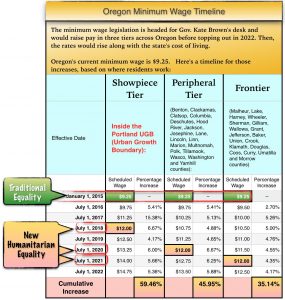
Additionally, for all the media time spent on social justice and wage-inequality, this legislation makes wage inequality the “Law of the Land.” The progressive voting block, centered in Portland, gets enormous wage increases compared to those elsewhere in the state. Why? What happened to the supposed concern for “equal pay for equal work?”

Portlanders, in the Governor’s “Showpiece” Tier will race to a mandated minimum hourly wage of $12.00, by 2018. While the “Peripheral” Oregon Tier will not receive that wage until 2020, and the poor folks on the “Frontier” won’t arrive in Nirvana until 2021.

This is not humanitarian equality, this is nothing but pandering and vote-seeking. Government gets the bounty while the lowest person on the totem-pole gets sacked.

Stockman documents in his book, The Triumph of Politics, “Public policy [is] not a high-minded nor even ideological endeavor, but simply a potpourri of private interests parading in governmental dress.”

Government cannot accomplish what it claims without 1) gathering resources, 2) feeding itself first (with 60% of the resources gathered), and 3), designating a special-interest group for the remainder. Yet, just like the rainfall, the moisture must come from somewhere.

These policies will not help Oregonians. These are gross misrepresentations masked in humanitarian language and masquerading as some glorious fount of governmental blessing.

“The fundamental source of all your errors, sophisms and false reasonings is a total ignorance of the natural rights of mankind. Were you once to become acquainted with these, you could never entertain a thought, that all men are not, by nature, entitled to [equality.]” —Alexander Hamilton, 1775

Recommended Books…